
The Art of Mindful Sex: Level Up and Deepen In with Tantra
Andrea and Hannah explore the world of Tantra, offering a fresh perspective on how to bring spirituality into the bedroom, demystifying this ancient practice and revealing how it can transform self-awareness and your intimate life.
Powered by RedCircle
Andrea and Hannah explore the world of Tantra, offering a fresh perspective on how to bring spirituality into the bedroom, demystifying this ancient practice and revealing how it can transform self-awareness and your intimate life.
What you'll discover:
The true meaning of Tantra and how it can enhance your sexual experiences and spiritual growth.
Simple yet powerful practices like eye gazing to deepen your intimate connections.
How to overcome sexual blocks and embrace your divine femininity or masculinity.
Practical tips and resources to start your Tantric journey, whether you're single or in a relationship.
The transformative power of Tantra in experiencing pleasure and cultivating sacred connections.
Andrea also shares her personal journey with Tantra, offering a relatable and inspiring perspective on how this practice can enrich your life.
This episode is a treasure trove of wisdom for anyone seeking to explore their erotic energy, enhance their sexual experiences, and cultivate a deeper, more sacred connection with themselves and their partners.
Tune in to 'Lush Love' and let Andrea and Hannah guide you through the transformative power of Tantra."
CONNECT
Continue the conversation on Insta
https://www.instagram.com/andreabalboni_lush/
Work with Andrea
Book in a 30 minute consultation:
https://cal.com/andrealush/consultation-call
Visit the Lush Coaching website here:
Listen, Rate / Review us if you loved this.


Meet our guest:
Hannah Franklin
Hannah is a neuroscientist and entrepreneur who, like most of us, is curious about sex and how we talk about it. She is very open and has had many deep discussions about sex with her friends, but has always found it a challenge to broach the subject with those she cares most deeply about.
We sat down for a candid conversation on how to make talking about sex easier.
Meet your host:
Andrea Balboni
Andrea is a certified Sex, Love and Relationships Coach at Lush Coaching.
Her mission is to help people experience pleasure and fulfilment in their intimate lives.
From finding love naturally and easily, to deepening connection and resolving conflict with ease, to keeping passion alive over the long-term, Andrea supports individuals and couples in all phases of intimate relationships.
Work with Andrea - Book a 30 minute consultation call and learn how coaching can help.
Let’s continue the conversation
The Art of Mindful Sex: Level Up and Deepen In with Tantra
Andrea: [00:00:00] Hannah is a good friend who like so many of us is deeply curious about sex, but didn't know who to ask about the more perplexing elements of this human experience. Sex is a topic that rarely gets discussed in ways that actually help us have better experiences. Whatever better looks like to you. Even more rare are opportunities to learn from someone who studied it professionally for years.
That's why Hannah and I decided to record our raw conversations about the intricacies of sex and intimacy and share them with you so that you can explore alongside of us. From practical questions like, how do I talk about sex in a new relationship to more esoteric explorations like what makes sex sacred.
We dive into the beautiful complexity of intimate relationships. This is the Lush [00:01:00] Love podcast, and I am your host, Andrea Balboni. I'd love to hear what our conversation brings up for you. So meet me on Instagram and share your thoughts. And if we don't cover something you're curious about, send me a DM and I'll be sure to address it. For now, sit back and listen in.
Hannah: Hello.
Andrea: Hello again, Hannah.
Hannah: How you doing?
Andrea: Doing pretty good. Yeah, thank you. How about you?
Hannah: Yeah, good. Thank you. I've been so excited for this conversation. We've covered a lot already, but as many of you know, Andrea is an expert in Tantra. Um, I've been dying to deep dive into the world of Tantra, and I guess a really good place to start is what is Tantra?
Andrea: Yeah, so Tantra is an ancient. Philosophy from India from mid, well, [00:02:00] it's uh, from medieval India, so not quite ancient, but we think of it as as old anyway. And we have, it's been brought to the west oh, pretty relatively recently to be reinterpreted, let's say. And from the classical version. Into what we know as neo tantra now.
So most of the tantra that you will learn and hear about, uh, is actually neo tantra. And it is however. In my experience, it carries forward into the now from what was the original philosophy stuff that we, that really serves us today, especially when we talk about sex and sexuality and our experience of sex.
So tantra as a philosophy, sex and sexuality is just one tiny fraction of a vast. Uh, a vast philosophy, way of life, way of being in the world. Uh, so what we have been passed, um, [00:03:00] passed down is just one little tiny slice of it. However, I find that a really, very helpful slice considering all of the conversation that we've had about.
How, um, how we experience sex today. How we experience the energy of the erotic, the energy of desire turn on in our bodies, how we experience relationships today that tantra has really served, can serve us well. It certainly helped me to reinterpret and, um, create new frames around how I see myself as a sexual being in the world.
As a, as a woman in this world, someone who identifies as a woman, and also how I think about sex and how it integrates with, uh, with my life and with my experience here, um, on the planet. So it is sacred sex. It is beautiful. And [00:04:00] it's definitely, uh, practical in that the philosophy has been kind of interpreted in ways that you can practice tantric sex, you can practice tantra, um, and practice the philosophies through, uh, through your sexuality, through your relationships. So does that make sense?
Hannah: Yeah. I guess I'm kind of keen to hear a bit more about like what in practice, tantra tantric sex, you know, looks like, feels like, sounds like. If you could share a bit more.
Andrea: Yeah. Really simply, it's bringing mindfulness and awareness to sex. It's like the most simple version, so it's slowing down.
It's bringing a lot of presence and a lot of awareness to the bedroom, to what you're experiencing in your own body and with another person. So [00:05:00] really, really simply put it is, it is exactly that, bringing mindfulness and presence and awareness to an area of life and lived experience that we don't always come to, uh, with such.
Kind of curiosity, I would say. And openness and acceptance, which is what mindfulness and compassionate inquiry, one of the gifts of, of those practices. So bringing that stuff into the bedroom completely shifts how you experience, or at least I'll speak for myself and the people who, uh, who I know that practice.
Tantra in this way, in this, in this context of relationship, in the context of intimacy, how it's shifted, how we experience ourselves, um, as sexual beings, the relationships that we have with, um, with others that we're intimate with and with ourselves on an intimate model. So, yeah.
Hannah: Beautiful. Um, [00:06:00] I guess like it would be great to.
Try to understand like what are some of the practices of tantra? You know how if I was to. Say, okay, I want to give it a go. Like, I want to try, I, I dunno much about it, but I want to see if maybe that, you know, for our listeners that resonated with the first and the second episode of like, how to talk about sex in the early stages.
Maybe we can try tantra or things have dried out a little bit. Or I want to talk about sex with my partner. Maybe we could try tantra. Maybe that's something that could spice things up a bit. Like how would you go about starting that process?
Andrea: Yeah. So bringing that, um, kind of awareness and presence to an, a connection with another person.
I'll give kind of like a practical example and we spoke about a practice that you've tried and done with your partner that sounds really simple and is actually quite challenging and profound at the same time that a lot of people in [00:07:00] neo tantric circles will practice. And this is the one of, uh, eye gazing or sometimes.
Soul gazing depends on how you learn the practice, and it really is just sitting across from another person and holding their gaze with a soft focus. So it oftentimes brings up a lot of kind of nervous laughter or laughter with people because we're not used to being considered. So much and staying with another person in this way.
So the depth of connection that happens just by not speaking and sitting in another person's presence with focus, a soft focus on them through eye gazing, so basically staring into their eyes. Uh and we only physically actually can look in one eye at a time.
Hannah: Yeah. Which is very weird.
Andrea: Which is a little bit weird. And when you start, so when you start the practice, it's all like, really, can I, can I see the eye?
Hannah: That’s [00:08:00] definitely something I experienced. I was like, I, I, how am I supposed to do this when I can only look at one eye? Yeah, yeah. Definitely.
Andrea: And there's also kind of like something I, I say with all of these things, their practices and experiences to try out keeping what works and letting go of the rest. So also, I can speak about things and share experience, but really it's your own experience of the practice.
And what you might. Um, learn from it. What might surface for you that will determine whether you are like, yeah, I'm buying this stuff, it really works for me, or actually this is, you know, bs I'm outta here. Um.
Hannah: So you can kind of create your own version of it based on finding a deeper connection with your partner. Is that…
Andrea: Sure.
Hannah: Is that okay?
Andrea: Why not?
Hannah: Okay.
Andrea: Yeah.
Hannah: Okay.
Andrea: Yeah. Um, so with soul gazing or with eye gazing. It is such a curious thing to practice that and notice how your experience of [00:09:00] the other person may, um, shift or you'll see into things that you haven't seen before. So this deeper connection on levels other than just the material or physical is one aspect of what makes, uh, this.
We'll call it sex, uh, or intimacy. Feel a bit more sacred. Somehow you feel like you're seeing into another person, into-me-see, intimacy. You're seeing into another person in a way that maybe you haven't before because you haven't. Necessarily sat there and taken the time and then completely present in you and have the other person also be present with you and you be present with the other person in quite this way.
Hannah: Mm. I love that. Into-me-see, I've never heard that before.
Andrea: Yeah. Intimacy. Yeah. It's a beautiful way of kind of considering intimacy. And oftentimes [00:10:00] how in the the schools and the places where I've learned tantra things are framed, is what we are inviting ourselves to see in the other person are the aspects in them that are divine.
So the aspects of you that are, uh, some people use the word goddess, some people will use the words cosmic. Some people will use the word kind of, um, the spirit or the sacred within you we're choosing to see and focus on and get curious about the aspects and element of elements of that person. That are sacred, that are divine, that part of us, that is all that there is, all that is, that is connected always to universal consciousness.
So this is where it gets really mystical. And for people who practice spirituality or interested in expanding awareness or levels of um, their own. Um, exploring different levels of [00:11:00] consciousness or ways of seeing, ways of perceiving, perceiving ways of being in the world. The vehicle of these practices, uh, I would say when they're relational, but you can also work individually within yourself.
Seeing inside of yourself into-me-see, seeing into myself as well, works both ways, will have this effect of expanding how you experience the world. Expanding them, therefore, if you will, uh, awareness, expanding consciousness, expanding, um, the, the landscape within which you experience the other.
Hannah: Mm. God, that's really beautiful.
And actually, as you were talking and, and you were using terminology spirit and, and. I think energy is another really good one. You know, I think from my personal experience, I felt energetically connected to my partner in a way that, in touching what we've discussed previously, like you kind of, you know, when you start with eye gazing and you've got this nervous laughter [00:12:00] and energy, and it's weird, you know, it's not a natural thing to stare at anyone, like for, for however many minutes or whatever.
But it is kind of like a purge. Of the facade, you know, and letting go of like, I'm trying to be a certain way to please you. It's kind of like stripping down your most authentic goddess or whatever that is, and connecting energetically to the point. You can actually be the rawest form of yourself.
Andrea: Which is why it's terrifying. Which is why this extremely simple practice is a very advanced practice. If you are able to let the masks down and allow yourself to be seen, even as you're seeing other. Vulnerability. I mean, it's, it's one of the most vulnerable kind of spaces that you can sit in when you are allowing yourself to be seen in that very raw way, you're letting your soul be seen almost.
So it's, [00:13:00] um, again, one of the most. Simple practices to hold for and, and terrifying. And so when I explained to a couple, okay, we're gonna do this practice and it's gonna sound really easy, and it's also no, that it's very, can be very challenging. Then they're like, okay, yeah. And then we begin the practice and it actually is quite Wow.
Okay. A lot's coming up and you'll know, um, also on another level, uh, as a neuroscientist, what. Holding someone's gaze for those extra few moments can do for nervous system alignment, for attunement, for connection in a very kind of scientific way, like in a very, um. You know, biological way, this is probably more your domain than mine.
Uh, so I'm not sure quite the right terminology to use, but when our nervous systems come into attunement with one another, there's definitely an experience of much more connection because we're kind of vibing in the same frequency. [00:14:00] And so a practice like eye gazing or feeling each other's breath or feeling each other's, um, heart energy in this.
This another practice that, that we do helps us to feel more connected to the person because our nervous systems are coming into, um, attunement with one another, and we can help regulate each other and feel more safe and more calm within the presence of another because we've both come into frequency. Um, and laboratory.
Hannah: I mean, it's so, so powerful. Um, I guess I'm trying to think into the minds of people listening and what I think they might be asking is, so where does the sex come in? You know, because that's a powerful practice and potentially something that you could do with a friend or, you know, it's, it's, it's sort of just like taking a minute, connecting.
You know, finding a sort of mutual frequency, um, but how does that improve sex or how does that [00:15:00] translate to sex?
Andrea: Just before we, before I answer that, you can also do that eye gazing practice in the mirror as well, and when there's an ancient way of doing the practice. I think it may be shamanic. I don't wanna say, I'm pretty sure you are holding a candle, so you have some light
Hannah: Okay.
Andrea: where you can see, but with the darkness and the mirror and some light, you're looking into your own soul and you're seeing what's there behind the masks that you're carrying.
And so it's also a very. It's mesmerizing a way of connecting with your own self in parts of you that haven't been seen by your own self. So I would, I would definitely recommend trying that one out.
Hannah: Yeah.
Andrea: And it also helps you to be able, especially if you're in a avoidant kind of verse, attacher, then it helps you to practice.
Being seen first by yourself. And if you can see yourself and know your, the [00:16:00] depths of your own soul, it's more easy, uh, over time to let other people see that as well. You feel safer within yourself, knowing yourself differently, and can allow yourself to be seen just a little bit more easily as well. So.
Hannah: So Tantra's, not just about sex.
Andrea: Absolutely.
Hannah: Well there you go. I think that's probably a, a common misunderstanding of what tantra means.
Andrea: Yeah. However, you could argue intimacy is a form of connection and intimacy. Is what we're building with the practice that we just described. And allowing someone in that close is also, um, what shifts in experience of them coming together for sex entirely.
So if you do the eye gazing practice before you then have sex, your experience of sex is completely different than if you've never done that before. And I would say try to believe [00:17:00] it, but, um. My own personal experience and working with people, it's a hundred percent shifts. How you experience that, that connection in sex.
So even indirectly, even if you're not applying tantra to a sexual, like the act of having sex, which I'll talk to speak to in a minute, that just that practice being seen in this way, being held in this way. Having that person look to what in you is our, um. Other states of, of being, that are maybe more spiritual or less, uh, visceral and more energetic.
Allow you also to expand into those spaces when you are having sex. And hold yourself in those spaces when you are having sex. So that is one kind of indirect way, how you work with the sacred when you are actually having sex. Does have a lot to do, um, [00:18:00] with the energy exchange that happens and beginning to work in a very conscious way, in a very focused way, and in a very intentional way with erotic energy.
The energy of turnon with the energy of raw desire. Um, so as you begin to work with this energy, which you could think of as orgasmic energy or the energy of pleasure, the or energy of, of bliss, the experience of bliss in your body. It's a, it can be a physical, um. Experience and sensation, but it also is an energetic one.
And as you begin to cultivate an awareness of this, and I don’t know if mastery is quite the word, but you equip yourself with the ability to move this energy through your body through different practices, then that energy you in sex when you're building that energy through. [00:19:00] Intercourse or through connecting sexually or even sensually or even just energetically without even.
Touching one another. It is erotic energy that you're working with. You're intentional on, um, the quality of that energy that comes from your sex center and moving that energy through your body. And when you practice with another, experiencing their energy as well. So there's an energetic exchange that's happening as you are experiencing.
Um, it could be intercourse or it could just be working with the energy. So it expands the definition of sex and what we know sex to be into what I think is a more accurate experience of, um, of sex, which is it is also energetic. It can also be emotional, um, energy and the energy of emotion that's connected with when we're connecting with someone specifically in this way. [00:20:00]
But it is a, um. Another element rather than just a physical coming together that is erotic, that is sexual. Sexual, if you will, that is sensual for sure. Um, and it's, and it's beautiful creative life force energy that when the intentionality behind it comes from a place of, um, well, it depends on, on what you're intending with it, uh, of connection of love.
Of an experience, of openness, of curiosity, then can absolutely 100% feel sacred because it is a part of us that is sacred.
Hannah: It's like unlocking, it's like leveling, entering into a new dimension, really.
Andrea: Yeah
Hannah: In a way.
Andrea: Yeah.
Hannah: And I'd be interested to know, you know. Who would you recommend Tantra to specifically if they hadn't already considered it? [00:21:00]
And I guess I was also thinking about, we were talking before about having a bit of a mental block when it comes to sex, feeling disconnected, and that could be for, for various reasons. Do you think that Tantra would sort of help. Alleviate people of this sort of mental barrier when it comes to sex and fulfilling their, you know, pleasure and, and things like that. Do you think Tantra could help those people?
Andrea: Definitely. It's so it's helped. It's helped me move through a lot of blockers, especially I would say, belief structures that were conditioned in from society and culture being pretty sex negative from religion, from, um, media, from family. Stuff that gets inherited and kind of like packed in, um, programmed in.
So Tantra helped me to reframe this whole thing that sex is something that is sacred and natural and uh, and beautiful. And, and [00:22:00] pure of expression when the intentionality behind it is clean and clear. It doesn't have to be something that's shameful. It's certainly isn't…
Hannah: Dirty.
Andrea: Dirty. Yeah. Or cheap or, um, wrong when it's in right context with Right, uh, kind of intentionality behind it.
So when we are blocked on experiencing the pleasure we would love to experience, or an experience of sex in our, or of our sexuality, our expression of who we are, then I find that the reframe of tantra, that sex is sacred, that we are divine beings inhabiting a human body that we are, um, there are beautiful things about being in the energy of yin.
AKA, the feminine and beautiful things about being in the energy of yang, AKA, the masculine and that expression of both within each [00:23:00] human, uh, no matter whom they are, is something to be celebrated and lived can help us move through a lot of the blockers that we have around if you're saying sex is shameful or it's not good to be receptive and empathetic, um, because there's so much kind of piled on, it's getting better.
But especially yin energy and or being, and let's say. Feminine. It's, it's not a gendered thing. It's more about the energetics of, of that, um, that tantra can help, uh, us expand the experience of ourselves. So in our last conversation, you brought up this point of women who are in business and the business world and professional and executing and focused and doing all the wonderful things and.
Being productive and even creative and innovative. A lot of that energy falls into yang. So it falls into the space of Yang doing, which is great, doing action, [00:24:00] action oriented, assertive. All really super valuable.
Hannah: Masculine energy, yeah.
Andrea: However, mostly in this masculine space. And so what happens when we also, and so the yin that we get to experience or the feminine within us gets shrunk to kind of a little tiny portion when we're in our, with our girlfriends and we're laughing and, you know, joyful and just being so.
Hannah: We're having this conversation.
Andrea: We're having this conversation. Yeah. Um, it gets lost and we also lose. Or, or, or maybe don't realize that we can step into either space at any time. And so if you are, have been alienated from the yin space, which happens a lot in the world that we live in, because the yin has been so pushed into the shadow and devalued, then we feel disempowered as women.
Um, it's really tough to say, okay, I'm gonna choose to step into that space and feel empowered. It's like I'm now…
Hannah: It’s like you’re [00:25:00] cheating on yourself. In a way.
Andrea: Yeah. Or how can I be. Take me Or how can, can I be receptive? Or how can I just um, step back from the go, go, go and just allow for things to come?
How is that powerful? Because you gotta do to make it happen, and you've gotta take action to make things happen. And yes, there's truth to that and there's also what happens in the void. Or what happens in the downtime or what happens in order for anyone to be creative or innovative? What happens when we, when we step back and allow, and the gift of receiving?
If you wanna give a gift to someone, how does it feel? And they say, no. No thanks. 'cause that person can't receive. So the gift that receiving is and allowing someone to give 'cause they want to. And it feels good to 'em to give. Um, so for you to be able to really receive and to not, and again, what do we make it mean?
So what do we make it mean if in the relationship that we have with our partners, sometimes we just want to be. [00:26:00] Receiving. We want the door held open or we want the to be the one who receives, um, receives gifts or receives love. And what does does that mean? Now I'm completely. I can sing so many different labels.
I'm now a kept woman. I'm no longer independent. I've lost my, my spirit, I've lost my power. I've given up everything to the other person. It's like, okay, that's one way to see it. And another way to see it is for, um, I'm choosing to step into this space so that someone gets the gift of having something that wants to be given received.
It's no fun being someone who gives for someone who doesn't ever wanna receive, or I'm gonna give myself the gift now of just taking it easy and having some downtime and seeing what flows through me. I'm gonna have some play, I'm gonna have some creative time, and what does that do for me? And so tantra.
Has really helped me [00:27:00] to value the yin again, to value the parts of me that want rest or that need space that are creative, that want to be spontaneous, that want unstructured time for play. That want to not have to worry about productivity for a minute and just enjoy a moment with someone or uh, time with friends to step back and say that may, that has meaning too.
That has purpose too. That has a place to that just because, or maybe because I am able to step back and receive. And create space for someone to come towards me, uh, or for someone to be heard in a certain way. There's so much power in that. There's so much power and beauty in that, and it's a different way that we think of power and consider power, um, or being empowered.
I, I, it's probably, maybe I'm still playing with this, but it's being empowered, um, rather than disempowered [00:28:00] by being in that, in that, in that way and that softness and the gentleness and the empathy and compassion, which I'm not saying that women are the ones who own that space. It's that energy within any human, any person that in the society and culture that we live in, hasn't been as recognized or acknowledged as something that is powerful and generative, which is absolutely what it's so when we can be empathetic and compassionate, it's generative.
It gives energy to us. It creates space for things to be creative. It allows all the different expressions, uh, and ways of being in the world to come forward. So it almost sounds silly to not be that way and just…
Hannah: Totally. Everyone should be doing it.
Andrea: And yet, yeah. And yet it's a form of leadership that we don't often, um, often see and have.
You know, sometimes we do have yet to really live [00:29:00] fully, um, and, and, and try out to have it to have. Yes, I would say yes. There are certain people who have certain leaders who have, and, um. And, they're right now, it's, it's difficult to kind of see them.
Hannah: Sure. So just to kind of, um, wrap things up a little bit, I guess one, it would be great if you had sort of like, if you could summarize the value of tantra in, you know, a few words.
For the listeners, that would be amazing. And also if you have any books or resources that you would recommend or your own sort of interpretations that people could refer to.
Andrea: Yeah.
Hannah: If you could share those.
Andrea: For sure. So Tantra is, so I know you've gone, we've went really philosophical there.
Hannah: Yeah.
Andrea: And I've kind of gone woo, I've drifted way far away from, um, kind of like the initial question.
So, [00:30:00] uh, to kind of bring it back, you know, bring ourselves back that, um, there's so much more to be experienced in, in sex and pleasure, uh, that tantra opens the door to. And when you have someone to guide you. Um, because a lot of it is, you can experience a lot of it by, there's urban tantra I was telling you about by a book, by, um, Barbara Carrellas.
I'm not sure I'm saying her name properly. That's great. Diana Richardson's books are great. The, um, multi-orgasmic man, multi-orgasmic women, multi-orgasmic couple books are great. There are a lot of resources out there where you can learn more about being in the place. I certainly teach it in the coaching that I do, and I have an intro to Tantra.
Um, PDF as well that people can, can download and there's some practices in there to get started with. So there are actually a lot of ways to access very [00:31:00] practical ways to begin the journey, um, into being, bringing presence and awareness and expanding experiences of pleasure and bliss in your body and in your being.
For sure. And, um, and yeah, so Tantra really opens the door, the gate, it's a gateway into a more embodied. Experience of pleasure in wider states of bliss. So it's not that everything is out here and floating in energetic fields, and it's also very much about through the body and in the body experiencing also the expanded states.
So, mm, the multiorgasmic kind of. Practice. You can learn to be multiorgasmic, for example, as a man, as a woman in anybody. Um, can learn how to expand pleasure in that way. And extended states of, of bliss are [00:32:00] absolutely possible. And, um. Yeah, just lengthening and, and deepening into pleasure in, in whole new ways are some of the gifts definitely of practicing tantra.
Hannah: Super powerful and also beyond having multiple orgasms, which is fantastic.
Um, what I really loved that you mentioned earlier is actually that this is a practice that you can do alone. You know, I think it's, it's beautiful to share with someone in a relationship to sort of, um, connect spiritually and unlock this new potential. But I love what you said about staring in the mirror and seeing a different version of yourself.
And how I was hearing that is actually, that could unlock so many things just in everyday life and how we see ourselves, you know, imposter syndrome and how tough we are on ourselves as, you know, not just women, but, you know, I know that that's a, a big problem. And I think that's something I've never thought about.
That's definitely been an education for me, that [00:33:00] tantra is not just sex. You know, it's not just a sex practice. It's something that can enrich a sexual experience, but it's just also enriching for you, for your soul, and for everyday life really.
Andrea: And so when I first started practicing Tantra, I was in, um, yeah, for three years in a school where I was single the whole time and pretty much practiced on my own.
So a lot, even the energy work of working with erotic energy and moving it through your body and experiencing extent kind of extended and expanded states of orgasmic pleasure and bliss is absolutely a practice. In fact…
Hannah: How are we talking?
Andrea: As long as you want it. Some people for days, some people…
Hannah: Oh my God, that sounds exhausting.
Andrea: Yeah, so, well, it is until you learn to work with that energy, because the energy is regenerative and it's, um, yeah, it's coming from source really. So it's not necessarily like you're not, it's. [00:34:00] Also more subtle as well. Like it's more subtle, the energy that you're connecting with. Not always. It's also fire and fierce.
Hannah: Well, I feel like I wanna say tune in for a future episode to learn how to have a three day walk.
Andrea: Totally up to you how long you want it to last. But uh, yeah, those expanded states can last for, for, and, and when you learn how to tap into the energy and move it, you can really tap into it at any time and move it and expand on it.
And, um. Yeah, and experience it and channel it into endeavors in life. You can channel it into work, you can channel it into life. It can be, it can be kind of applied in, in many different spaces and places, but knowing your body and knowing how the energy works within you is what almost it, well, I would say it's, it's often what I do first with even with couples.
So within each individual, are you able to understand how this energy moves? Are you able to experience it? How is your body responding? What's going on for you? [00:35:00] And now we're gonna introduce in the other person. And they're gonna begin to tune into their energy now that we know yours. Now that you know what's happening within you, it's really difficult to kinda…
Hannah: And you’re not just thinking about your energy in the context of the other person.
Andrea: Exactly. As well.
Hannah: Yeah.
Andrea: Yeah. And this is where the mastery comes in. When you do feel mastery with your body, where you do really understand how that energy works. Within you, then you more easily can connect with another person and what they're experiencing while staying connected with yours, your experience.
So it helps with that too, which I know we spoke about, I can't remember if it was in episode two or one, but that experience as staying with your experience as much as you're also staying present too, and aware of the other person's experience as well, so it becomes more of a play. Between you and the dance in this way, then…
Hannah: I like that [00:36:00] dance.
Andrea: It is, it's lovely.
Hannah: Well, thank you so, so much. Wow. Like what a conversation. I've learned so much and I think everyone else has too, and I can't wait to. Continue this conversation and, and there's so many things that I wanna ask, but I guess we've gotta wrap things up. But thank you so, so much and we'll share all the links and books and things in, in the description, so thank you so much.
Andrea: Thank you. Enjoy.
Hannah and I would love to hear from you, especially if what we've discussed has been something you've been sitting with for a while. Comment on this episode or connect with us on Instagram to continue the conversation. And if today's discussion stirred something deeper in you and you'd like to explore your own relationship with intimacy in a more personalized way, I'm here for that too.
Private coaching sessions offer you the chance [00:37:00] to address your specific questions and challenges with a focused attention and support that you deserve. To learn more about working with me one-to-one, visit my website lushcoaching.com. That's L-U-S-H-C-O-A-C-H-I-N-G dot COM, or send me a DM on Instagram.
Links are in the show notes below, and so that you don't miss future episodes, subscribe or follow us now here. Until next time, warm love. [00:37:47]
Breaking the Pattern: How to talk about sex with your long-term partner before it’s too late
We dive deep into the complexities of sex and intimacy in long-term relationships. They explore the nuances of discussing sex with your partner, whether you've been together for six months or sixteen years.
Powered by RedCircle
In the previous episode, Andrea and Hannah talked about the challenges and joys of talking about sex with someone new. In this episode, they dive deep into the complexities of sex and intimacy in long-term relationships. They explore the nuances of discussing sex with your partner, whether you've been together for six months or sixteen years.
What you'll discover:
Practical tips for initiating and navigating sex talks with your partner
The importance of creating a safe and non-judgmental space for intimate conversations
How to understand and communicate your 'erotic blueprint' for a more fulfilling sex life
Expert insights on supporting each other through sexual changes and transitions
Strategies for addressing mismatched libidos and keeping passion alive
The impact of life changes and hormonal shifts on sexuality and intimacy
How open dialogue can deepen your connection and enrich your relationship
Join Andrea and Hannah as they demystify sex in long-term relationships and provide a roadmap for enhancing your intimate connection. This honest conversation will leave you feeling empowered and ready to explore the depths of your relationship in whole new ways.
If you love this episode, Rate and Review us on iTunes
Meet our guest:
Hannah Franklin
Hannah is a neuroscientist and entrepreneur who, like most of us, is curious about sex and how we talk about it. She is very open and has had many deep discussions about sex with her friends, but has always found it a challenge to broach the subject with those she cares most deeply about.
We sat down for a candid conversation on how to make talking about sex easier.
Meet your host:
Andrea Balboni
Andrea is a certified Sex, Love and Relationships Coach at Lush Coaching.
Her mission is to help people experience pleasure and fulfilment in their intimate lives.
From finding love naturally and easily, to deepening connection and resolving conflict with ease, to keeping passion alive over the long-term, Andrea supports individuals and couples in all phases of intimate relationships.
Work with Andrea - Book a 30 minute consultation call and learn how coaching can help.
Let’s continue the conversation
Breaking the Pattern: How to talk about sex with your long-term partner before it’s too late
Andrea: [00:00:00] Hannah is a good friend who like so many of us is deeply curious about sex, but didn't know who to ask about the more perplexing elements of this human experience. Sex is a topic that rarely gets discussed in ways that actually help us have better experiences. Whatever better looks like to you. Even more rare are opportunities to learn from someone who studied it professionally for years.
That's why Hannah and I decided to record our raw conversations about the intricacies of sex and intimacy and share them with you so that you can explore alongside of us. From practical questions like, how do I talk about sex in a new relationship to more esoteric explorations like what makes sex sacred.
We dive into the beautiful complexity of intimate relationships. This is the Lush [00:01:00] Love podcast, and I am your host, Andrea Balboni. I'd love to hear what our conversation brings up for you. So meet me on Instagram and share your thoughts. And if we don't cover something you're curious about, send me a DM and I'll be sure to address it. For now, sit back and listen in.
Hannah: Hello again.
Andrea: Hello, Hannah. How you doing?
Hannah: Good, thank you. How are you?
Andrea: Doing all right. Thank you. Excited for our conversation today.
Hannah: Me too. So we've covered a lot so far, and we touched a bit upon how to navigate the topic of sex in a new relationship. Um, which I think we both came to the conclusion that it's pretty nuanced and complicated, but your advice was, you know, have that conversation, have it early, and keep it simple, which I think is fantastic advice.
So I think what a lot of people might be thinking and I'm definitely thinking about is, okay, that's, [00:02:00] that's great. But what about when you've been with someone for a little while and you want to bring up the conversation of sex? It may be because you are not necessarily quite satisfied with, with your sex life or, um, you know, for whatever a variety of reasons things have changed and you want to talk about it.
It's more complicated perhaps than with someone that you've only just met. Um, so it'd be great to kind of dig into that and hear any advice you might have.
Andrea: Mm-hmm. So if you've never talked about sex before with your partner openly, then yes, it can definitely feel hard, difficult, and also complicated. Or if you've maybe spoken about sex, but it's always been great and now things are changing, then it can also feel tough as well because instead of saying, yeah, I love the sex we have, it's so great being intimate with you.
It's like, ah, it's not feeling as good as it [00:03:00] used to, or my body isn't responding like it used to. And even that question kind of is a person who's maybe had a little bit of, uh, thought around what is going on with them, um, or for people who have never spoken about it and get to a point in their lives where they're like, okay, I don't think we're having the sex that we could be having, or I'm not experiencing pleasure, like I would like to and and never have.
Then how do you bring that up? 'Cause it can feel like, hmm, you don't wanna hurt the other person. You don't want the other person to be offended. And also, again, it might just feel awkward or you might just not know, like, how do I bring this up and how do we talk about this and how do we navigate it? What's going on? So many different questions.
Hannah: Talking about, you know, you've been in a relationship for a while and you've never spoken about sex.
Andrea: Mm-hmm.
Hannah: And so it's, you know, you've kind of perhaps had a bit of a realization that, you know, could it be better? Is there more to explore? You know, am I [00:04:00] pleasuring my partner? Do they, you know, is, is, is, is this something that we could level up?
Andrea: Mm-hmm.
Hannah: You know, or it could, you know, it could be better, but we've never spoken about it. So how do you bring that up after 2, 5, 10, 15 years?
Andrea: Yeah. So actually quite similar to talking about sex in a new relationship, outing yourself first and saying it's quite awkward because we've never really talked openly about this, have we?
You can even ask the person for valid, like, you know, confirming. Yeah, we've never really talked about it. Um, and it's important to me because I would love to experience something with you that maybe is a bit different from what we have, or I would love to explore this with you and I'm just not quite sure how to go about it.
So can we have a conversation inviting the conversation in? Can we have a conversation about sex and our intimate life? Is there a good time? Is there a good place? So [00:05:00] when you invite that conversation for the first time, it again probably will feel awkward even if you've been with someone for a long time because it's the first time you've spoken openly about it.
And there may be a lot that's not said and a lot that's assumed. Um, so knowing it's gonna maybe, potentially feel a bit awkward, inviting the conversation in. And when you invite the conversation in, it's not about having the conversation in that moment because a person may feel like, oh my goodness, not quite ready.
Don't know what you know, wow, where'd this come from? Out of the blue, I thought everything was okay. Like I thought we were fine. Um, so asking, is there a good time? Is there a good place? And are you open to having this conversation with me? And seeing how they respond to that. Then deciding together on a good time.
So like we spoke about before, in a new relationship, best not to do it when you're naked in bed together and feeling super vulnerable.
Hannah: Sure.
Andrea: Or [00:06:00] great to have the conversation when you both aren't super tired and just don't have the time. So making sure you've got a bit of time together and that it's not necessarily when you're in the middle of or about to start having sex. It's okay, let's talk about this thing.
Let's have lunch together tomorrow, or coffee, um, outside of the bedroom as well. So that context can be quite charged. Or if you are even outside of your home, can make it feel like, okay, we're having this conversation in
Hannah: neutral
Andrea: a more neutral place rather than having, connecting it with, um, with the past or things that you've experienced so you can kind of set a new ground.
Hannah: And you’re kind of on a level playing field in a way. You're both equally comfortable and equally equipped to bring something to the table in that conversation instead of one person being caught off guard, I guess.
Andrea: Exactly. So giving that person also, you know, a chance to say, yeah, Tuesday at 10. Looks great. [00:07:00] Or say at five is pretty free. Let's, let's do it then. It gives them the time that they need to kind of process through, okay, maybe there are some things that might be there for us to be with. So.
Hannah: I think that's really good advice. I've never thought about it in that way. You know, I'm such an impulsive, impatient person.
I'm like, I wanna have this conversation now. And that doesn't necessarily work for everyone, and I think it's really valuable to actually just take a step back and sort of say, okay. I'm setting my intention. I wanna have this conversation like, would you know, will you come meet me halfway? Where, you know, where would you be most comfortable having it at what time?
You know, you are saying, I wanna have this conversation, so you tell me a time that you feel most comfortable doing it and having it. You know, I think that's a really nice way to, for both people to come into the conversation like prepared, open, equipped, you know, I think that's really important.
Andrea: And also the creating this, we use this term a bit more now and kind of, you know, everyone's saying create a safe space. Create a safe [00:08:00] space. Well, what is that safe space? And so what you described is the beginning of creating safety, um, what is, this would work for me. How does it feel for you? Or, uh, this is what I would like to have happen.
This is a conversation that I would like to have. What do you suggest for a time or a place? So already you're creating a bit of safety. What's good for the both of us? So that both of you can relax back into the conversation.
Another thing that can help it feel safe for both people is really making it easy for the conversation to happen. And what I mean by that, when conversations and sharing feel easy is when we know we're not gonna be judged or that things won't be brought up in a way where we're using that information, um, or experienced as blackmail or manipulative, manipulating a situation in some way.
So again, saying [00:09:00] this is not a time for, kind of, I won't be judging what's happened or I won't, I'm not judging the quality of the experiences that we're having. I just wanna share what I'm experiencing and hear how you are experiencing it too, because, well, this is a bit, me being kind of, I guess, coachy around it, but it would be, um, I might follow that with something like what I'm experiencing, maybe something very different from your experience, what you're experiencing.
I don't know. I'm curious. I'm really curious about what you might have to say and what your experience is, because I know what I'm experiencing, I'm just not sure about what you are, where you're at with it. And I'm, and I'd love to know, I'd be, I'd be really curious.
Hannah: I think that's really important because, you know, as you were talking, I was thinking some people, even if they have time to prepare for this discussion, might take what their partner is saying quite personally is, you know, the [00:10:00] whole relationship's flawed.
What are we even doing here? Why are you with me? If you, if you're so unhappy sexually, why are we still together? You know, and, and you know, I guess it's what you're saying is it's super important to kind of set that intention and tone beforehand of like, this is not, you know, I'm, I'm not going in on our relationship being terrible, and this is not accusatory or combative in any way.
This is just, I want to share how I feel about it and I want to hear how you feel about it, and then we can together work from it, you know? From this valuable information and feedback. Mm-hmm. We were talking about feedback, it's,
Andrea: yeah
Hannah: it's like gold.
Andrea: Yeah.
Hannah: And having that understanding what the other person is experiencing. So to your point. A lot of couples who come to me will say, will have this fear around what it means about their relationship because they've either stopped having sex, they haven't had sex in a really long time, sometimes decades. Yeah. So sometimes it's years, sometimes it's [00:11:00] months, sometimes it's decades.
Uh, what does this mean about us? Does it mean we're not meant to be together? Does it mean that we are not in a healthy relationship? Does it mean that I am not as, you know, sexy as I, I should be, or that the other person, like we make meaning out of what's happening or what's not happening, and it's not necessarily, let's say, indicative of the quality of your relationship, the quality of, the, maybe the quality of the life that you've built together, it's just something that you're experiencing together.
And that can also feel like you're experiencing it quite separately if you haven't connected on it before. And it doesn't, certainly doesn't mean that your relationship is doomed. Um, and it does what, what I would say it it asks for is calling for is exactly what you shared of how can we come together, [00:12:00] speak about something that is maybe feeling quite challenging to kind of verbalize and talk about or, or be with and find a way through it together. Are we able to do that? Are we able to move through that process and come to a different place?
Is that part of how we wanna be in how we relate to one another? And that's more tells me more about the quality of a relationship than how much sex you're having or not having, or what you're doing or not doing. And is it normal? That's another thing. Is it normal that we only have sex once a month? Is it normal that we only have sex once a week?
Is it normal that our, you know, whatever it is, and it's kind of like, rather than, is it normal? Is what it is for you? Does it feel like enough? Does it feel nourishing? Does it feel healthy? Does it feel good? Does it feel good for each individual? Does it feel good for you together as a couple? What do we even mean by feeling good? What [00:13:00] does even good look like?
Hannah: And what do we even mean by sex? You know, sex means different things for different people, and I think I've been hearing, you know, this, this thought, this line of thought of sometimes people in relationships have a mismatched view on what sex is, and sometimes when they're not happy with their sex life, it could be because they're not having the sex that they want to be having, but their partner's having the sex that they want to be having.
So I guess like, you know, one part of it is, is perhaps there's a need to do some self-reflection too of what kind of sex do I want to be having? What does sex mean to me? And it's something that actually I speak to my girlfriends about quite a lot. You know, we're all, I guess, bit of a generalization, but we're all quite, um, you know, career orientated, strong minded, you know, women.
And it's taken a long time for us to realize that [00:14:00] actually what we want sexually is to be a bit more submissive. And that's a conflict. It's like an inner conflict of, oh, but I'm always in control and, you know, I, I have to be in control. Um, and, and actually we want to sort of take, take the backseat, you know, sexually because we, we have so much.
You know, and it's things like, it's just an example of having that realization that, okay, well why aren't I happy with the sex? Well, maybe it's because it's not the kind of sex I want to be having. So do you, what do you think about people's kind of taking some ownership of doing their own reflection and, and figuring out what sex means to them?
Andrea: Yes. This kind of draws a little bit back. So you've asked some really beautiful questions and there there are a few different questions in there or a few different things to consider. And we began in last, in the last episode's conversation around pleasure, we were talking about what feels like pleasure, what feels good in our bodies. And so instead of [00:15:00] even asking the question, what kind of sex am I having, it's, is the way that I'm connecting intimately feeling pleasurable?
Is it feeling like pleasure? And focusing on pleasure rather than sex, Emily Nagoski speaks about this now a lot. It's, um, a lot in her way of thinking. She's amazing if you don't know her already. Um, her work, Emily, is, is fantastic. So if we have a pleasure focus rather than a sex focus, then what might shift or change or how might we think about the experience that we're having with our partner.
And what are we, um, what are we chasing? Are we chasing something? Like are we chasing a peak experience? Are we chasing, uh, a frequency of experience? Are we chasing, what are, what are we going for here? And in sex mostly what I hear a lot of people want is connection. It's pleasure [00:16:00] for sure in their bodies and their hearts, in their being pleasure, but it's connection really underlying all of that, they want to feel connected to the other person.
Connected to their body, connected to themselves, uh, intimate with the other person. There's a sharing that wants to happen in that space alongside or together with or interwoven with an experience of pleasure. And so for many people, it's the quality of connection that brings pleasure. And then that can happen within the context of, of sex.
But it doesn't necessarily have to only be there, and it certainly doesn't have to only be in one flavor. Hollywood, thank you. Um, or vanilla sex. Yes, thank you. It can be in a variety of ways or even, um, sexual, sexual sex instead of sensual sex, or all these different other ways of experiencing intimacy and erotic energy. So [00:17:00] if, and I know we talked about speaking about tantra.
Hannah: Can’t wait to, to deep dive onto that, yeah.
Andrea: Yeah, that, in that practice certainly doesn't shy away from energetic experiences of eroticism and desire and pleasure without touch, touch at all at times. Um, and so that's, we'll put that to the side for now.
So what is pleasure for you? What is pleasure for your partner? What is pleasurable for you in coming together with another person to be in the space of the erotic, of desire, of it is, um, sensual, it's a very unique way of experiencing, let's say energy or a part of being human, a way of being human.
What does make for a beautiful, pleasurable experience for you, and what is it for your partner? And then what do you make that mean? What meaning are you making about what the quality of the experience that you've had with this person? Many people that I speak [00:18:00] with will compare it to a quality of experience they've had with someone else, uh, that may have felt more firey or may have felt what they, um, think of as better sex.
With a person that they were dating five years ago, then with the person they're now committed to or married to, and what does this mean about who I was and who I am now and how I'm experiencing pleasure now. So, so much can come up around identity and experience and meaning making that we don't often speak to as well because we're focused on frequency and peak experience and just wanting to kind of widen that landscape of all that is here.
Which is also why it can be really tough or feel difficult to talk about sex. Or feel really difficult to have these conversations because it hits on so many different layers and levels of our being, beingness and experience of being human and in relationship and in intimate relationship that it can feel [00:19:00] like quite something to navigate.
And so if you are, I'll just kind of say if you are really struggling to navigate through, you are fortunate because you have a wonderful community of open-hearted. It sounds like open-minded and, uh, wild spirited women who are willing to go there. And many women that I speak to do not have that. They are dealing with this on their own, in their own reality.
So finding community can be super, super helpful. Um, not everyone feels safe in opening up in community based on past experience they've had with being in community. So that's not necessarily going to, um, do it all unless you heal some of that, those relational wounds at the level of community.
So one-to-one with someone like a trusted, um, a trusted friend or an elder, someone who's, who's been through stuff that you feel safe and comfortable with, a non-judgmental person who's able to hear and be with things, uh, within their [00:20:00] capacity, that's enough for you, is great for, for holding. And then there are, of course, there is always nature to be in. I'll put it out there.
So being in nature can be very healing and, um, expressing yourself in nature, but then also working with someone like me, a coach or a therapist who is, um, is helping people to navigate and has been on their own journey of navigating all this stuff, uh, can be helpful and is sometimes necessary because of all the nuance. Um, and I'm not saying it just to kind of, you know, plug myself or the industry or therapists and coaches. I'm saying it because I have benefited from people who have been able to guide me very intentionally and are here to create that space for you to explore and have been trained in.
I've had a lot of training and personal and professional oftentimes, and professional experience in navigating all the intricacies of it. So, um. All of this to kind of come back to it and say, if it feels tough to talk [00:21:00] about this with your partner, it's because there is a lot that can show up and it's as simple as taking that first step.
So sometimes it is as simple as opening up that conversation to have it feel safe in the ways that we described of introducing the conversation, inviting the person into having that conversation.
Choosing together a time and a place away from that context where sex and intimacy is expected to happen or has happened or should happen, or whatever, just, um, into, uh, at a time and a place where you feel comfortable, safe, and also have the energy, so not when you're totally fatigued and taking those first steps and, um, and they, in that in of itself can be really healing and really a beautiful way to begin.
A new way of relating and being with a person that you've been with for so long. Another thing that we were speaking about kind of just in [00:22:00] conversation between the two of us. Are all the ways that we shift and change throughout our lives? Um, all the phases of life that we live through, all the different, um, transitions that we go through too. All the ways that our bodies change, all the ways that our relationship changes.
We think about even day to day how much, how much we change and shift perspective view, um, from living life. And so things are always shifting and transitioning. And so if sex used to feel good and now it doesn't, or it didn't use to feel good and now you're enjoying it more. That is totally normal.
It's also okay, and it's something to explore. It's a, it's a space or place to explore. It's maybe opening up to pleasure in a new way. Maybe it's backing away from that for a while and just letting your body settle into a new, a new space or place. Doing a bit of introspection, taking some time out from it all [00:23:00] communicating to this to your partner.
That again, it's not about what your relationship means it's something that you're experiencing now that your body feels like it needs a little bit of cocooning a lot of times. And when we talk about perimenopause or menopausal women, um, speak, speaking maybe a little bit more to people in Peri. It's, um, it's a time in life where our bodies are transitioning.
Massive hormonal shifts are happening. For some women, we want to cocoon. And so there's, I, I find it a little judgy and kind of like this thing that we feel like we have to fix the fact that maybe libido is shifting and it's related to hormonal shifts, but also thinking a little bit more about could it also be that you're transitioning into the wisdom years of your life, what you have lived and the relationships that you have had, and the relationship that you have been in may want a bit of consideration.
And what you have done [00:24:00] with your life and how you have lived your life up until now, maybe all of a sudden isn't feeling quite right anymore, or isn't working so well for you anymore, or it just feels like somehow you're shedding that skin or you've outlived it and you're not quite sure what's, what you're burning into or what you're moving, shifting into what wants to emerge.
And so in this time. Cocoon feels absolutely 100% the right thing, but it goes contrary to what we learn. And this narrative that desire is, is going down, libido, and from ever on. You're never gonna wanna have sex again. It's like, actually, maybe you just need a pause. Maybe the Meno pause is a pause also, um, kind of like a deeper level where you give yourself time for introspection and reflection and understanding before you open up to desire again, before you open up to being intimate with someone again, maybe just this is your [00:25:00] wintering for a new spring.
And unless you give that yourself that space and place to take a break without judging it or. And I totally get it. We hear so much narrative around it from here on in, it's like, are your sex drive's gonna go down? It'll never come back. And sex after 60 doesn't happen. I know we've spoken about how actually women, um, and I don't have the exact stats for it, but you can go online and you Google it, you can, or ai it, you can find the, the stuff, the, you know, evidence.
Evidence that shows, um, and also speaking to women, speaking to different women that many women, uh, have the best sex of their lives after 60, because they no longer are doing what we spoke about in the first episode of pleasing the Other and looking outwards towards, you know, is everyone okay? Is everyone all right?
Is everyone. It shifts. And, okay, what's right for me? Who do I wanna be now? Um, I'm not saying that this is a [00:26:00] thing that only happens after menopause or after peri or, it's, you know, it's different for everyone, but it can be something that, that you experience that many women actually experiences. Okay, I'm done with people pleasing.
I'm done with pleasing and appeasing. I'm ready to step into life for me. And maybe it's a shift in career, maybe it's a shift in relationship. Maybe it's a shift in, um, how you live your life.
Hannah: I love that. I love that. And I think it's like, you know, our body keeps the score right and our bodies are incredible, powerful, complicated things.
And I love this idea that like, you know, perimenopausal, going through that transition, whatever that looks like for you, it's almost like my body's telling me to stop. It's like a physiological alarm clock to stop, reflect, think about whatever aspect of your life you want to think about, but maybe like physically and, and listen to that.
And you know, importantly, as you mentioned, like communicate that if you have a partner, [00:27:00] you know, they can't read our minds, they can't read our bodies. Some can better than others, but you know, to communicate that that's what you are feeling and that doesn't, you know, write the, the next chapter of your life.
But, you know, just to feel like you can, you can navigate that with space and with time and use that as an opportunity to reflect and think actually, you know, maybe now, maybe now is the time that we can talk about sex and what that means to us. And, and I guess it would be really great to take that a step further and for those that are listening and thinking, okay, great, so.
I've got the confidence now to have that conversation with my partner, and we're going to, you know, set the time and the date we're gonna have this conversation. Okay, so what happens if in the conversation it becomes very clear that you are totally misaligned? One person wants this, the other person wants this.
They realize that, you know, they've been married for 15 years. Sex means totally different things for each of them. And actually for [00:28:00] one person, intimacy for them is a hand on a leg watching tv. And that's enough for them. And the other person, they want to have, you know, sex, they want to have traditional intercourse, and that's what intimacy is for them, and they need that. Otherwise they're not satisfied. It's just an example. What would you say, how would you navigate that with someone?
Andrea: So this is where you work with the other person to come to agreements. So it's like, okay, where can we, how can we find a middle road? How can we find a way forward so that we both feel good about what it is that we're experiencing and having and sharing, and how do we support one another in that?
And so it is a beautiful opening. I I, I've seen for couples because they'll have a much deeper understanding of the other person and a lot of compassion as well for the, what they're experiencing one either way.
So for the person who's like, I just need time off. We just had a kid, my body's not ready. I need a break. Like [00:29:00] I can't have anyone near blah. Okay. And the other person, I get that and I still feel like I need a physical closeness. I feel like I, how do we do this? Like, what happens? So how can you meet the needs of the one person for some space and meet the other needs, the needs of the other person for more intimacy, more closeness?
And I wish I could give like, oh, here's the things that you do. But it's really unique, couple per for couple.
Hannah: Sure.
Andrea: So even more kind of, uh, I guess staying the point that these conversations do want to happen so that you can find ways that work for both people, both individuals and um, and navigate that navigate your way through so that the agreements can be, they're doable.
They're, it's kind of like the smart, you know, that you have the smart goals and corporate, but it's like, are is it gonna be doable? Is it going to be, um, we would say measurable? Can we say, okay, we're doing this thing within this timeframe.
Can we sit, [00:30:00] can we agree that this is, we can both meet the expectations of the other here, and if not, can we be, can we talk about things as, as we, we move through? So finding that way of, of moving through together so that both people's needs are met. Um.
Hannah: And so let's say, I'm trying to think of a really sort of general, um, issue or topic that might arise.
'Cause obviously it's so specific from couple to couple and person to person, but let's say the classic one person in the relationship has a higher libido, bigger sex drive than the other person. Do you have any kind of tools, tricks, like strategies that can kind of help, you know, find a happy medium for that? For a couple in that position?
Andrea: Yeah, so again, various couple per couple and depends on the, the two people in the relationship and each individual as well, what they're okay with. But a lot of times. It's really [00:31:00] super important not to shame someone who has a very vibrant libido because people can also be shamed for wanting and desiring sex quite a lot.
Uh, and it’s, it's very natural for some people to feel a lot of desire, a lot of kind of erotic energy, and that's wonderful. And it's also very natural for other people to not have very much desire at all. And so it's kind of like there's not one that's better or worse than the other. It's just this question of, and how do we meet each other when there's such a discrepancy or what feels like a discrepancy in how we wanna experience pleasure and how much we wanna experience.
So what I often will ask is, do you have a healthy self-pleasure practice for the person with a higher libido who wants a lot more to connect a lot more with that energy and express it in the world. Yeah. And their life. Um, do you have ways to, to move that, move with the energy, enjoy it, get nourished by it, and not necessarily have [00:32:00] it depend on having the other person there with you.
So do you have a healthy relationship to self pleasure? And, um, if you, if you can, if you do feel open to that and wanna explore it, uh, it doesn't mean that you'll never have sex again. The meaning that we're making or the assumptions that we then have that Oh, they're having, you know, more sex with their vibrator than they're with me now.
Hannah: Yeah, sure.
Andrea: And that means I'm not showing up enough, you know, like all the things can come up. Also with, with any of the, or like self-pleasure when I'm in a relationship like that person, you know, that just means again, like what are we making it mean? So, um, but if that energy is there. Erotic energy is creative life force energy, and there are different ways that we can express it.
There are different ways that we can use it and, and in our lives. So one way is by having sex with our partner, but other ways are, um, to, to, to channel [00:33:00] that energy into, into work or into a creative project or in, in these. It sounds less, it almost sounds less sexy in a way, but creative energy is creative energy.
Life force energy is life force energy. So if we take some of that expression, some of that way of being and channel it into a healthy, um, other space or place, then what might that look like and how might that feel? It's a totally different way of being with that energy when it's alive and within us, because we think the only solution for, uh, expressing it is through intercourse.
Or sex. And it doesn't have to necessarily be. So for the person, so if a person has a really vibrant libido, and then I'll often ask that question first. Are there other ways that you express this? How does this show up in your life? Um, and see what feels good for them for the couple and for someone who has a lower libido, if they are okay with it.
They're like, I'm totally fine [00:34:00] with this. It's just that I can't meet my partner where they wanna be met. So how can I show up? It's, um, also exploring. Okay. Is there, are there ways for you to show up and be with a person where you also still feel really good about showing up and being there with them, but don't necessarily have to be doing the thing.
Are there ways that you, um, are happy to show up and be with them? Are there other ways to like, you know, exchange, um, exchange energy? Can it, instead of intercourse, be sensual touch? Does it always want to be sexualized? And again, this is for the couple, it's like one person may be like, yeah, if they would show up just like that, then that'd be fine.
I'm great to be supported in that. And, but other, uh, someone else might say, oh, that's not quite enough. Or the person with low libido might say, yeah, but I wanna work on my desire because, so if they do say that and they feel like there's something more there that wants to be explored, then we'll begin to look at the supports. [00:35:00]
That can be created for the person to support, um, a fire, so to speak. So sometimes, again, Emily Nagoski describes this, uh, well through her work. Though I know the research comes from, um, also for another place is what are the breaks on desire and what are the gaps? What are the things that put the pedal to the metal?
And the more we remove the brakes, like a cold room, like it's cold. I just don't wanna, just wanna get warm. Okay. So we'll heat the room up. What's another kind of thing that might put a break on? Mm. I don't know. I just don't feel so good in my body. Okay, can we work on body image stuff? Take some of the breaks off there.
That could be a big one. Um, take some of the breaks off there so that desire is more free to kind of. Come through or, uh, so removing the brakes will put, uh, more gas on the accelerator just naturally. So sometimes it's about that. Um. And [00:36:00] then to your point, okay, so these are different ways to kind of work with each individual, but then coming to that space of, okay, we're both doing our own independent things.
This is gonna be a journey that we're gonna be on together. Over time, it'll shift and change. Are we okay with, does it feel good that we know we're both doing our things and we're checking in with each other along the way? And sharing experience where it feels like and where we agree to share. And then having that own personal exploration privately where it feels like we wanna just have that for ourselves.
And so how are we navigating this journey to come to a place where it feels good for us to, uh, to be, to be with us together, maybe in different. In different ways. These are just a few of the ways, there are many ways to explore it.
Hannah: I feel like what I'm hearing is actually one of the biggest breaks, you know, to your, the terminology is lack of communication.
And it all kind of stems back to this openness and, and communicating. What you need or, um, you know, [00:37:00] just even starting that conversation in the first place in a relationship and, and redefining, figuring out what your sex language is, I guess. I dunno if that's a thing, but I'm making it a thing.
Um, you know, because it might be that. Your libido is actually, well, you know, I don't want the kind of sex that my partner wants, and that's become sex. So actually I've muddled it up in my brain since it's been so long that I think I don't want sex, but actually I just don't want that kind of sex, you know?
And through having a conversation about it, you are actually finding a new sex that is exciting and that you wanna have, and it might be that that's just. Having a passionate kiss, you know, without assuming that that's gonna turn into, you know, intercourse because that's what you don't want. You don't want that right now.
You don't want that to happen every time, you know? So I feel like it's such a huge break perhaps for everyone is lack of communication and through having an open conversation, things will [00:38:00] become clearer. You'll remove some of those. You know, those breaks. And it sounds like, you know, it can kind of, it can only be positive in that you just, you discover new things or you figure out that actually, um, you know, there's, there's work that needs to be done.
Andrea: Mm, definitely. There is a really, um. The work of Jaiya is really beautiful. She was, she was on Goop as well. So if you haven't watched Sex, Love & Goop, it's great. Love it. Uh, and Jaiya's, one of the practitioners on there and her, um, what she's developed is Erotic Blueprint. It's called the Erotic Blueprint. So understanding how you express.
Your sexuality or maybe erotic energy or desire, how that shows up for you and how it might be different. Kind of like a lot of people are familiar with love languages, um, or the love language, um, the work of a person, I can't remember the name of right now. But it, that, that framework can help people to [00:39:00] understand, okay, my expression of the erotic looks like this and it's different from my partners.
So it's not. It's not wrong or it's not less than, or it's not better than sometimes people will think, oh, it's better than, um, it's just different. And so if you do, uh, Jaiya's got a great, you can do, I think the erotic blueprint still, you can answer a few questions, understand what your blueprint is, and then it's very similar to the love languages.
Support your partner in experiencing the kind of pleasure that's meant. For them that comes through them naturally and easily. Uh, and it might look a lot different from the way that you experience pleasure or how you define pleasure at all. So, um, so yeah, that can also be, it can also be really super helpful.
It's something that I also, some of her work I do with couples in the work that I do, because it's really great in understanding, okay, this is what it. Is for me to experience pleasure. It looks like this. It's more, [00:40:00] um, for example, some people are more energetic, like we were talking about, where they feel a lot of energy flowing, the erotic energy moving through, and it's very gentle, very subtle kind of.
A lot of times, a lot very sensual. And for their partner, they'd be very, may be very sexual in their blueprint. So they like a lot, a lot more touch, a very physical kind of raw desire, a very physical way of having sex, which sounds like it could be a complete mismatch and in some ways it kind of is, because it's like with the love languages where there's a mismatch doesn't mean.
You now need to go find a partner who has your love language or shares the same erotic blueprint. It's kind of like, oh, I'll explore their world and they'll explore mine. And there's something beautiful in that too, because you're living a different kind of eroticism or pleasure than you might normally.
And what's wrong with that? It's like beautiful. So, um. Coming back [00:41:00] to like, we go out there. Coming back to the original question of yeah. How to talk about sex in a long-term relationship. It's, um, I like to think about it as a gateway to learning your partner in a whole new way. Experiencing your partner in a way that you never had before.
Have before on levels and in dimensions that you may not have explored. And. Again, each individual person is changing and shifting. So much day by day, year by year, over time, who is the person that you're with now and getting super curious about what is there for them now. Um, and what might be there for the two of you to explore together, uh, that you haven't before?
Because things were different before and now you're a whole new. A new person, a new being, and in a new relationship almost. So there's a lot of opportunity for discovery and for newness and for, um, [00:42:00] for learning. Another that may be, I know everything. They think I know everything that they say. Yeah, but do you, because yesterday you thought you knew yourself, and today you're totally a different person and you thought you were gonna be a different way in a certain situation, but you're not.
So now times that by two. It's kind of like, okay, how can we get curious about what, uh, what the other person may be experiencing?
Hannah: It's really exciting. It gets me excited. You know, the thought of like one conversation can totally transform the course of your relationship in a really positive, beautiful, enriching, pleasurable way, and I think that's really cool.
I hope everyone else. As excited as I'm to go home and have this conversation with my partner.
Andrea: I was gonna say, are you gonna do it?
Hannah: Yeah, I think so. Why not?
Andrea: Yeah.
Hannah: But no, thank you so much. I mean, it's super informative and it's definitely helped me and I'm sure everyone else at home, so thank you for sharing your wisdom with us. And it's not all doom and gloom if you think you're stuck. [00:43:00] There’s a way out and it’s drinking.
Andrea: Yeah, there's a way through.
Hannah: Yeah, there's a way through rather than out.
Andrea: Yeah.
Hannah: And it's great to hear that there's actual terminology for what I call love language. It's actual erotic blueprint.
Andrea: Yeah.
Hannah: There we go. You learn something new every day.
Andrea: Great, yeah.
Hannah: Thank you so much.
Andrea: My pleasure. Thank you.
Hannah and I would love to hear from you, especially if what we've discussed has been something you've been sitting with for a while. Comment on this episode or connect with us on Instagram to continue the conversation. And if today's discussion stirred something deeper in you and you'd like to explore your own relationship with intimacy in a more personalized way, I'm here for that too.
Private coaching sessions offer you the chance to address your specific questions and challenges with a focused attention and support that you [00:44:00] deserve. To learn more about working with me one-to-one, visit my website lushcoaching.com. That's L-U-S-H-C-O-A-C-H-I-N-G dot COM, or send me a DM on Instagram.
Links are in the show notes below, and so that you don't miss future episodes, subscribe or follow us now here. Until next time, warm love. [00:44:40]
Breaking the Silence: Why Talking About Sex Before You Have It Changes Everything
Andrea and Hannah dive headfirst into one of dating's most nerve-wracking moments for almost everyone: talking about sex with a new partner. Whether you're the type who finds it easier to be open with strangers or someone who clams up at the thought of discussing boundaries and desires, this conversation will resonate.
Powered by RedCircle
Ever wonder when and how to bring up that conversation with someone new?
Andrea and Hannah dive headfirst into one of dating's most nerve-wracking moments for almost everyone: talking about sex with a new partner. Whether you're the type who finds it easier to be open with strangers or someone who clams up at the thought of discussing boundaries and desires, this conversation will resonate.
What You'll Discover:
Why having "the talk" early actually increases spontaneity (yes, really!)
The surprising difference between discussing safety vs. pleasure - and why both matter
How to navigate the discussion when one person talks about sex easily and the other person struggles
The magic of the 50/50 rule for keeping intimacy balanced
Why "what do you like?" can feel as overwhelming as "tell me your life story"
Practical tips for starting these conversations without killing the mood
From exploring your own pleasure identity to creating space for a partner who's never talked about sex before, this episode offers both the emotional permission and practical tools you need to transform awkward conversations into the foundation for incredible intimacy.
Ready to stop guessing and start communicating? Your future self (and your partners) will thank you.
If you love this episode, Rate and Review us on iTunes
Meet our guest:
Hannah Franklin
Hannah is a neuroscientist and entrepreneur who, like most of us, is curious about sex and how we talk about it. She is very open and has had many deep discussions about sex with her friends, but has always found it a challenge to broach the subject with those she cares most deeply about.
We sat down for a candid conversation on how to make talking about sex easier.
Meet your host:
Andrea Balboni
Andrea is a certified Sex, Love and Relationships Coach at Lush Coaching.
Her mission is to help people experience pleasure and fulfilment in their intimate lives.
From finding love naturally and easily, to deepening connection and resolving conflict with ease, to keeping passion alive over the long-term, Andrea supports individuals and couples in all phases of intimate relationships.
Work with Andrea - Book a 30 minute consultation call and learn how coaching can help.
Let’s continue the conversation
Breaking the Silence: Why Talking About Sex Before You Have It Changes Everything
Andrea: [00:00:00] Hannah is a good friend who like so many of us is deeply curious about sex, but didn't know who to ask about the more perplexing elements of this human experience. Sex is a topic that rarely gets discussed in ways that actually help us have better experiences. Whatever better looks like to you. Even more rare are opportunities to learn from someone who studied it professionally for years.
That's why Hannah and I decided to record our raw conversations about the intricacies of sex and intimacy and share them with you so that you can explore alongside of us. From practical questions like, how do I talk about sex in a new relationship to more esoteric explorations like what makes sex sacred.
We dive into the beautiful complexity of intimate relationships. This is the Lush [00:01:00] Love podcast, and I am your host, Andrea Balboni. I'd love to hear what our conversation brings up for you. So meet me on Instagram and share your thoughts. And if we don't cover something you're curious about, send me a DM and I'll be sure to address it. For now, sit back and listen in.
So, yeah.
Hannah: Where should we begin?
Andrea: Where should we begin? What feels like a good beginning?
Hannah: I guess something that we've spoken about a bit before is, you know, the topic of sex in a new relationship. And where you begin with that I guess.
Andrea: Yeah, so sex in the topic of sex and talking about sex anyway, in general, people we're just not really used to it.
So when it comes then to the pressures of a new relationship, it can be even more kind of, ah, people [00:02:00] can feel a little bit even more apprehensive to talk about sex because they don't know the person, they don't know how it's gonna be received. They're not really sure. How the person might react and because we're so not used to talking about sex openly.
Some people, yes, but many people know we oftentimes don't know quite where to start. Like how do we begin to that question, it's like, how, where do we begin? How do we bring this topic up and. Oftentimes when we do consider talking about sex, it's concerns around safety. Am I gonna have safe sex? Is this person gonna be up for the kind of ways I wanna keep myself safe?
Um, and so protection is like a big way. We think about starting the conversation and we won't necessarily consider pleasure. Like how is the first time that we do come together with this intention, whether it happens or not, [00:03:00] what's going to make for the best scenario for it, like what's gonna be the context that's gonna support pleasure for both of us so that we can be relaxed if we think even beyond just the initial, um, kind of topic of protection.
So I know for you, and it sounds like for, for your friends and the people that you speak with, that in a new relationship, it's kind of the opposite. Like talking about sex with that person is easier because you don't know 'em, so you have less story behind the relationship and what it might mean. And so just kind of wanted, wanting to acknowledge that you could feel more relaxed.
When talking about sex in a new relationship, or it could be the exact opposite. When it is new, you feel more pressure because is that conversation gonna make or break the relationship? Especially in those very, very first kind of weeks or months. It's like, oh, everything feels so, like tenuous and I'm not really sure what's gonna happen.
Um, and I really [00:04:00] want this thing, especially if you're invested. Like, I really want this thing to work with this person. I don't wanna misstep or I don't want them to misinterpret or not understand me. So it can be, um, yeah, it can be quite daunting that first, those first initial conversations.
Hannah: It's really interesting and to kind of echo your, there's sort of two schools of thought, right?
You've got this one side, which is, I don't know you, you know, I, I may never see you again. I'm very happy to say what I want and what I don't want, and you know, and then there's the other side, which is fear of how they're gonna interpret what you said, and you know, what's okay, what's not okay. Are they going to be put off by this kink that I have or the fact that I've, you know, very openly asked them to wrap it up, you know?
Um, so I think it's quite interesting to navigate, you know, the two. And I guess also, you know, on the, on the protection side of things, why is it that we feel so uncomfortable [00:05:00] talking about protection?
Andrea: And just keeping ourselves feeling safe and comfortable.
Hannah: Yeah. It's almost like we would feel more comfortable not saying anything and then, you know, going for a check or, you know, dealing, sourcing things out ourselves later without them around. Why is that?
Andrea: Yeah. Well, I would say when we think of protection, it also often is fear-based.
Hannah: Yeah.
Andrea: So there's kind of like this fear behind it. What's gonna happen if, what's the worst case scenario? And also you're beginning to ask the person maybe what feels like inadvertently about their sexual history.
So how many people have you been in, been with? How safe are you actually? Like, am I gonna be okay? Being this close to you and sharing fluids or sharing like this, this, um, like our, our bodies kind of really coming together. And so it can feel a little bit offputting, um, because there is so much fear because it may also bring up [00:06:00] questions about, well, what if, you know, what if one of us does have an experience that one of us gets pregnant, for example, what would we do then if there's no protection?
And then you're opening kind of Pandora's box of do you wanna have children? Where's this relationship going? And like you say, maybe you're not necessarily even invested in. Having a relationship with that person, you're just maybe interested in an experience or getting to know them, um, or having some, some fun for yourself as well.
Like a period of exploration or just, um, trying different things with different people, trying different people on in, uh, in this way, which can be. Um, if that is, you know, depending on what you really want from the liaison, like that connection with the person can, um, yeah, it can be tricky just to ha to navigate that conversation.
But again, I find it really interesting that you ask, um, the question in this way because for so many people that I speak with, [00:07:00] it's the opposite. So they're okay. They're more okay with saying, I wanna. Let's talk about the protection thing.
Hannah: The safety.
Andrea: Yeah, the safety. Because that's kind of a basic standard. No way in hell am I gonna share with that person a kink. God, I don't even know them.
Hannah: Wow. Interesting.
Andrea: And I'm not even comfortable with my own sexuality or expression of sex to even consider whether there's a kink there or what I want. And I don't even, I'm not even in touch with my own. Pleasure enough to name what I like.
I don't even know how to say what I like. That's a privilege that maybe I've not been privy to. It's not a question I've ever asked myself in a culture where, especially for women, we're not often asked, well, what makes you feel good? It's how are you gonna protect yourself? From pregnancy, from a disease, from it ruining your life.
And then the second question oftentimes is, if ever asked is what do you like? And being able to [00:08:00] connect with pleasure and name it for many people, feels like one, never thought of it. Two, where would I even start in naming things? Three. I'm not even that connected to my body and myself. Because I've never even asked that question.
How do I then share that with another person? Because even connecting with pleasure feels really tender. And really, so I love that you're coming at it from almost like the 180 from what my own, I guess, personal experiences been. And many of the people that I work with is.
Um, because there is absolutely, you know, the world is, is full of people with different ways of coming to things. So, um, I love the fact that in, in your world, the women that you speak with and the people that, that you're in, in connection with, are able to even say, okay, this is what I like. This is how I want it. Whether it's at the beginning of a new relationship and.
You know, we'll talk about the complexities of long [00:09:00] term, um, what it, what it's like to bring the conversation up for the first time long term. But the fact that that is there as a presenting with the first thing, for me, says something about how things have shifted, like at least I wouldn't, I wouldn't necessarily wanna say it's generational because I see, um, all different ages, people of all different ages.
So it kind of sometimes feels age agnostic. Like there's not necessarily a generational thing. It has more to do, I think with conditioning and how you've been, um, how you've learned about pleasure. Or have been exposed to, um, or, or how you've thought about sex and sexuality that determine the questions that you may ask in the comfort level that you have with speaking about, um, about safety or, and or pleasure first. So yeah.
Hannah: You’ve touched on so many important points that I really wanna sort of zoom in on. I'm so fascinated. I think just [00:10:00] going back to the point of safety and protection, I think, you know, it's almost like a bit of a mood kill, right? You know, to bring that up. You're in the moment things are, you know, getting heated up and all of a sudden you're thinking, oh gosh, now I need to have this conversation about what's your sexual history and, you know, um, but it's an incredibly important conversation to have.
And I think as a society, you know, I'm, I'm glad to hear that on the most part. Your, you know, from the people that you've spoken to, that they're more comfortable discussing that than perhaps, you know, what pleasures them. And I think, you know, it's interesting that I've, as, as you said, that I've kind of experienced the opposite.
That, that, you know, it's, it's become. Almost a taboo conversation to talk about protection rather than pleasure, which is really interesting. But I guess moving on from the protection side of things, what you were talking about, which really resonated with me, is like this concept of what are you [00:11:00] into?
What do you like? You know, it's such a difficult question to answer. It's kind of like being asked, you know, when you meet someone for the first time, what's your story? Who are you? You know, all of a sudden it's like you've got ten mirrors around you and you're like, oh my God, who am I? I don't know.
You know, what do I like? And I think articulating that and understanding, you know, your own pleasure identity, pleasure profile, whatever you want to call it. Like that's really difficult. And as you, as you said, you know, you've spoken to many people who haven't yet connected with that side of themselves and they dunno how to even begin to communicate, you know, what brings them the most pleasure and like, yeah, it'd just be really interesting to talk more about that.
Andrea: And sharing with another person. What you like or don't like. They're all very, they all feel like so many of these, the topics from safety to pleasure, to feel like very tender ones. [00:12:00] Like they feel, it feels very vulnerable to share with another person. Even though sex is a natural part of what we do, it's a natural part of the way that we live and who we are as humans.
And for anyone listening, it's kind of like the more that you talk about it with friends, with text positive communities, if your friends aren't really talking about this stuff and many, many people or have, there's no one in my friend group that I speak with or you know, for many people that's. The case, but there are so many communities now and spaces and places where you can begin to listen and learn from other women's experience and then begin to articulate also for yourself, um, and find like words for basically what your experience is.
And, but kind of coming back to how do you do that with someone that is new or someone that you've just met and. The first step I would say is [00:13:00] just outing yourself in a way and saying something like, this is a, a bit of a difficult conversation for me to have. It feels a little awkward bringing it up, and I am interested in seeing where things go with you.
So it's, um, it feels even more. Challenging or difficult to bring this up, but it's really important to me that, um, that we speak to it. And is, would you be open to having a conversation around, around sex and what are um, our first. Kind of time together might, might look like. And this way before you get right into the moment where you're both feeling extra vulnerable and then all the chemicals start running and all of the erotic energies there, the desires there.
It's if you can have that conversation way before that initial first kind of. Possibility is there, um, the better because when you're in it, it's a lot more, there's a lot more happening and going on. [00:14:00] And I am also kind of hearing people say, yeah, right. Whatever. Like, so we're at lunch and it's like, Hey, let's talk about sex.
Hannah: Yeah.
Andrea: And it's kind of like…
Hannah: That’s what I was thinking.
Andrea: Yeah.
Hannah: That's a devil's advocate, right? Is it really that sexy? You're on a date and like. Okay, can we just sort of map out what sex might look like later? You know, is it like a bit, you know, you're assuming that that's gonna happen and then does it not take the mystery outta the sexual experience?
And you know, it may be, um. Yeah, you want to kind of just let the vibe sort of form naturally and then perhaps discuss in the moment, you know, say, no, I don't wanna do that, or Yes, I wanna do this. I don't know. I'm, I'm, I'm just thinking that, that some people might, I'm thinking you were like talking about this with my friends, like really like speaking, you are on a first date and you are like talking about, you know, what sex might look like between the two of you, like.
Andrea: Yeah. So totally hear you. And totally get it. And for anyone who [00:15:00] hasn't, I would say, if you haven't tried this, it's kind of like something to try and see what might happen. And how it might shift things when you actually do get to the point of having sex with a person, if you ever do.
Because sometimes I would also float the possibility that. Ironing out or getting clarity on, um, something maybe ironing out, but maybe getting clarity on, uh, what is, um, how to, it's kind of like how to prepare yourselves to have the best possible experience with a person. The best possible experience with a person still could look like anything.
There's still enough mystery, there's still enough kind of magical moments that can happen. There's enough serendipity, there's enough spontaneity. Trusting that desire and pleasure anyway isn't a one way street. The intrinsic nature of orgasmic bliss and pleasure is a thing that gets experienced in the moment.
And the things that can [00:16:00] come up in that moment can be. Anything, it's a wide, vast arena. So by having a conversation prior to actually in a, like, let's say a time and a place where you're gonna do the thing, just says, okay, we're getting, getting the discussion about, um, how we're gonna protect ourselves out of the way.
So in the moment we don't have to feel a disruptive element of, uh, what are we gonna do? It's like we've already agreed before that this is what, um, how we're gonna best keep ourselves protected and. Also having the conversation around what might be a beautiful thing to explain what, how you like to experience sex.
Um, it doesn't have to be articulated. I like this position. I prefer that. And like the other thing…
Hannah: You don’t need to map the whole thing out before it's happened.
Andrea: No. If it's freezing cold in the room or if we're in a semi-public place, I'm not gonna like for the first time, not. Totally gonna be, you know, maybe okay with that, but maybe not.
So if that happens in the [00:17:00] moment, just know I may change and shift. It's nothing to do with you, it's just I've not done this in this kind of environment before. So, and it's, it's sort of. Having enough information and enough things spoken where you both feel like, okay, whew. Good thing it's not like in the moment.
'cause I've had so many of those where I've never spoken about this before and then in the moment it's always like, oh, what's happening? I don't really feel quite, and it's interrupted.
Hannah: Right?
Andrea: That pleasure just because you don't, there's so many questions. That aren't answered.
Hannah: So rather than, because my initial instinct was that, does that ruin the spontaneity, right?
But actually what you're saying, what I'm hearing is that in fact, quite the opposite. You are dealing with the sort of, you are dealing with the admin beforehand.
Andrea: Totally.
Hannah: So that you can actually lean into the spontaneity and in a safe, you know, remove some of the unknowns and, but keep the good unknowns, you know?
Andrea: Yeah.
Hannah: That's kind of, [00:18:00] and, and, and that's sort of flipping what I initially thought on its head in a way.
Andrea: Yeah. Anyway, especially in the beginning when you're in a new relationship, it's a new person, it's a new energy, it's a new experience. So even if you have. You know, and, and we daydream as well, where we, we have, oh yeah.
It would be amazing to be with this person in a com in my bedroom on the, in the kitchen. In the, the forest, like on the beach, wherever. Anyway, anyway, we kind of imagine already, which is a sort of, um, it could be a bit of foreplay, but it also could be a little bit of preparation that we're kind of priming ourselves to have an experience that feels really good.
Hannah: And setting boundaries.
Andrea: And we don't say that that's now no longer. Kind of mysterious or exciting because we've just imagined having sex with 'em on the beach. And guess what? We're going on on a date with 'em on the beach and we're gonna have sex with them on the beach. Like.
Hannah: Yeah, yeah, yeah.
Andrea: It doesn't ruin the moment of like the sunset and the waves crushing and the sand in your bi- like, yeah, but maybe [00:19:00] you've prepared a little bit for the sand in the, it's like, okay, I may need a moment.
And, um. It's just so you know, like. Uh, and I'm all right with that. And boundaries is also a big one. So if you've, if you're setting boundaries and um. And, and both consenting to kind of like, okay, we're gonna have this experience in this way. Uh, and these, this is the space that we're gonna go into and this, this, these are the places and spaces we're gonna kind of stay away from.
Um, at least initially as we get to know each other. Oh, my goo- my whole body just relaxes. Just having shared that with you, it's like, okay, we can see what happens. And then for the things that I'm not quite sure about, I know that in the moment I can name it. And the person, because we've had this conversation.
Isn't going to, they may still get triggered. They may make meaning out of it. They may say, oh, she's not having a great experience. But also it's kind of like, [00:20:00] okay, and we have spoken about this before, just because we're not doing X or Y doesn't mean anything about what I'm experiencing now. It's just we wanted.
To give this thing a go and see how it felt and stay in the zone. That felt really good. And if we begin to kind of go outside of the zone in the moment, we can shift and change things. And name that. I know we spoke about not doing this thing or doing this thing before, and now that I'm here. It's shifting for me.
Let's, let's go for it. That's okay too.
Hannah: Sure.
Andrea: But you have that, that safe kind of zone set up for yourself where you can just explore within that space and. It's, it's, you know, it is, especially in the newness of things, you are feeling each other out. You are exploring there is that, okay, what is gonna feel good, what isn't gonna feel good?
And you're getting to know the other person as well. Will they respect the boundaries? Can they, um, are they always trying to push the edge of things to [00:21:00] a point where it doesn't quite feel good for you? Can you say, okay, you know. You wanna dial things back or, or stop. And they're making that okay. And it's like, well we have this conversation.
I told 'em it wasn't gonna be about us or, or anything. And they're still not able to kind of hold a boundary. That gives you a lot of information about a person.
Hannah: Sure, sure. Absolutely. And just, it just made me think to all of our friends listening at home, I imagine some people might be thinking. You know, in line with what you were saying at the beginning, which is some people are fearful that if they have these very honest, open, frank conversations in the early stages of relationship, you know, you've gone, you've just met this person, you've gone on a day or two, and all of a sudden you are like setting sexual boundaries and you are having these conversations of what you want and don't want, and they might feel worried.
That being so open might put the other person off, or, you know, whether it's because, um, [00:22:00] they're put off by this pers by the other person's sexual preferences or desires, or they've just kind of got the ick, you know, because they've been really open about setting boundaries, which is, you know, in my opinion, get rid, because anyone that's gonna get the I, because you're setting boundaries, is not someone who should be entertaining.
But anyway. But to, to your point earlier about people that are fearful of being honest about their sexual preferences and desires, like what would you say to them?
Andrea: I would say if you have a strong yes, you're also gonna have a strong no. And. If you're a maybe owning it, I'm a maybe on this, I'm not sure.
As the person on the other side who wants you, is invested in and is interested in, um, and you enough and your pleasure enough and your experience enough to want that, the experience together is really good, is gonna set, relax back and be like, whew. She's clearly a yes on this. That's a go zone for me. I [00:23:00] know where to go.
I know what to do. I'm gonna get a guaranteed positive response. Oh my goodness, right? For like green card go card, I can go there and it's gonna be well received. She's a strong no. Or he is a strong No, I know not to go there. Like I want this to be a positive experience for myself or the other person for the potential thing that this could become, whether a lover or a long time partner or maybe both or some, you know, iterations, like some, um, kind of.
I guess a combination of that then that is, it's, it's, it's so much easier when a person is clear about their yes and their no to one trust, what they say as true, and to know where to go and how to please them. It's, it's a green card. It's like I can relax back. I can use my imagination within that.
Yes, I'm gonna stay away from the no in that space of maybe I'll be [00:24:00] sure to be aware and sensing into and asking explicitly, is this feeling okay? How are you doing? How's it tracking? I'm happy to go back into the, you know, into other things. Or, you know, are you okay in this? And ah, I want, you know, this is feeling okay, let's go a little further.
Or now it's turning into a no. Okay. No. Yeah. And so it's, it really helps that other person to kind of have this beautiful experience of pleasure because you know where to go.
Hannah: And it takes the guesswork out of it, right?
Andrea: Takes the guesswork out of it.
Hannah: You know, and I think the alternative is you don't say anything and you just let you know perhaps a relationship run its course or the evening.
It might be an evening. It might be, you know, a few evenings or days. Or mornings. Um, or it might be a relationship and then you end up in a position where you are. Lying there, and he's like, rubbing your thigh and you are.
Andrea: Yeah, you’re like, I’ve always hated that.
Hannah: Well, you know, and you are just like what are you doing? [00:25:00] And it's kind of like, well, actually, you know, if you'd had that conversation earlier about you know, what your boundaries are, what you like, what you don't like, or even just. In the moment, let's say for whatever reason you haven't had that conversation beforehand and you are having intercourse, and in the moment you are like, Hmm, no, not a fan of that, or, oh yeah, I like that, or maybe, you know, slower or over here or whatever, then you know that's.
It, there's still a bit of guesswork there, but at least you are sort of refining the direction. But, you know, the alternative, you don't have these conversations is that you could be 10 years down the line and then it's so tough to to, to bring it up. And that's also something that, that we are both keen to talk about is how do you have that conversation when you've been with someone for a long time and you realize actually things could be better and I'm not happy with our sex life.
Um, but I wanted to just go back to, um, talking about. Connecting with yourself and your pleasure and what you [00:26:00] like, and that whole, you know, what do I like? I don't know. You know, if, if someone came to you and said, you know, how do I connect with myself in that way?
And, and I feel like I am a sexual person and I, and I feel like I haven't yet, um, fully experienced, like the potential of what I can feel and I want to sort of connect more with, with my desires and my passions. You know, what, what would you say to them?
Andrea: Mm-hmm. What I always say is self pleasure. So masturbation to be for people who aren't in the euphemistic, kind of the self pleasuring yourself first.
Knowing your body first, exploring your, your body first. Is what I often respond, and then some people right away will respond. Well, I know that when I'm with my own self I just don't know that when I'm with another person. I can't access it. So there are, there's nuance there for sure, and everyone's a bit different.
[00:27:00] Uh, and many people haven't explored their bodies, haven't felt safe to, so my own personal experience was, I felt safe enough with other people. I didn't feel safe enough with my own body.
Hannah: Interesting.
Andrea: Because I learned very early on probably. Before I can even remember that touching myself and feeling pleasure wasn't okay.
Maybe I was little and, and my, you know, maybe my parents saw me touching myself. Who knows? You know, when kids are little, they're exploring their bodies and I got shut down for it. Um, also probably had to do something, um, something could do with my, um. My Roman Catholic upbringing and accessing pleasure in my own body anyway, for, for different people.
It's different. Um, so I had to learn how to. Come and come back and, well, it felt like almost for the first time, explore my body and give myself permission to go there and begin [00:28:00] to allow myself to experience pleasure that just comes from the inside out. Just because this is how our bodies are constructed.
Um, and. Set up for pleasure and accessing pleasure. And so that for me was a big part of my own personal journey. And for many women that I work with, uh, that's a great place to start because you can lock the doors. No one needs to be witnessing. There's no one around. It's you and the relationship that you have to your body and to the pleasure in it.
And beginning to kind of work through the stuff that's maybe keeping you back from experiencing the full range of pleasure there. So that is a great place to start for some women. Um, and men both, I would say. Uh, I work with a lot of women, so I tend to kind of default to women, but I also work with a lot of men just in a bit of a different.
Oftentimes in a [00:29:00] different way than with women, but many times also in a very similar way.
Hannah: Right.
Andrea: Which is always surprising. Um, always surprising to me and to the people that I speak with. Uh, but anyway, so if it's. Beginning to really connect with your body and giving yourself permission to feel pleasure, um, on your own is one way in.
If you're like, yep, I'm totally okay with that. It's when I'm with a partner that things get a little bit. I just don't, I just haven't ever orgasmed with a partner. I've never, or some women have never been with another person, dunno where to start, or they haven't been with someone for a very long time.
And our bodies and our pleasure change, um, over time as well. So how you access pleasure when you are at one phase of life may change dramatically after, say if you've given birth to children or if you've transitioned. Um, if you're perimenopausal or menopausal, like things can change and just our bodies are constantly changing as well.
So re-exploring pleasure and opening [00:30:00] yourself up to the fact that it may show up differently. Depending on where you are in the. Experiences that you've had in life can be a, a bit of an access, um, into pleasure. Again, if we're, and I'm, I do this sometimes too, maybe a little bit more with exercise and things like that, but it's like, why can't I be like I was when I was 18?
Like, or why isn't it like when I was 28? It's, it's coming to acceptance that it's different now. It's not less than better than. It's, it's different how you, and there are beautiful gifts of the experience of pleasure at different ages and phases of life. So also opening up and shifting mindset can help.
Um, and then for women who are like, yeah, okay, you know, I can do this with my own body, but with a partner it's much different. Then this almost, um, can feel. A bit more daunting whether you're with someone for a long time or with someone new because you don't always want [00:31:00] to like, you know, admit that actually I'm not feeling much pleasure because you don't wanna disappoint the other person.
Hannah: Yeah.
Andrea: And then you also don't wanna feel broken. Yourself. You're like, no, they're gonna think I'm broken. I think I'm broken. Like, why isn't this working? Sexuality and our experience of pleasure is actually very complex and nuanced. And so the kind of the way forward in the solution, the solutioning, um, or the opening up to new experiences, the pathway can be different for different, uh, different people.
So starting, um, to know or beginning to notice. What does feel really good in your body and asking for more of that is a great way to start too.
Hannah: And I guess, you know, perhaps, and I was just thinking, you know, it's so nuanced. It's so complicated, and. You mentioned, you know, this could be so different from one person to the next, but it's also can be so different for the same [00:32:00] person from one day to the next.
You know, there are so many influences, our hormones, our cycles. You know, something I'd love to talk about is, you know, the influence of antidepressants and, and things like that. You know, the sort of. The brain orgasm axis, if you like. Um, there's so much at play and there's so much to consider, and that's even if you are just on your own, let alone when you bring another person into the mix.
And I guess, you know, something that I'd love to ask you is what I've definitely been guilty of in the past. You know, and I, hopefully this resonates with other people. I feel pretty comfortable when it comes to giving myself pleasure. I know what I like, you know, I can get there pretty quickly. I know what I'm doing when it comes to navigating that with someone else.
I've tend, I I, I've sort of fallen into this trap in the past where I'm kind of overwriting what I know. I like to pleasure the other person at a cost, you know? And I kind of slipped into [00:33:00] that, uh, in early on into a relationship. And then I sort of got to the point where I'm like six months in or a year or two or three years in, and I'm like, oh gosh, if only I was honest, you know, at the beginning, I wouldn't be in this position now, which is, you know.
Let's say not as good as it could be. Um, and again, we'll get to the sort of navigating that, that part, you know, in an established relationship later. But I guess you know what, you know, can you unpick why people might. Be comfortable with their own pleasure and know what feels good, but in the moment, kind of push that to one side and almost just ride on the other person's pleasure.
Andrea: Mm-hmm. And this is, I've seen this happen in for, for men and for women where they push what they want and need aside in order to make sure the other person is okay, the other person is experiencing what they want and. To be quite frank, it's exhausting. And then you don't [00:34:00] wanna have sex at all because it's a chore and there's so much work to do because you're working so hard for the other person.
That all of the energy is going there and you're left pretty wiped out actually. Because you're, you aren't receiving the nourishment that pleasure brings. And so this is a really complex one as well. And so to kind of. Say just a really short way of saying it, but again, it's, it's nuanced and complex is keeping 50%, let's say, of the attention and focus on yourself, your pleasure, what you're experiencing, and then 50% of the focus and, um, awareness on the other person and what they're experiencing and being sure that, um.
And the, and the dynamics of this can, can be, again, like I was saying, a bit complex, but to be sure that as much attention as you're giving to yourself, you're [00:35:00] also with the other person and have them, um, there along with you. Uh, throughout the experience. And so coming back to kind of like our initial, um, question, which is how do we talk about sex in a new relationship or how do you bring this up at the very beginning is to definitely be sharing with the other person what you're experiencing as you're moving through it.
And this, if you can't find the words, can be done with sound. It can be done with, um, movement. It can be done, um, yeah. In, in different ways of kind of expressing that you're liking something. Or enjoying something, asking for more of what. You love and letting the other stuff go um, is one way to begin to express what feels really good for you.
And the other person is going to love hearing what it is that you're enjoying, what it is that you find pleasurable. It's going to inspire [00:36:00] them to also respond and, and give as well.
Hannah: Feedback's great, right?
Andrea: Feedback is so good. Whatever, however, it can be through sound. And you'll develop a vocabulary with your, with your lover, with the person that you are intimate with, um, over time as well.
So it could be something that develops if, again, if language is really difficult or you can't find words, um, moving closer towards, uh, or drive away from what doesn't work is. Is also, also can work in that, in that very beginning, um, time. So I'm not sure I answered your question.
Hannah: No, you absolutely did. And it's so articulately, you know, it's such a nuance and complex thing and it's so different from person to person, as I said, you know, with one person other than with two people or more people.
Um, but I think I, I definitely think you've sort of communicated the essence of it. Um, and I think it's, you know, what I'm hearing is like authenticity. I think [00:37:00] being your most authentic self and being communicative of what you you need and setting those boundaries is the kind of the best, you know, way to the best foundation that you can lay when it comes to, you know, navigating pleasure and sex and relationships. And the earlier you have these conversations, the better.
Andrea: So much better. And also because it sets a standard for. The relationship it sends, set sets a really great foundation for open, honest communication, which is really the bedrock of a healthy relationship.
And I'm just gonna voice again, it's, it's not, um, I don't wanna make it more difficult by saying it's not easy, but just know if it were so simple to show up authentically and to speak your voice and to say what you needed to say.
Whilst considering what the other person has bandwidth to hear is something that takes practice and it's not necessarily how [00:38:00] we are in the world. It's not always safe to be.
Completely wide open and not always appropriate to be completely wide open. However, when we can show up, as you say, authentically, which is kind of a word we use a lot now, but when for me it's more about degrees of vulnerability as well. So the more that you can show up and show up as. You are, and with the experiences that you're having in an honest and open way, as much as feels safe for you and as much as the other person is able to receive it, um, is really the key.
It really is. And if a person isn't able to hear you. And be with you in a way that you feel you need to be able to relax into the level of intimacy that, uh, is presenting itself, then you know, okay, maybe it's not quite the [00:39:00] time to go there. Yeah. Until they're able to be with you in the way that you need as well.
So it's not about forcing them to listen or hear everything that you have to say, if they really can see me. The way people can, if they get overwhelmed and they don't really know how, it's, it's letting there be space for that person to grow into authenticity and showing up and open and honest communication with you. So, um.
Hannah: That really just sort of resonated with me what you just said. You know, I think. It's almost a fear that the other person's not gonna be able to match your, you know, openness and vulnerability and even just have the vocabulary. And, you know, I've experienced that myself and I think, you know, if someone can create that space and hear what you have to say, take that on board.
Whilst also acknowledging they might might not have that insight themselves or be able to like, you know, mirror what you said. That's okay. And I [00:40:00] think, you know, it's, it's another important point that I'm sure resonates with a lot of people listening is what happens when two people have different.
Libidos different previous experiences sexually, you know, I mean, there's, there's so much that we can talk about here, but you know, you, let's say we're talking about new relationships and sex in new relationships. One person's coming in and they are very comfortable talking about what they like and pleasure and orgasm and trying different things.
And you know, we spoke about the terrifying question of what do you like? And let's say, you know, the person, I don't know. I don't know. I am. This is new territory for me. I've never spoken about sex before having sex or after sex. I just do the sex, you know? But I think I'd be interested to hear your thoughts, but you know, for me, I, I felt like if that person can create that space.
They hear what you have to say. They take it on board and you know, they bring that into [00:41:00] practice and then they sort of get more comfortable over time, sort of building that for themselves. And then they can communicate that with you. But I dunno if you have any thoughts about how to navigate that.
Andrea: Yeah. So, uh, yeah, I do. No, it is, it's, this is where. This is where I, we come back to the question of how can this conversation or having this kind of conversation be, one, make an experience boring or not spontaneous, or not open for surprise or mystery or discovery because there's so much here. There's so much here.
It's so layered and um, it, sex happens on all the levels of being your physical body. Your emotions are involved. There's mind stuff going on. There's energy that's being exchanged. Things are happening in all the ways. It's, it's, and that's a [00:42:00] beautiful thing. And so if you consider this more as, even if it's just one night, a journey of discovery, like a journey of, uh, it's more like an exploration or an adventure.
Rather than, we know the route we're gonna take, we're gonna go this way, we're gonna do this thing. It's more of this is the territory we're gonna explore. This is what, where we're going to be.
Hannah: So we've spoken a lot about, you know, if you are feeling unsure or disconnected from your own sexuality and pleasure, identity, and struggling how to communicate that to a partner in a new relationship. But what if you are quite comfortable with that and you come into a new partnership or sexual, you know, experience and you are, you are able to very clearly communicate what you like and establish your boundaries and, and what you don't like.
But the person that you are sharing this experience with doesn't have that vocabulary and has [00:43:00] never, you know, been able to articulate what they like and don't like. Have you got any advice for people on how to navigate that?
Andrea: Yeah, so. For the person who is able to be comfortable with things and talk about things, it's likely also that they're able, maybe because they have the space to kind of notice what the other person is experiencing.
So if you notice the other person kind of clamming up or becoming really uncomfortable, just maybe saying, okay, I'm noticing that this maybe isn't the easiest conversation for you to have, and I get that. For not everyone's used to talking about sex and, and, and be with it in the way that that I am.
So we'll just take it as it comes. We'll go as slowly as you need to. And checking with 'em, how does that sound? And seeing how they respond and going slowly, taking the steps that, that both of you are ready for really is, is the key.
Hannah: And just a follow up question to that, [00:44:00] if you are, um, as I said, if you are able to communicate to your partner what, what you like, and you're sort of asking what do you like and they don't know, like, how do you then create that space for them to.
Potentially explore a little bit. Um, you don't want to put pressure on them or make 'em feel uncomfortable, but their sex isn't good enough for your sex because it's, you know, but, but, you know, create that space to help them explore a bit or, or, yeah.
Andrea: So again, I would say if you've done a bit of exploration with your, with yourself, and if you've, and maybe you've always been this way, so it's hard for you to kind of step out of that and see how, for another person it might not be so easy, but, um, making it easier for them.
Some of the ways that you could kind of lead this is saying, okay, when you, when something feels good. Could you let me know by asking for more of that?
Hannah: Yeah, okay.
Andrea: Um, or [00:45:00] if you, and just simply say, yep, this feels good, keep going. Or if there's a different kind of quality of touch that you'd prefer, or a speed that you prefer, or a, like a pressure, a texture, or something else that you want to experience to request it, I'm okay with hearing that.
Like it's absolutely okay. And, um, really noticing if, as much as possible, how much the other person's experiencing. Some people it will be easier to read this than with others. So it's doing that dance and making it more and more okay for the other person to really have the experience that they're having and for you to be okay with whatever experience that they're having as well.
So the more acceptance and compassion you can bring to the situation and to the experience of other. Then generally that is the best formula for things kind of going in a way that will be positive, positive experience for both of you.
So, um, yeah, certainly not putting pressure on the other [00:46:00] person to speed up or to, and I feel like many, um, especially with women feel like they've gotta speed up to kind of, I have to experience pleasure in this way and it's gotta build within X amount of time when the actual effect of the matter is for many women. Uh, and for. For most women, it takes more time than certainly we learn that it should take and that's okay.
So becoming also more okay with this thing that it's going to take the time that it takes, and if you're worried or nervous about the time that it is taking, you can articulate that and request that the other person letting them know that you are enjoying the experience. It is that your body is where it's at and things are taking the time that it's taking.
And the more that you can be okay with it, the more the other person will become, hopefully okay with it should they be able to feel into things.
Hannah: I think that's really, really good advice. And I [00:47:00] think that point that you just raised about, you know. Not being too hard on yourself, you know, which I think many of us are guilty of in all aspects of our life.
Um, but I think especially, you know, your brain is your biggest sexual organ. Right. And I think if you're trying so desperately to, you know, show up in a certain way to please someone else. You are gonna, you are, you are putting roadblocks in place and, and you're not gonna enjoy and have that pleasure, pleasurable experience that you want to have, and neither will they.
Because humans, you know, smell and you know when someone's uncomfortable and they can feed off that energy. So I think it's, yeah. Anyway, it's really, really interesting and we've covered a lot of ground and obviously like what I'm hearing and I'm sure what other people are hearing is, it's so complicated, it's nuanced, you know, and there's no one size fits all.
Everyone has different experiences and individuals can have different experiences themselves. So I guess if we can try [00:48:00] and distill into sort of like a couple of points. What you think is like the most useful advice for people that are asking that question. How do I talk about sex in a new relationship?
Andrea: So the first thing that I would like to normalize is that, uh, for most people it feels awkward. So if it feels awkward, and if you're like, I shouldn't be stumbling, you know, it should be easier. Well, we're not so practiced in this. And so it's more that it, it, you can make an assumption it's gonna be a bit awkward and feel a bit odd and know that you'll be better off for having had it had the conversation however it evolves.
Um, and that it's the, if it's the first time you're having the conversation or even the fifth time you're having the conversation, it can still feel a bit awkward. Uh, and so. That's okay. It's, the more that we do the new thing, the easier that it becomes. We know this. And um, so as much as we would love to be articulate and have it feel [00:49:00] free and easy, it's like, it's probably gonna feel a little bit crunchy at first, the first times around, um, if not with every new person, because everyone's different.
The more comfortable you get in having that conversation and outing yourself and saying, yeah, it's gonna be a bit, it's a bit maybe difficult for me to say this, but starting there can be a really good place to start. That's the first, the earlier on in the relationship or the earlier on that you do this, the better.
So that it establishes a ground for open, honest communication. Even if it feels awkward, or especially if it feels awkward. So difficult conversations are gonna come up throughout the lifetime of your relationship, whether you're with the person for. 10 minutes or 10 years or, or decades in, there's always gonna be difficult conversations that wanna be had because we're, we can't anticipate all of the road the bumps and all the changes and all the transitions of life.
So establishing the fact [00:50:00] that it is safe to have difficult conversations, even if they don't sound perfect, just by beginning that conversation is my second. Um, kind of tips so the earlier on you can establish it's safe to have difficult conversations. By having that conversation, the better. The longer you wait, it can feel, and we'll talk about this in a subsequent episode, the longer you wait, it can almost feel like more difficult, um, and tricky.
However, if that solid foundation of it is safe to have difficult conversations. Even if it feels tender, even if it feels vulnerable, then we can go there and I know it's gonna be okay. That is great. And the third tip I would say is start small. So you don't have to jump in there with like your deepest darkest king or your deepest, brightest king.
Hannah: Yeah.
Andrea: Or kind of like the thing you've always wanted to try, but haven't found anyone to try it with yet. It's like start [00:51:00] small. Start with the things that feel okay to verbalize okay to voice for yourself and the receptivity of the other person. Are they able to to hear stuff? Are they able to be with stuff?
You ask a great kind of question, like, what if the other person isn't so used to having these conversations? Okay. So you start small, but you start and you can always build from there and explore deeper, um, from there. And even if you do share a kink, it doesn't mean that you've gotta live it out or act on it.
Sometimes just voicing that interest can be really liberating and enough. And other times it wants to be lived out. But starting small, starting with the stuff that just feels like the basics, uh, around pleasure, what's gonna make for the best kind of experience and, um, protection. What's gonna make you and help you to feel safe and, um.
Like you're taking care of yourself and the other person feels taken care for, taken care care of. Uh, then that is also a good place to start. [00:52:00] Yeah. And I have a guide. There is a guy, so there is a PDF. It's pretty, it's a pretty basic one, but it gives sort of some great tips. If you wanna go a little bit deeper, get some more kind of tips on how to start these conversations and what to talk about and how to do them.
Like should I be texting this stuff or does it have to be in person? Like when's the best time, what do I share? The first, all this kind of stuff is in, also in a PDF. Um, so if you wanna go deeper then we'll put the link in. I think we said the show notes. We'll put the link in below, so if people wanna, um, download that they can.
And if they have questions, if you have anyone's listening and they have questions that haven't been answered or spoken to, then definitely, um, they can be in touch with me. I'm on Insta or through my website, I’m here to, to help.
Hannah: Amazing. Well, if this conversation's anything's go by, I have no doubt that the PDF and everything else is gonna be super informative. I've learned a lot. [00:53:00] Um, and I can't wait to dig into, I've got so many questions and I could talk about this for hours and you are so easy to talk to. Um, but I guess let's, let's hold something back and save it for the next episode.
Andrea: Sounds good. Can't wait. Looking forward to it.
Hannah: Okay. How do you wrap one of these things up?
Andrea: Lemme just say. See you next time.
Hannah: See you next time.
Andrea: Thank you.
Hannah and I would love to hear from you, especially if what we've discussed has been something you've been sitting with for a while. Comment on this episode or connect with us on Instagram to continue the conversation. And if today's discussion stirred something deeper in you and you'd like to explore your own relationship with intimacy in a more personalized way, I'm here for that too.
Private coaching sessions offer you the chance to address your specific questions and challenges [00:54:00] with a focused attention and support that you deserve. To learn more about working with me one-to-one, visit my website lushcoaching.com. That's L-U-S-H-C-O-A-C-H-I-N-G dot COM, or send me a DM on Instagram.
Links are in the show notes below, and so that you don't miss future episodes, subscribe or follow us now here. Until next time, warm love. [00:54:43]
Erotica Reinvented: Beautiful, Ethical and Super Sexy with Anna Richards
In this episode, we are joined with Anna Richards, the creator and producer of FrolicMe.com, a platform dedicated to ethical erotica and female pleasure.
The conversation explores Anna's journey in creating a groundbreaking platform that challenges traditional erotic films by prioritizing female pleasure, consensual connections, and ethical production practices.
Powered by RedCircle
In this episode, we are joined with Anna Richards, the creator and producer of FrolicMe.com, a platform dedicated to ethical erotica and female pleasure.
The conversation explores Anna's journey in creating a groundbreaking platform that challenges traditional erotic films by prioritizing female pleasure, consensual connections, and ethical production practices.
What stands out is Anna's commitment to portraying s*x as an empowering, beautiful thing we humans do to connect, while maintaining high production values that make it feel luxurious and gorgeous to watch and ethical standards.
Anna shares her perspective on what makes her films truly ethical. She emphasizes the importance of understanding who produces the content and their values when choosing ethical adult content.
The discussion delves into how the platform serves not just women but also couples and men, fostering better communication about desires and pleasure between partners.
If you love this episode, Rate and Review us on iTunes

Meet our guest:
Anna Richards
Anna is the creator and producer of FrolicMe.com, a platform of beautiful erotica, offering ethically produced erotic films, videos, erotic stories, audio porn, photographic galleries, and an online magazine all focused on female pleasure, healthy sexuality and wellbeing.
Anna’s desire to portray sex in a positive, socially acceptable way has led her on a unique path of creating ethical porn and erotica crafted in her own unique style – exquisite, elegant, and very, very sexy.
You can connect with Anna here:
Meet your host:
Andrea Balboni
Andrea is a certified Sex, Love and Relationships Coach at Lush Coaching.
Her mission is to help people experience as much pleasure and fulfilment in their personal intimate lives as they desire.
From finding love naturally and easily, to deepening connection and resolving conflict, to keeping passion alive over the long-term, I support individuals and couples in all phases of intimate relationships.
Work with me - Book a 30 minute consultation call and learn how coaching with me can help.
Or send me a message here and let’s begin the conversation.
Let’s continue the conversation
Erotica Reinvented: Beautiful, Ethical and Super Sexy with Anna Richards
Andrea: [00:00:00] Hello and welcome to Lush Love, the podcast. I'm your host, Andrea Balboni. Through conversations with special guests, we'll navigate the intensity of intimacy, the highs and lows of relationships, and the beauty and complexity of the erotic, desire and pleasure.
I'll guide you through embodiment practices and meditations in special episodes that will bring to life and make real what you learn from conversations with thought leaders, teachers, and guide of all kinds. My goal is to support you, to experience intimate relationships in the way that you desire, so that you feel nourished by deep, meaningful connection, by passion and pleasure.
I'm so [00:01:00] glad you're here with me on this journey. And if you are to rate and review this episode, if you feel the same.
I am here today with Anna Richards, who is the creator and producer of FrolicMe.com, a platform of beautiful erotica, offering ethically produced erotic films, videos, erotic stories, audio porn, photographic galleries, and an online magazine all focused on female pleasure, healthy sexuality, and well being.
Anna's desire to portray sex in a positive, socially acceptable way has led her on a unique path of creating ethical porn and erotica. crafted in her own unique style that I would describe as exquisite, elegant, and very, very sexy. [00:02:00] It is porn made by this incredible woman, woman that we get to hear from today.
For women, that is real, meaningful, and beautiful. With a more realistic approach to sex, it offers the balance between a fantasy fueled style and education that both uplifts the beauty and the pleasure of sex. I'm so excited to welcome Anna to the conversation today. Welcome, Anna.
Anna: Thank you so much. It's lovely to be here and chatting with you.
Andrea: Incredible. Um, I have loved, as I've spoken to you many times about the work that you do and the beautiful films that you produce. And also the, so there are so many other resources available on Frolic Me that are just incredible to dive into and offer a whole new world for women to explore their sexuality and pleasure, but also for the people that they [00:03:00] love.
So for men and for couples as well. And this is, I know also not necessarily the route that you would have guessed maybe your life would take, um, when you first started the company. So I would love to hear what brought you to Frolic Me and to create this incredible work that you do.
Anna: Yeah, well, absolutely.
I'll be honest, in my 30s, I certainly wouldn't have ever imagined that I would be heading up a brand such as Frolic Me. Um, and certainly not being such a name in the world of erotica. I, um, I suppose it, it wasn't in many ways, it was both a personal journey and, and also a business journey. Um, I was in my forties when I actually launched the site.
And it was one of those where I felt as a woman, what was out there for me? So when I looked around, it was, everything was all so male centric. Where was [00:04:00] the, where's the erotica? Where was the really lustful, passionate films and movies that you'd want to, you know, look at? What about the stories? What about all the fanciful imagery?
Um, where was basically the erotic sex? And that's something that I really wanted to hit home with. I wanted erotic sex, but I wanted it to be all about the female pleasure and it just did not exist. Women were just not catered for. So over the few years in my forties, I kind of explored and, and tried to gain as much as I could and garner that information.
And I realized it got to a moment in time where being a creative person anyway, um, I'd had businesses before and I just went, no, it's time. There's no point just sitting back and saying, look, I don't like what I see. There is a moment in time. It's like, well, if you don't like what you see, do something about it. So I literally put my money where my mouth was sort of [00:05:00] thing and I said, right, I'm, I'm going to go out there and I'm going to produce an erotic site for women and couples. And that's how I started back in 2015.
Andrea: Incredible. How did you envision it then, different from what you were seeing out there? How exactly was it that you felt, okay, this isn't for me. I don't see what I want to be seeing. What did you, how did you kind of come up with that vision of what you did want to see? What felt like, um, what felt right for you when you were creating this.
Anna: It, I mean, it is very much through the eyes of a woman, through myself I was looking. And I thought, you know, I'm not because I'm a woman. I'm not looking for something that's just soft because I genuinely believe that women are incredibly sexual creatures.
And we, we want to be sort of taken slightly out of our comfort zones. We want to see the full wealth of pleasure that can be garnered. So [00:06:00] it wasn't that I was trying to look for anything soft. And some people might go, oh, was it, you know, what, what was wrong? And actually a lot of what was out there, maybe some of the content, you could kind of go, well, okay, some aspects.
But the problem was it was never focused on the woman's pleasure. They just seemed to completely miss that because everything was so male centric. The whole industry to a point at that stage was always about what a man wanted to see. They were completely missing the other half. What would a woman want to see?
And I think the problem was women switched off because they couldn't envisage themselves in that scenario. It was too gratuitous. There was no, um, understanding. What, what, what was the, the content that they were seeing? There was no, no meaningful relationship somehow. Um, there was no real human connection.
We were just objectified and if you like somewhat [00:07:00] used in in these sort of images. And when I talk about it, I mean, at the time, still the most that you ever see when you come to searching for anything online, it is predominantly tube sites that you are faced with. So if you search for anything, you'll see most of it.
I mean, the most famous, of course, is Pornhub. It is a tube site. And therefore, what that does is it uploads a lot of content, um, a lot of which you're not looking for. It's basically what they were prepared to present to you. And therefore, unfortunately, pornography has taken that turn where it's become ever more gratuitous.
Um, and to a degree, seedy, it's not the sort of imagery that we want to have portrayed as much as it is. So that was always my, okay, how do I, if you like, challenge that stereotype? Because that was what was very much [00:08:00] becoming deep rooted and that, whenever you say to somebody, pornography, that is the image that they'll actually come up with first and foremost is, is what they're being presented by predominantly by all of these tube sites.
And I needed to disrupt that. And I needed to say no, sex is the most incredible human connection that we can have with any, anyone. Um, we need to actually show it at its absolute best. We need to play on the fantasy. We need to play on the connection, the consensual connection and actually show it for the, the, the amazing, um, connection and, uh, opportunity and moment and intimacy that it, that it actually offers.
So that was my challenge. Um, could I actually do that? And I, I, yeah, I bravely took on this challenge and started the site with 20 films, which I [00:09:00] thought was impressive. We have over 500 now. I mean, and we, we produce weekly. So 20 back then probably didn't seem very many, but to me it was the start of where I was setting my stall out.
We had these stories, we had the galleries, and we had the films. The audio porn came a few years later.
Andrea: So really building on, well, I guess I would ask, as you put out those 20 films, what kind of, how were they received by the world and how did you get them out there in a way that presented them differently?
Because oftentimes when people hear porn or even erotica, um, I think it's changing, but when they hear that, like you say, they are just that one, like that one vibration or that one expression of it just comes and it's like, uh, okay. Not all, you know, and for there are, like you say, there are elements of it that were important for you to [00:10:00] keep.
Um, but how did, how was it received and how did you then expand upon, I guess, what this, this foundation was?
Anna: Well, it was, it was very gently, um, released into the world and I did think, okay, this is great. Now, now I've got to drive traffic, but I very much focused on turning to the media. I very much focused on talking about, um, the erotica side of it.
And it, what was incredible is how quickly it gathered pace to the, to the point there was one occasion literally within, um, a few weeks of sort of launching and I was away somewhere and that the site went down and it was like there was just all of a sudden too many people coming to the site and and all of a sudden our I.T. had to expand and we had to really take on the knowledge of, you know, I've got to expect to have hundreds of people all on that side all at once from all around the world.
So that became a big challenge for [00:11:00] me back then. But it did very much start to sort of snowball. And, um, as I said, the media have always been incredibly kind. And actually featured the site because it was very much still an unknown. Sadly, there really are very, very few female producers and people who really genuinely do produce their own content, not just license.
There's, there's a big world out there where sites will actually license other people's films, uh, but they don't actually produce them themselves. So they haven't necessarily got the, the true ethos of, of being ethical in how they actually produce and collaborate with the models and have all the well being and consent on set. So, um, that was important, that it was something I, I needed to do.
But really, when you want to start looking for erotica, there's very, very few outlets out there [00:12:00] because there's a challenge, we are competing with big tube sites that actually do drive a lot of traffic.
Andrea: So, it's kind of getting, getting the word out. And I’m really glad to hear about the snowball effect, which is amazing.
And that the media has been friendly because you and I know that when we are looking to promote sexual well being and educational material about sex, that it can be quite, um, quite challenging. We were speaking before we hopped on about censorship and social media especially and, um, and that kind of thing.
So I am so glad that it's working, and continues to grow and that you've had great success. I know you've won awards as well for the films that you've produced that are, they're just beautiful. So I absolutely recommend anyone listening to watch, read, um, listen to [00:13:00] the content that Anna has, um, has so beautifully and considerately and, and intelligently produced. Um, yeah, it's just I can't say enough good things about it.
Anna: Thank you.
Andrea: But I did want to ask because so many people haven't even heard of ethical porn. Sometimes I'll say, oh, ethical porn, you know, consider a Frolic Me. It's a great, um, it's a great way to, to have that experience of the erotic and learn from also from these beautiful videos that you create, but they're not, they're ethical.
What does that mean? So I was wondering if you could just share a bit. How you live that value in your work.
Anna: Well, what, what it was, was it, I mean, it has become a little bit of a buzzword. So, like any marketing speak, you have to actually delve a little deeper to go, is this really ethical? Um, and I suppose if, if you try and put it in perspective of, say, fair trade, if you're buying coffee, if you're buying chocolate, if you're buying [00:14:00] something and they say it's fair trade, you instantly think, ah, it's actually about the production.
Have they been considerate to the, those involved? Um, have they been fairly paid? What's been the situation about their wellness and and um, and the concern for their well being and so on and that really is where ethical has come from It's, it's really to break down a lot of concerns and particularly I think women we, we tend to really look at those, um, terms much more than, say, I would say, our, uh, male counterparts would.
So when we look at something and we go, oh, that's been made carefully and it's been considerate and so on to those involved. Um, that was something, because I wasn't in the industry, I just didn't understand why it wasn't possible to both produce and consume erotica, porn, um, in an ethical way. [00:15:00] Because I thought, well, look, you know, it's, there's no different to producing a short film, but yes, we're going to have some sex in there, but so long as everybody's aware of what's, uh, getting, um, filmed and we, it's all very consensual.
And in fact, it's a collaborative process. So they're very much part and parcel of creating what it is that we're actually filming. Um, everybody actually has a great time on set and we create some wonderful films that others can then go on and enjoy. So it's, um, it really spans from everything to do with the production.
It also comes down to the ethos of what I'm prepared to portray as well, because I do feel I have a responsibility that what I put out into the world I need to be very aware people take that as oh, is that what you do? So I'm very, very conscious of actually being [00:16:00] very careful how I portray, what I portray, you know, using lubes, using toys in the way we do, actually showing it so people can understand, you know, you don't really do that unless you're very careful and conscious that maybe you need some lubrication.
Um, but all the way through to actually when you land on the site. You will find there's no ugly pop ups. There's no concerns about malware or anything like that. Uh, the content that is the sexual content is behind a paywall. So again, I feel, you know, I've got to have a, an ethical view that when it comes to the, the real sexual content, and it is, it's 18 plus, these are adult films.
Those bits are behind a paywall. So that, you know, I'm there trying to help protect those that shouldn't be seeing it. from just stumbling across it. Um, but when you come to the site, you can tell there's an erotic vibe about it. But the the [00:17:00] real sexual aspects you actually then join with a membership. So again, it's very transparent, that's how I make my money, it's a membership and we try and keep our fees as low as possible to allow myself to pay for everybody that's involved in the production of the films, the stories, the audio, everybody is fairly, um, paid for the jobs that they do.
Andrea: From what I'm hearing is that from the concept all the way through to creation and then production, you're looking at that, and then also promotion, you're looking at not just for the people that are involved. It is collaborative in that you're looking out for the people that are involved. Everyone is consenting adults and getting paid fairly and treated properly, let's say professionally.
Um, and you're also considering audience. So the eyes that might be seeing it and making sure that that is all of, you're protecting those [00:18:00] who shouldn't maybe be there, and snuck in on the side, um, that you're protecting those people as well. Um, yeah, so thank you, that gives a, that's a, I'm sure everyone, like you say, it's a buzzword, ethical, um, so we're not ethical washing anything.
You're very clear and explicit about how you, how you live that value. So, uh, so thank you. And, um, yeah, it's definitely appreciated by me for sure.
Anna: It is very important because I, I, I do think it has been misused. Don't, don't think that every site that you come across just because they suddenly go, I'm going to say this is ethical.
You've actually got to look and say, who is making those films? Who is making that porn? And a lot of sites do license and therefore you'll see maybe lots of other names being used. They're not actually behind the production and therefore they really don't know how those films [00:19:00] were produced and also they're not in charge of what it is that's being portrayed either. So it, it's quite important to sort of understand when you come to a site to look at it and say, who is producing that pornography? And if you can then discover that and understand, then it makes you feel much more comfortable in actually putting your money to a site like that than maybe to to something else. Um, so it is a an important step actually just to check out and ask yourself who's making it.
Andrea: And what their intentions are behind it because what I hear is that you're very discerning about the what you're portraying and that I find must be, well I guess must be challenging because there's so much nuance and subtlety that can happen.
So I'm just wondering how you, um, how you, I don't know if filter is the right word, but how do you feel for what feels like it's in the space of very sexy, [00:20:00] very erotic, explicit even, and still, um, responsible and uh, I guess uplifting and, I don't know if protection is the right word, but just instilling the kind of values that you have was, as you mentioned earlier on in our conversation with lifting sex up and showing the beauty of it and the connection that can happen and the relationality of it, all of that.
So how do you dance that edge? Because I imagine it might be a fine one at times.
Anna: Well, it is because at the end of the day, uh, our view of sex is all so different. Uh, we all have a different view of the type of sex we enjoy. Um, and also down to some of the acts we enjoy. And our journey changes as well. We may find that as we go through the path of life, there's certain things we enjoy at different stages of our life.
Um, [00:21:00] so I think it's also important that we have to be open minded, that this everybody likes maybe something a little bit different. So, I'm very much sort of conscious of what women enjoy. And some women do enjoy, and I speak to many women all the time, some do enjoy a little bit more extreme sex. But it's how they are catered for within the film.
So for example, I might have, um, I might have, uh, a foursome. There's a particular film, I'm, I'm just sprung to mind now as we're chatting, and it's called Fulfilling. And it's actually three men and a woman. Now straight away you might go, oh my goodness, you can imagine they're all onto her. You know, it's all, she's, she's basically being used.
No, in my film, I have these men, three lovely guys, but I decided I was going to keep them all very naked, but I was going to remove their [00:22:00] heads. So they almost became just torsos in the, in the nature of the film. I have this fabulous girl that I've worked with before. And she's there in a very provocative way, dressed in a way that she finds sexy and so on.
And she plays with these men. She enjoys having the pleasure that she wants. So she brings them in to her moment of pleasure, where she wants them, how she wants them. So she's got three men, basically, at her beck and call. And she is having some very sexual sex. But she's in charge. She's empowered. She's loving it.
And at no point do you watch that and think, oh, poor girl. You watch that and go, oh my god. And in fact, I then get fabulous comments afterwards. There was a comment by a couple and the chap said, you have just actually produced my wife's fantasy in full color. So for many women out there, being pleasured by [00:23:00] multiple partners in a way that is for her pleasure is probably right up there.
You know, a lot of women actually love group sex. But they don't just want to be used. They want to be adored. They want to be pleasured. They want to be intimate with all those hands mouths and, and everything all at once so it's, it's really heightening that moment of, of pleasure for them. So it's, it's looking at things in that nuanced way, but always understanding, bring it back.
What is it women want? What is it we, we would enjoy? Um, and even if that's something that maybe you have experienced in your life, or maybe it's just that fantasy, it's that in your head, oh my goodness, that, that's enough to kind of fuel your mind with, with such wonderful sort of fanciful, um, thoughts.
And that fires up your libido [00:24:00] and then you find that you become much more engaged in your own sexual self and actually enjoy intimacy with your partner where you've realized you've ignited that, that little seed of who am I sexually, um, and, and that's what really a lot of erotica is about. It's just fulfilling our imagination.
We're liberating it. We're allowing it to fuel up our libido. And this is where it becomes so valuable. Because without stimulating our mind about those, those, those sexy moments, we don't necessarily engage enough in our own sexual self.
Andrea: Yeah, I would agree having worked with many women that even that it's quite, it can be quite a leap to claim pleasure or claim or even understand what feels pleasurable.
And it's, sometimes it's about creating the space for it, but a lot of times it's about permission, and so giving yourself [00:25:00] permission and normalizing a female desire that it can show up in a lot of different ways and pleasure can show up in a lot of different ways. And the script has been so limited and kind of narrow for so long.
And even this thing of our pleasure and claiming our pleasure and what feels good to us taken out of the script completely, um, for so many women, I see it over and over again, that reclaiming or, um, opening up to, um, sometimes it's claiming for the first time, uh, pleasure and what it is and getting comfortable with accepting it even, and there's a lot of fear around really experiencing our full erotic selves, For so many different reasons that it feels like this could be a gateway for many, for many people gateway into connecting with and understanding what they might find pleasurable and also what they may not.
So they may see them and they may watch that film and, oh, it's not for [00:26:00] me, but now they know. Okay. That's not for me. Now the women are curious. Okay. Interesting. Then other women. Okay, yeah, completely. Yes. Thank you. Haven't seen it. So I haven't known it. Haven't been open to it. It hasn't been. Again, I can't express enough how beautifully crafted and designed and created these films are, they are just gorgeous for, for the eyes to kind of to be in those spaces.
So you can imagine yourself in these experiences because they do bring you to another place that is a place that you would want to be. It's so, your work is so powerful for that. Yeah, so much potential in the exploration, um, for women, but also for men. So I was wondering if you could speak to, we've spoken a lot to how you've created these, um, in the female gaze, for the female, for, for women.
And I know that there are a lot of men that also respond really positively to what you've created. I was wondering if you could [00:27:00] speak a bit to, to that as well.
Anna: Yeah, well, I, I always knew from my perspective, I very much focused on the women because we were just not being catered for. But I knew that there wasn't going to be a man out there that wouldn't actually enjoy seeing these films as well.
And particularly really seeing and starting to understand so much more about what it is that, that women become aroused by, um, how women can enjoy pleasure. And, and that extent of the pleasure, you know, we, I touched on at the beginning saying that we were, we are very sexual creatures. Um, and the pleasure almost knows no bounds.
Uh, when we allow ourselves to actually go for it and not worry about the sort of the stigmas and the taboos and, and so on. Um, so, and I also think that there's not a man out there that wouldn't [00:28:00] enjoy being with, uh, a female partner that was actually having the most incredible time and having the most amazing moment.
It will make him feel like he's 10 foot tall because ultimately men I do believe men love the idea of being able to pleasure their female partner. That predominantly is where a lot of men, but maybe they don't know quite what it is that will do that. You know, what, what is it that's, and I think we do struggle with communication.
And I think particularly women do struggle with, how do I communicate what I really like? I mean, if anybody's been out there and watched Baby Girl, she, you could see there was a long term couple, and she was struggling to actually tell her husband what it was that really just tweaked her mind that she found then she'd have the most [00:29:00] incredible orgasms and so on afterwards.
And she was struggling to sort of say it, but she found it easier to communicate that with a stranger. And I think we, we do have that, that how do I quite tell him that I actually like it like this? Um, and this is what, again, coming to looking at erotica and pornography, it's a wonderful laboratory.
Because you can actually look and find out what it is that turns you on, you know. Is it a bit of spanking? Is it a bit of this? Do you find that whole blindfold moment, just using a blindfold and actually removing a sense that you're not aware of? It's little things that maybe you haven't yet discovered.
It also allows you to talk about it. So if you watch something, there's an opportunity for you to say, oh my god, that looks amazing. Then you're opening up some dialogue. Do you think you'd like to try that? Well, I don't know. I haven't and so that opportunity to kind of go, should we have that as a little adventure?
Should we, should we try that? So [00:30:00] it, it is, I very much hope opening up dialogue, opening up communication, which we, we can struggle with, um, and opening up just ideas or just opening up the fantasies in our heads, because they are fantasy led. Um, yes, a lot of them are beautiful lovemaking scenes that we can all possibly see ourselves in that situation.
But are we in that beautiful moment when we're looking at it, it somehow is still that fantasy because you think, oh my god, come, you know, tonight, I'd love to have that scene and they're outdoors and it's and this is happening and that is happening and we're sowing that seed of fantasy for them to engage their minds with and and and then maybe play out, uh, in a later situation but um the men know they are just as big a fan and I do get some wonderful comments from couples and also from [00:31:00] men going, thank you so much because I can watch something without shame, uh, that is still arousing, that's still beautiful and is just still damn right sexy.
So, so that I do manage to cater for all but by catering for women predominantly. and focusing on the female pleasure. It's opened up the eyes for a lot of men.
Andrea: Such a gift, such a gift. And I'm certainly not saying it's the only way that we can learn about sex, but it is one of the most pleasurable and beautiful ways to spark ideas, to get creative, to, yeah, to just have more fun.
And men that the men that I work with over and over again, what I hear is what gives them pleasure is seeing the women that they're with, the partners that they're with really experiencing joy and the erotic and ways that are incredibly beautiful that they can feel that are palpable, and it does make you feel 10ft [00:32:00] tall for sure.
And gives them great pleasure and that there's so much generosity and beauty in that. Um, it's really, if you, if you view it that way, then, uh, yeah, there's just expansive places to explore and express and be inspired. So, uh, thank you so much. It's been such a pleasure speaking with you. If people did want to learn about, watch, read, listen, all the things, um, sexual well being, have a little bit of inspiration or a lot of inspiration for their erotic lives, for their sexual lives, for their sexuality, where can they go? How can they explore?
Anna: Come to Frolic Me. So, uh, do come along. It's literally, Frolic Me is all one word. F R O L I C M E dot com. Um, you can even Google, Anna Richards Films, [00:33:00] and I'm sure you'll, you'll find Frolic Me and, and myself. Um, and certainly you can come along and follow us on Instagram.
We have a couple of Instagram accounts. I have my own Instagram account as well. Frolic Me underscore Anna, or Frolic Me underscore official, if you want to see our Instagram, uh, for the site. Um, and the brand. And then we do have a Twitter account. Um, again, Frolic Me underscore Anna, um, and you can come along, but come to the site, come and explore.
We do do, um, a very simple five day trial. If you're not sure, you can just come for five days and actually have a look around the site and you'll have full access to audios, stories, and films, and the galleries, and the online magazine. And we have also launched, um, a sex education platform with a number of guides that provides some detailed resource when you're actually wanting to explore certain, uh, [00:34:00] terms or certain aspects about sex, and you're not quite sure where to go.
Andrea: Uh, such a valuable resource, all of it really. Thank you so much. We'll have everything in the show notes as well so everyone can connect really easily and explore and have fun and play because there's so much beauty and pleasure and play in, in the site and in the space and in what you've created. So thank you so much for being such a wonderful guest and for all that you're making happen in the world. Yeah. Thank you.
Anna: Thank you so much for having me. It's been always a joy to chat with you, and always a joy to chat about, um, my erotica.
Andrea: Thanks Anna.
Thank you for listening. Share this podcast with anyone you feel would benefit from its message. If you [00:35:00] love what you heard, rate and review us wherever you listen. And if you feel that you could use some support, connect with me, Andrea Balboni, through my website, LushCoaching.com. That's L U S H C O A C H I N G dot com. Special thanks to Nicholas Singer for the musical score, and Dion Knight for editing and production. [00:35:39]
From Boardroom to Bedroom: Peak Performance with Tiffany Zehara
Join me as I explore the intersection of business and personal growth with Tiffany Zehara, and learn how Tiffany's work is making a significant impact on both individual lives and the broader movement for women's rights and bodily autonomy.
Powered by RedCircle
Join me as I explore the intersection of business and personal growth with Tiffany Zehara. Tiffany shares her unique approach to consulting, which often starts with business challenges but quickly delves into personal and intimate aspects of her clients' lives.
She discusses the importance of authenticity and how it impacts both professional and personal success.
Whilst Tiffany works primarily with men, she is making a significant impact on both individual lives and the broader movement for women's rights and bodily autonomy by helping men to connect more with their inner worlds.
Tiffany's insights offer a fresh perspective on how embracing our full humanity can lead to more fulfilling and successful lives, both personally and professionally.
If you love this episode, Rate and Review us on iTunes

Meet our guest:
Tiffany Zehara
Tiffany is a strategic growth officer, a writer, and a speaker who focuses on peak performance in both the boardroom and in the bedroom.
She is the founder of humanitarian entrepreneur, where she bridges the gap between personal authenticity and business success as a consultant in business.
She has a website for her business Humanitarian Entrepreneur.
And you can connect with Tiffany here:
Meet your host:
Andrea Balboni
Andrea is a certified Sex, Love and Relationships Coach at Lush Coaching.
Her mission is to help people experience as much pleasure and fulfilment in their personal intimate lives as they desire.
From finding love naturally and easily, to deepening connection and resolving conflict, to keeping passion alive over the long-term, I support individuals and couples in all phases of intimate relationships.
Work with me - Book a 30 minute consultation call and learn how coaching with me can help.
Or send me a message here and let’s begin the conversation.
Let’s continue the conversation
From Boardroom to Bedroom: Peak Performance with Tiffany Zehara
Andrea: [00:00:00] Hello and welcome to Lush Love, the podcast. I'm your host, Andrea Balboni. Through conversations with special guests, we'll navigate the intensity of intimacy, the highs and lows of relationships, and the beauty and complexity of the erotic, desire and pleasure.
I'll guide you through embodiment practices and meditations in special episodes that will bring to life and make real what you learn from conversations with thought leaders, teachers, and guide of all kinds. My goal is to support you, to experience intimate relationships in the way that you desire, so that you feel nourished by deep, meaningful connection, by passion and pleasure.
I'm so glad [00:01:00] you're here with me on this journey. And if you are to rate and review this episode, if you feel the same.
Here with us today is Tiffany Zehara. Tiffany is a strategic growth officer, a writer, and a speaker who focuses on peak performance in both the boardroom and in the bedroom. She is absolutely a disruptor in the business consulting space as you can imagine. She is the founder of humanitarian entrepreneur, where she bridges the gap between personal authenticity and business success as a consultant in business and also in her clients’ personal lives, including intimacy when they are open to it.
I am so excited to have Tiffany here today because her work really does navigate the narrative on what makes us human, both in the business [00:02:00] world, and within our personal lives. And for her, what makes us human is bodily autonomy, authentic connection, and intimacy.
Tiffany helps entrepreneurs and execs align their values with their ventures. She tackles stigmatized topics as well around women's rights, bodily autonomy, and intimate wellness. She creates safe spaces for honest dialogue. And she believes, and in her experience, that this is how change happens. Welcome, Tiffany. It is so good to have you here today.
Tiffany: I'm so excited to be here. Thank you for having me.
Andrea: I would love to hear from you how you describe to the world the work that you do because you describe yourself upfront as a disruptor, a connector, and an educator. Three very unique qualities that come [00:03:00] together in you.
So I would love to hear how those qualities express themselves in your work and what exactly it is that you do with the people that you work with.
Tiffany: So I work mostly with men. I work with women as well, but mostly with men and when I'm doing individual work. And so when I'm having these conversations, it's really the brass tacks of I'm having issues in my business.
How do I get to the next level? How do I grow? How do I, you know, navigate these different stumbling blocks? To get to the next level in, in revenue and all of these things. And so those are the presenting problems. It's very practical things. However, the one, how we do one thing is how we do everything. And so we can't divorce the business side of us, the work side [00:04:00] of us, as well as the personal, because they all go hand in hand.
And so. Once I’m able to create a safe space for clients, a lot of the times those that work with me will start to go into the challenges that they're having in their personal life. Whether it's, um, just navigating all of these other roles, um, that they have to do so that they can meet with the clients and do all of these other things.
Um. And then it starts to get into more of the personal and just being able to have conversations, um, with their partners. And that also goes back into the business side of things, because if you are presenting one way in your business, but you're trying to market, uh, to a broader audience. So how I typically describe this as the bro marketing that you're supposed to do in business, and you can very easily scare away the women clients. [00:05:00] And so, if you're having trouble in your personal life with your dating and relationships with women, it's how to have these authentic conversations in all areas of your work. And so it's really about the connection. It's that authenticity that it really plays a part in everything. But of course the men that come to me are presenting with the, I need to deal with the business first.
I don't care about my personal life, but it ends up coming out anyway.
Andrea: That is fascinating. So they come to you looking for business, and I'm going to guess whether that's strategy or business development, um, they're coming to you for that. And then they must know or have a bit of an inkling that you also do this other thing.
Tiffany: Yes.
Andrea: So I am curious about how quickly that shows up for them.
Tiffany: So I have experience as a sex worker [00:06:00] and so I'm able to, um, be very upfront with my conversations, obviously in platforms like this. And I have found that it's very dismantling for people. It's very disarming. It's, um, oh, okay. There's nothing that I'm going to say to you that you're going to judge me for.
You've seen her done it all. And so I feel like it happens really quickly because, um, they recognize that there is that, uh, safe space because there isn't the judgment. Um, because of all the experience that I've had in my life, personally, professionally, everything, there's that, um, just that safer space that they can go into deeper parts that they are not necessarily able to with, you know, a straight, uh, business consultant or a straight, um, person that's dealing with intimacy and sex.
It's really bridging the gap. A lot of people, um, don't [00:07:00] necessarily go into the sex unless that's what they focus on. A lot of, um, consultants also don't, uh, you know, bridge these two. And I feel like even though I started really with the business, all these other parts have started to come out. So I've had to, um, really tailor my language to be like, yes, this is this is what's going to end up happening. Let's just put it all on the table, shall we say.
So, you know, you're not the only one that's going to go into these places. This just naturally happens. So it also is able to go deeper, quicker, knowing that, okay, I'm not the only one venting about, you know, the fact that I haven't had sex with my wife in 10 years. You know, it just naturally progresses that way radically.
Andrea: Wow. So yeah, this is definitely a key differentiator I would say between you and let's say other business consultants. What super powers do you feel you've mentioned? You've kind of alluded [00:08:00] to a few of them. What, yeah, superpowers or what kind of leverage does that bring to someone who's open to exploring that space as well as the challenges they're having in their business and entrepreneurship?
Tiffany: I think it's authenticity is so, so, so important. And it's what we crave. Um, I was having a conversation, um, with a client actually yesterday, and he was talking about, you know, the, trying to be all polished in his delivery, um, on social media and the ums and the ahs and editing all that out. And. Yes, I understand that.
But at the same time, it's real and people are drawn to what's real. And so when you're able to put yourself out in, um, a way that people feel safe, um, it's going to help you both professionally as well as personally. And so it's, um, [00:09:00] also starting to deal with these issues that you didn't realize were impacting your business.
Um, but, you know, and it doesn't have to mean like that you're just laying everything out there. It's really just people seeing, oh, you're a real person and it's okay. I can trust you with, you know, 7 and 8 figure deals, 9, 10 figure, wherever you're at, you know, people feel like, okay, I can trust you with this. And it just, it goes, again, with the professional side as well as the personal.
And so, um, authenticity is, is super important in this. And it's really learning how to have that authentic connection and communication that I feel like we lack a lot in this day and age, especially with social media and the ability to edit with everything. And we lose some of that humanness that we really, really crave. That's what we're drawn to as humans.
Andrea: Beautiful. So showing up [00:10:00] authentically and clearly communicating who, not just kind of what you offer, but because of the authenticity, people really get a clear sense of who the person is, so who your clients are, that are more apt to, I'm just going to jump there, to trust them to the, to, to feel like they know them and therefore are willing to do the deals, to put the money down on the table, to push things through because they feel like they're connecting with an actual real human.
Tiffany: Yes. And also to trust yourself, to do these deals, to have these conversations, to push these boundaries. Cause sometimes you've been doing something because you thought that that's what you had to do to bring in money. And in reality, you hate it. That's what's rebelling your clients. And so when you start to figure out what you really want to do, it's not, you know, throwing the baby out with the bath water and scrapping everything that you've been doing for, you know, however many years, but it's pulling what you have been doing and what [00:11:00] you really want to do together, cause that's happened as well.
So really being authentic with yourself, which is very, very scary, and why having a safe space is super, super important. It's not just these brass tacks strategy with the business that you're in is, is this really what you want to be doing? And then, you know, going from there.
Andrea: Amazing. Wow. So I am really getting a sense for the power of the way that you approach the work that you do, that it gets to the heart of things pretty quickly. And I know myself working with men, that results that come quickly, quick results is very important. And then in my, again, in my experience, guys are willing to invest and go there and make the changes and do the thing if they can see that the results are going to come through.
And it sounds to me like, because you go there, you go right there to the heart of things quickly that they're able to really, um, to move and to make a lot of changes [00:12:00] in the work that you do with them.
Tiffany: Yes.
Andrea: Yeah. Incredible. Where do you find, if you do find, where are their blockers? So are there hesitations or resistance to, um, where does that mostly show up in the work that you do with men?
Tiffany: I attract a lot and work a lot with hyper masculine men, um, so those that are current or ex law enforcement, current or ex military, um, and, you know, even if they are in these spaces, doesn't mean that they are not having side hustles and things. I'm, I'm thinking of one who, um, in particular who works like 80, 90 hours a week. It's insane. Um, but in doing both.
But those that have been trained, um, this is what a man is and it's, um, trying to navigate the machismo culture that [00:13:00] has been, um, deeply ingrained into them and how to really trust yourself, how to, again, lean into a little bit more of this feminine space, because what I typically say is when you have the pendulum so far to one side, you have to be able to allow it to swing back so that there is balance in your life so that you are a whole person.
And how far you allow that to swing, I mean, is up to you, but there has to be some balance because operating in one space for so long, it's not healthy. This is why you're coming to me. This is why you're having the challenges that you are. Um, but again, how do you do that and still be that man? Um, as, as my work, uh, as a sex worker, it's, you know, doming.
A lot of guys have specifically had issues around, um, you know, [00:14:00] those again, law enforcement, military that want to have more of that softer submissive side again to varying degrees. Um, but you know, they're coming to me because they don't feel that they can have these conversations with their partner.
Their partner was attracted to them because these, they were these strong men. And how do you have the conversation that, you know, maybe I need to cuddle, or maybe I want to be wearing lingerie and pegged, you know, it's, I mean, to varying degrees, but how do you have that conversation and, you know, still feel respected as a man with your partner. That's one of the huge blocks.
And it's, that's obviously the personal side, but on the professional, again, how do you still come off as a man as, um, in control as in power, if you're showing a little bit of, uh, emotion, which can be perceived as weakness by these men, um, by not just boom, boom, boom, boom, boom, instead [00:15:00] of actually listening to what your female clients or, um, however, the females that you are working with are coming to you, whether it's, um, a variety of problems, how to still have that empathetic ear and still be a man. I think that that's one of the biggest challenges that I see.
Andrea: And what a challenge to tackle. Well done on navigating that space and helping your clients navigate that space as well, because we know that it happens or it shows up on individual level as well as collective, collective level. And so I feel that that work alone, helping men to connect more with this, this other side of them, so they can feel more whole as a human, uh, that other side being perceived as feminine.
So the more, the more emotive side, the parts that in that part of them, that's in touch with how they feel and what they're experiencing that, [00:16:00] um, can be considered softer. And in our society and culture, soft isn't necessarily as respected, the power of softness isn't acknowledged either. So how, um, helping navigate all of that is really an incredible, um, piece of work that you're doing an incredible area of focus and so liberating for men to step into that space and feel more fully human and be able to express more of themselves as just being more human really in the end. So.
Tiffany: Thank you.
Andrea: Yeah. And I would say that you also have a focus area on women's rights and bodily autonomy.
And so it sounds to me like through the work that you're doing with men, you're absolutely 100 percent doing work for women as well. But I was just curious about how you see the work that you do as supporting women's rights and bodily autonomy.
Tiffany: So it's different, uh, advisory roles that I [00:17:00] have. Um, my graduate work was focused in this space and, you know, part of the big conversation was you have to have men at the table.
And so the focus really is all about the rights that we have as individuals in our bodies. Um, but women, however, you are defining yourself as a woman, um, it's, everybody has individual rights. And so, you know, I sit on, um, advisory committees for these types of organizations. But really, a lot of the change needs to happen on the men's side to really have that buy in.
Um, and through the individual work, being able to connect with that softer side, being able to understand that feminine aspect of yourself. It's. Yes, it's obviously impacting you personally and professionally, but it's [00:18:00] collectively moving the movement forward on women's rights and bodily autonomy.
Andrea: Mm. Incredible. Thank you. Thank you for the work that you’re doing.
Tiffany: Thank you.
Andrea: So that makes humanitarian entrepreneur as the name for your business make perfect sense to me. And I just wanted to ask if you wanted to speak a little bit more to why you chose that as the name of your business, because maybe it's a little bit less, um, obvious for people coming for business support and business, if that's what they're coming first, even if they have other stuff for, um, yeah, just to speak a little bit more to, to why humanitarian entrepreneur and how the values that are behind that show up in, in your work.
Tiffany: So I started working cause I originally came from a charitable space and I was focusing on women's rights, and again, the bodily autonomy and these types of [00:19:00] organizations that, um, it's been a progression over time. Um, when I started working with these organizations, I, it really became business consulting. Um, because it was all these, uh, charities that, um, were very, very frustrated with not being able to move the needle forward and not seeing themselves as businesses.
And so that's really where this started with the business consulting and then the progression just happened that I was attracting these men, um, as well as all of the experience I've had as a sex worker, um, the types of men that I was attracting. So that's really where everything progressed. And so, the name is still there because it's about navigating the narrative on what makes us human, and it also calls into mind [00:20:00] of what entrepreneurship is and what it isn't.
So it's also bridging the gap of that masculine and feminine. You think entrepreneurship, historically speaking, as again, very masculine, very business oriented, but bringing in humanitarian as that softer side. It's bridging the two worlds. My rationale of why I've kept that name.
Andrea: Yeah, I love it. So, and it feels future facing. It feels like the direction of so many developments that are very exciting in business, um, are happening. And a lot of the view that I've had into that world has been through female entrepreneurship. So women in business really leading the charge on bringing full heart and awareness and positive intention to business. And it's been incredible.
So I'm really excited that you are navigating the way for helping men to navigate the way forward and that too. Um, because it is us [00:21:00] together learning how to do this all together.
Tiffany: Yeah, it's not us versus them. It's all of us together. But sometimes there needs to be a little bit of massaging of understanding these other parts of ourselves.
And I mean, same thing on the feminine side, understanding, um, how to, uh, because I mean, you know, we're conditioned to be the good girl and, you know, not take up space and not do all of these things and how to massage that masculine side. So you're not necessarily losing yourself, but being able to pull in certain aspects at certain times. And so it's for both sides. Um, to really understand how to navigate that.
Andrea: Absolutely. And it's an ongoing challenge. I feel like if you've been in this and I was in the business world for a very long time, um, before entering into this entrepreneurial more entrepreneurial space and really lost a sense of myself as a woman in that world.
Um, because it’s so dominated by masculine [00:22:00] energy, which is beautiful and positive. And just put me, brought me completely out of balance. And it sounds like that's the rebalancing that you're helping, um, men with, and that we're all kind of navigating together. How can we express fully as humans in both our masculine and feminine ways? Because we are all, all of it.
And, um, being with how the world perceives us as we navigate that change is also tricky. And so having someone like you there as a support feels super, super valuable. And again, thank you so much for the work that you're doing, because it just sounds powerful, incredible, and that your clients are getting a lot of benefit from it, um, in the world. And the people around them and then the world also beyond that. So, so, thank you.
Tiffany: Thank you for those beautiful words. I appreciate it. Thank you.
Andrea: I just say what I see. That's all. My last [00:23:00] question for you is, well, I have two questions. One is, what do you love most about the work that you do?
Tiffany: Oh, I that connection with someone else and really seeing the impact. Um, one of the things that I felt like I lost when I was strictly business consulting, when I was really starting this, um, and didn't have the more human side was, um, you know, not being able to see the change because the macro is, is awesome, but at the same time, you kind of miss those little wins.
And when you're working on both sides, you're helping to really move the needle forward, but you're also seeing those little wins that happen in real time. And that just charges me up because of the ripple effect that it has on the world. And, you know, it's, um, not necessarily, you know, [00:24:00] these huge movements.
It's, it's the ripple effect. It's one person really can make a huge difference because of how it just permeates out into the world. And so I'm so excited to be able to be a part of this.
Andrea: And we're so excited that you are. Thank you so much. Um, yeah. So my last question is if someone was curious and wanted to take a first step in this, um, space of doing this work of being with the challenges they're having in business and maybe having an inkling that there's something else there too for them to be with, um, what would be a first, uh, first positive step in the right direction, do you think?
And everyone's different. I know it's a different difficult question to answer, but, um, if there's one positive forward moving way step, what might that be?
Tiffany: I always say, just listen to your intuition. If you're being called to read a book, there's a reason for it. You may [00:25:00] not necessarily see it right there, but then you remember, oh, I remember this sentence from this book like a year ago.
And it all comes together. If you're being called to watch a documentary, or even if you're just like, oh, I should take a left instead of a right on my way to work, you don't know what you're going to pass. You don't know if you're going to see a billboard that's going to solidify something for you or run into somebody that you haven't seen in years.
Just follow your intuition on where you're being called and trust that. And I know that it can be very scary, especially for men, um, to be able to have this blind trust, but just little ways, even again, if it's taking a left instead of a right, if that's what you're feeling called to do, just go with it.
Okay. So maybe it takes you five extra minutes. Just follow those little whispers and you're being led to where you're supposed to be. Everything happens for a [00:26:00] reason. Everything's happening for our highest and best good.
Andrea: Oh, and trusting that is also a challenge for me. So I'm on, I'm in the boat with the man on that one. Trying, living that, living that truth is, is, um, is definitely, definitely a challenge. I'm going to say it, um, but trusting in, trusting in those golden kind of breadcrumbs that are left and following them is really what courage is all about I think.
Tiffany: Well, it's also like it's, I mean, I know it sounds all super, super fluffy, but I am saying this from personal experience. You know, I have been brought to my knees so many times, just had no idea the next steps, no idea. I only had the option of surrendering and just trusting that everything was happening for my highest and best good. And I may not know it right in this moment. I am completely at rock bottom, but I know that there's a reason for this.
There's a lesson in this. And it's just [00:27:00] allowing it to unfold. So this isn't superficial again, woo, woo, blah, blah, blah, blah, blah. This is something that I've had to learn the very, very, very hard way because for a very long time, I just wanted to be in control. And then I realized control is an illusion.
It's something that I've just had to surrender because I've I had no other choice, and just seeing what has unfolded from that, I, I couldn't have created anything better, and it's just, everything's happening for a reason.
Andrea: Tried and tested.
Tiffany: Yes! The very, very, very hard way.
Andrea: I'm with you, sister. Um, okay, so if people want to get in touch, they want to connect, they would love to, uh, learn more about you and your work, what's the best way for them?
Tiffany: I can send you all of those links for the show notes to have a conversation. Um, see where you're at, see what I [00:28:00] can do for you. And I'm not for everybody, uh, obviously. If I'm not, um, I definitely have an amazing network and you know, it won't be a wasted call.
I will refer you to people who, um, may be able to help you with the next steps and what you're looking for, or just support in your business or other types of resources. So, um, you know, it's, uh, always a, a fruitful conversation, even if I'm not the fit for you, it's, you know, just helping you, um, with that next step.
Andrea: Amazing. So we'll put the links in the show notes. One is for your website, humanitarian entrepreneur dot com with a hyphen. Um, and are you also on the socials? Is there anywhere?
Tiffany: Yes, um, LinkedIn and actually if you reach out and specifically, um, message me and say that you heard, um, me on the amazing, your amazing podcast, then it would be great. [00:29:00] Um, just Tiffany Zehara on LinkedIn and all of that information will be in the show notes for all the listeners.
Andrea: Yay. Excellent. Thank you so much, Tiffany. It's been a wonderful conversation. I am excited to continue to follow you and see the work that you, um, are doing in the world as it evolves. Thank you so much for coming today.
Tiffany: Thank you so much for having me.
Andrea: Thank you for listening. Share this podcast with anyone you feel would benefit from its message. If you love what you heard, rate and review us wherever you listen. And if you feel that you could use some support, connect with me, Andrea Balboni, through my website, lushcoaching.com. That's L U S H C O A C H I [00:30:00] N G dot com. Special thanks to Nicholas Singer for the musical score, and Dion Knight for editing and production. [00:30:21]
Practice: Heart Breath – A Guided Meditation for Opening to Love
Join me on this intimate journey as I guide you through the Eight Directions Breath, a gentle yet powerful practice designed to open your heart to the boundless love that already exists within you.
Powered by RedCircle
Join me as I guide you through the Eight Directions Breath, a gentle yet powerful practice designed to open your heart to the boundless love that already exists within you.
In this episode, we explore how to consciously expand your heart, creating space for love to flow freely through your body to nourish you and those who come into your world.
Through this guided meditation, you'll learn to counteract the physical collapse of the chest that often accompanies emotional shutting down, allowing you to experience the empowerment that comes from fully embodying and expressing love.
The practice combines intentional breathwork, gentle awareness, and energy expansion to help you recognize that you are not only loved, but are love itself—infinite, whole, and complete.
By the end, you'll have experienced firsthand how focusing your attention on love can amplify its presence in your life, creating a natural pathway for more love to flow into your relationships and your entire being.
Love us! – Rate / Review on iTunes

Meet your host:
Andrea Balboni
Andrea is a certified Sex, Love and Relationships Coach at Lush Coaching.
Her mission is to help people experience as much pleasure and fulfillment in their personal intimate lives as they desire.
Connect with Andrea:
Work with Andrea – Book in a 30 minute consultation
Let’s continue the conversation
Practice: Heart Breath – A Guided Meditation for Opening to Love
Andrea: [00:00:00] Hello and welcome to Lush Love, the podcast. I'm your host, Andrea Balboni. Through conversations with special guests, we'll navigate the intensity of intimacy, the highs and lows of relationships, and the beauty and complexity of the erotic, desire and pleasure.
I'll guide you through embodiment practices and meditations in special episodes that will bring to life and make real what you learn from conversations with thought leaders, teachers, and guide of all kinds. My goal is to support you, to experience intimate relationships in the way that you desire, so that you feel nourished by deep, meaningful connection, by passion and pleasure.
I'm so [00:01:00] glad you're here with me on this journey. And if you are to rate and review this episode, if you feel the same.
Welcome to the Eight Directions Breath for Heart Expansion. This practice gently supports opening your heart to the love that is alive there. It's a simple practice that I'll guide you through now. Keep in mind that as you inhale, you are expanding your chest, your physical body and the energy and essence of love that is housed in it in eight directions, forward, backward, side to side, and diagonally out to the front and the back of you.
On a physical level, you'll release tension from the ribcage and your chest. You are really going to go for a full expansion of the chest so [00:02:00] that you counteract any collapse of the chest inward.
And a corresponding sense of closing off or shutting down to love. As you inhale, you are going to feel an expansion through your chest and body, and connect with a feeling of empowerment that comes from the embodiment and expression of love. And as you exhale, you're going to send and radiate that love like tangible liquid gold throughout your whole body to every cell and bone of your being.
If you struggle to feel the love move through your body during this practice, start off by imagining it moving through you. Eventually, over time, you may develop a feeling or a felt sense of this happening physically in your body. I'll guide you through the entire practice. Let's begin now.
To begin this [00:03:00] practice, find a comfortable seated position, either seated or lying down.
You can gently lower your gaze towards the ground, and if it feels right for you, you can close your eyes. Folding your focus and attention inwards,
you can take a moment to resource yourself. So resourcing can be something like simply scanning your body, starting from the top of your head, moving your way down, down, down through your body. Noticing where within you feels like home, like safety, like steadiness, like an anchor. This place or space [00:04:00] within you is your resource.
And if you struggle to find a place within your body, then you can consider a time or a place when you did feel safe and steady. Remember that feeling. Remember that place. Remember, perhaps, the people that you were with. Or if it was a pet, or another non human being, remembering how you felt when you were with them, and inviting that essence, that experience of feeling that way into the present moment now, maybe even into your body. [00:05:00]
And next, becoming aware of your breath. Inhaling through your mouth, exhaling through your mouth, just noticing the breath without having to change it or modify it. Feeling your body gently expand on the inhale and relax on the exhale.
And on the next inhale, breathing in through your mouth. Sending that breath all the way down right into the center of your chest. At your heart center, feeling your chest, your ribs cage gently expand. On the next inhale, breathing in through your mouth, all the way down through your body, [00:06:00] right into your chest.
Right at the center of your chest, feeling your chest expand with the exhale and on the exhale, simply relaxing back. The exhale can be slow, relaxed, and soft.
And on the next inhale, once again, breathing right into the center of your chest. Feeling your ribcage expand, your chest expand. And on the exhale, relaxing back, softening, slowing.
And one more inhale right into the center of your chest, [00:07:00] feeling your heart expand into the love that is within you at this place in your body. Right at the center of your chest.
And on the exhale, feeling that love softly expand even further outward as you exhale out, continuing to inhale right into the center of your chest. Noticing with each breath in how the love grows more bright and larger with every inhale. And on every exhale, expanding right into that love even more. [00:08:00]
With every inhale into love, feeling it full of compassion, gentleness, empathy, understanding and kindness, allowing these qualities to permeate your body, to permeate your being. And, on the exhale, letting these qualities settle within you as you relax back into the exhale.
And, on the next inhale, imagining your chest opening and expanding. And the love that's there extending to the front of you, way beyond your chest, way beyond your body, and that inhale. Exhaling, and feeling that love softly effusing outward to the front of you, [00:09:00] beyond your body, into the space just in front of you relaxing.
And on the next inhale, this time imagining the love house at the center of your heart, expanding towards the back of you, way beyond your physical back, right into the space behind you. Exhaling, relaxing, and feeling that love expand even further behind you.
And on the inhale, again, inhaling right into the center of love, the center of your chest, the center of your body. Expanding the love [00:10:00] out to both sides of you, way beyond your body. Exhaling, relaxing, and feeling that love gently expand just a little bit further out to the sides of you.
And on the next inhale, inhaling again, feeling the breath and the love expanding in your chest. Diagonally this time, forwards and backwards, side to side and in all directions, filling your aura, filling your being with a purity and lightness of love and your unique expression of it as it comes to you through your body here and now. [00:11:00]
And letting that love effuse throughout your entire body and your entire being. Recognizing that you are infinite, as is the love within you, that you are whole, that you are complete, that you are loved, and that you are love itself.
And noticing how you are feeling now. how it's possible to experience more love simply by bringing your attention and focus to it. [00:12:00] And this practice is now complete.
You can repeat this practice as many times as you'd like to, to experience more love in your life and notice how love comes to you more easily, more naturally, more fluidly. As you cultivate this feeling of love and the essence of love and all of your body in all of your being. [00:13:00]
Thank you for listening. Share this podcast with anyone you feel would benefit from its message. If you love what you heard, rate and review us wherever you listen. And if you feel that you could use some support, connect with me, Andrea Balboni, through my website, LushCoaching.com. That's L U S H C O A C H I N G dot com. Special thanks to Nicholas Singer for the musical score, and Dion Knight for editing and production. [00:13:46]
Sacred Timing: How Astrology Guides Modern Fertility, IVF and Intimacy with Nicola Smuts Allsop
I welcome Nicola Smuts Allsop of Fertility Astrology, a consulting astrologer specializing in fertility and reproductive issues. Nicola combines medieval astrology with modern fertility treatments to help couples conceive, offering insights into relationship dynamics and sexual well-being. In this episode, we discuss astrological signatures, the interconnectedness of fertility and intimacy, and how astrology can inform couples on the best times to try. We also explore navigating relationship challenges during IVF and rediscovering yourself after treatment
Powered by RedCircle
Join me on Lush Love as I welcome Nicola Smuts Allsop of Fertility Astrology, a consulting astrologer specializing in fertility and reproductive issues. Nicola combines medieval astrology with modern fertility treatments to help couples conceive, offering insights into relationship dynamics and sexual well-being. In this episode, we discuss astrological signatures, the interconnectedness of fertility and intimacy, and how astrology can inform couples on the best times to try. We also explore navigating relationship challenges during IVF and rediscovering yourself after treatment.
Love us back – Rate / Review on iTunes

Meet our guest:
Nicola Smuts Allsop
Nicola Smuts Allsop is a consulting astrologer specializing in fertility and reproductive issues. She has become a sought after expert in using astrology to help couples conceive.
The Wessex Astrologer Ltd published her book "Fertility Astrology, A Modern Medieval Textbook" in April 2018.
For more, visit Fertility Astrology.
Meet your host:
Andrea Balboni
Andrea is a certified Sex, Love and Relationships Coach at Lush Coaching.
Her mission is to help people experience as much pleasure and fulfillment in their personal intimate lives as they desire.
Let’s continue the conversation
Sacred Timing: How Astrology Guides Modern Fertility, IVF and Intimacy with Nicola Smuts Allsop
Andrea: [00:00:00] Hello and welcome to Lush Love the podcast. I'm your host, Andrea Balboni. And in this podcast, I explore the nuance and complexity of intimate relationships with thought leaders, teachers, and guides of all kinds so that we can navigate through the intensity of intimacy, the highs and lows of love, the joy and pain of desire, the promises and despair of relationships more easily.
And allow ourselves to be nourished by deep, meaningful connection, passion, and pleasure in all its forms.
Today's conversation is with Nicola Smuts Allsop, a consulting astrologer specializing in fertility and reproductive issues. [00:01:00] With a master's degree in myth, cosmology, and the sacred, she has become a sought after expert in using astrology to help couples conceive. Her unique approach combines medieval astrology techniques with modern fertility treatments like IVF.
In addition, Nicola offers insights into relationship dynamics, erotic connection, and sexual well being, with a purpose in helping her clients to conceive. Through her app, Nicola continues to make her specialized astrology services available and accessible to a wider audience, empowering couples worldwide to make decisions around the best times to conceive.
to try and formed by their astrological chart. Her work has been featured in major UK publication and on national television in South Africa, making her a respected figure in her field. In this episode, [00:02:00] we cover what an astrological signature is and how knowing yours and your partners, Can support you in connecting with one another more easily.
Fertility, sex, and intimate relationships are indeed separate. Yet often interconnected. And how the distinction between them shows up in the stars. How astrology's gift is timing. informing couples on the best time to try and how fertility astrology together with modern medicine and IVF can give you the best chance of conception.
We also discuss how to best be with the challenges that rise up in your relationship and in the bedroom when trying to conceive. And finally, how to find yourself again after a period of IVF treatment, including connecting with your body, yourself, and pleasure and play in whole new ways. [00:03:00] And now here's our conversation on astrology, fertility, and the erotic with Nicola Smuts Allsop.
Nicola: Every question that you can ever imagine to ask about anybody, you can ask of the chart and the chart will have something to say about it. So that's the first thing about astrology is that a skilled astrologer will be able to take whatever thing that you're asking and be able to find a way to interpret it according to the planetary alignment that they're looking at.
And that's also important. Thank you. to note is that it's a lot easier to look at the planetary alignment than it is to make anything up in astrology. So when people say, you know, what, but it's just an interpretation, you know, what is the pitfalls are, you know, is it transference? I just want to say astrology is so rich that it's just, it's all, usually it's all there.
You don't need to even think about it. I suppose, you know, when I was thinking about this question, I don't get asked specifically a lot [00:04:00] about people's sexual relationship when they come to me for fertility, but inevitably it comes up in some form. And it's usually, it comes up, I usually bring it up, um, because I would like people to have less treatment and more success.
So I don't want people having 11 IVFs and potentially ruining their, their marriage and their sexual relationship. And likewise, we have, we've Lots of myths around what sexual relationships should look like, and we have lots of myths around what a marriage should look like, and in IVF it's, it's, it's, it's exactly that.
There's so many fantasies that people have about how you should approach it. For instance, just a small example, A lot of people believe that if we're doing this together, we must do everything together. So the man must come to the appointment or the female partner must come to the appointment with you and experience everything that you are experiencing at the same time, because we are doing this together.
They kind of want to keep it as well. We will, if we did it naturally would be having sex together. So now we're going to go through this whole [00:05:00] path together, together. And for some people, it's an unbearable pressure. And for some partners, it's excruciating to see that their, their loved ones in. pain or discomfort.
And there is a certain amount of pain and discomfort. And I think it's about kind of approaching this process by saying, what are we capable of? What is the best way to do this? And how can I retain a little bit of mystery around this very sensitive issue while still having the support that I might need from my partner and understanding.
But astrology, interestingly enough, puts sex and marriage relationship in two different places in the chart, because astrology realizes that they don't always happen in the same place or with the same people. So there's kind of like this inbuilt split anyway, which I find interesting. So the things that would come up in fertility are very much more physical, very much more people asking on a soulful question, like, is the reason why we're not having children because we are not soulmates.
is the reason we're not having children because we're not going [00:06:00] to be good parents. Like much more deeper kind of questions along those lines, whereas if somebody were to be conducting an interview about their relationship and their sexual relationship in particular, the first planet, for instance, I would go to is not necessarily Venus and Mars, although those are the two principal planets we would look at in astrology for sexuality.
It would be Mercury, which is a planet of communication, because As you know, you are very adept at this, um, communication is everything and understanding your partner's love language and understanding your own without judgment is key. And again, we carry with us all these myths and fantasies about what it should look like, but our partners have got a completely different love language to, to a movie version.
And so I first start unpacking, okay, how do we talk? How do we kind of communicate? And then it's very interesting. And once you. Demonstrate to a couple that this is the way you communicate and it's not because you're not trying hard enough to understand the other person. You just can't understand the person [00:07:00] on that level.
And once we remove all of that blame and the judgment and they realize, okay, this is what I'm dealing with. And so I'm going to must be on the lookout for that kind of languaging, or I must understand that if I want. a buy in, I've got to appeal to their sense of fairness, so I've got to appeal to their sense, you know, it's something you've got to hook in, then you can create a better avenue, I think, for not having personal slights and resentments start being part, even part of the foreplay before we've even gotten down to having actual sex.
So, That for me is interesting. And yeah, and that some people need a longer warm up than others. Those aquariums are like light switches and, you know, the Librans need romance and, you know, so there's, it's just understanding who you are, what you need, how you communicate, but you can find every question, every detailed question will be there in the chart.
Andrea: Where I want to go a little bit deeper with you right now is on this very interesting split between in the, in the charts, as you've described it, if I understood it accurately between fertility [00:08:00] and, um, having babies, let's say, and sex and what that is, and then relation, intimate relationship we'll say, so a partnership, and just to be super crystal clear, and that those three different Phases or spaces in our lives show up in very different places in the chart.
And that distinction, I think, is really interesting because what happens is we make meaning that begins to merge and mesh and get really messy between those three, uh, different, different spaces. And so what I'm kind of like jumping to is maybe astrology helps people get clear on what's happening over here, how it may relate to, or not relate at all to what's happening here.
And then also to that third place of relationships. So the fertility space, the sex space, and then the relationality space. And it's fascinating to me because I do sex and relationships. And many relational, [00:09:00] uh, many relationship therapists and coaches will only do one or the other, or they'll do definitely relationships, but you go to your expert on sex and intimacy.
And so for me, it's always interesting that dance between in that space in between, because I'm very much interested in how that all relates. And then in the work and speaking that I've done with people who are trying to conceive, It's a whole other dimension that gets brought into the relationship, beginning there, and then with children, of course, it changes again.
And then all, so it's kind of like these three different moving parts that are interrelated, but I think it's very important to also keep them. Separate whilst inter, whilst understanding interrelationship. I mean, that's how I'm seeing one of the powers that you might have with working with someone's chart and being able to help people get clear on that interrelationship, but also the separateness and what's happening in [00:10:00] those spaces with the individuals and then also with the configuration of the couple.
Because it may be a heterosexual couple, It may be a non binary couple. It may be a couple that's working with a surrogate. And so they're all, one of the things I loved about how you speak to this work as well, is that there can be all these different configurations of relationship, of family that want to be considered as well.
And that one of your, your gifts and the power of astrology through you is that you help people also unpack and unravel and get clear on what's happening and how and why. I'm not sure if I've, if I've kind of understood it accurately, if there's anything.
Nicola: No, you have, you've understood it perfectly. I think what's really interesting about astrology is that it, because it is so particular, you know, we take the date of the person and the time that they are born.
And the time that they are born kind of arranges their own particular bespokeness about their chart. So yes, many people born on that same day are quite [00:11:00] similar, but the intricacy of time kind of gives your chart its uniqueness. That's for starters. So every chart is unique. But then there's also this thing that astrology understands, and that is we are contradictory human beings.
We can't be the same in this place as we are in that place, and we all, we've got a quirk, we've got a like, there's glitches in our matrix, there's just things where we can't all have this beautiful holistic wholeness and this predictability and certainty of outcomes. It's like we are really unique in that way, and astrology is able to describe that.
So later on as part of the conversation, I'm very happy to do a chart for you and show you What I would be looking at and how I would unpack the differences in what is sex, What is sexual reproduction for fertility? What is intimate relationship? What does marriage mean to this person? You know, these are very different things and people have children for different reasons and i'm not here to judge For some people, it is for those people who live in cultures like in India, for instance, it is a [00:12:00] social necessity.
In fact, it's a survival. If you don't have children, your, your partner can divorce you. So, um, for them, this is critical. Um, for other people, having children means it's taking the relationship to the next level. And they feel like if they can't take the relationship to the next level, then they can't have children.
What does that mean for their relationship? For other people, it's a way of cementing something. So the people often talk about cementing our relationship and our family without really realizing that If cracks are there before cementing over, it's not necessarily going to be the thing. And, you know, we need to maybe sometimes talk about what cracks that they are trying to paper over.
And it gives me an opportunity to get in there, maybe talk about that while still not judging their reason to have the children. I've got a, um, a particular belief and that is, you know, we can, as astrologers predict when it's, um, quite likely that people will conceive. But, um, no one, no medical doctor even has been able to, we can create an embryo, we can [00:13:00] give a woman hormones, we can put that embryo back into the uterus, but nobody has been able to force a conception.
So it's kind of like there's still the space for something else to speak. So, um, That's why I have no particular problem in helping people get pregnant because I know that if it's not meant to be, it's not meant to be. There's nothing you can do about it. I think when people also come to have children, they kind of put their intimate sexual, by the time they see me, they've usually put their intimate sexual hierarchy or priorities kind of to one side.
And they are already understanding. So they are already feeling a bit tired and a bit exhausted because they're doing that whole day counting thing. And it's day 14 and you must come home early from work because my temperature is just right. And they've already had a lot of pressure and they've also starting to feel a bit of shame around not being able to, to conceive and what's with us.
Um, and so it's kind of help. Is [00:14:00] there something wrong with us? And are we not meant to have children or are we compatible? Is this the charts or the universe saying that we shouldn't have children? And then it is around, okay, now what do we do? How are we going to navigate this? Because these are our limitations.
So a lot of people have financial limitations. I can only afford three IVF. Some people have no money for IVF and then they really are reaching and other people are not allowed to have IVF, but they really want to. One partner wants IVF, the other partner doesn't. So then we have to do the practicality thing.
And it's only really, I would say towards the end of the consultation, once I've given them the times, people don't really want to hear much until I've gone through, okay, here are your times. Now they know they've got the notes. They can refer to them later. It's always, I just want to ask one last question.
And that's the question that is always like on a deeper connectivity level where it's like, okay, once we pregnant or once this has happened, where to now? Because. I don't know how to relate [00:15:00] on a normal level or my libido is gone or I hate my body. I'm so fat after all of these drugs that I've been taking.
I feel disgusted with myself and I don't understand how I'm going to get back into being a sexual being again. But again, those questions only come right at the end. Sadly, not when I'm able to have. Another hour with him, but yeah, they do come up and there's always an opportunity to confront it for them.
Andrea: Yeah, I can imagine that in that moment, like you say, they've just been through it, you've been through it and back and they're coming to you really wanting to know, okay, this is it, let us know what we can do to optimize our opportunity. For this actually happen, and everything else has gotten pushed aside and the everything else that gets pushed aside will likely surface again at some point.
And so I can also really understand and have complete compassion for. You know, a couple or people [00:16:00] in that situation. And then also knowing that that's, it will come back again. And the deeper underlying questions, the meaning that we make, I think is really interesting. So if this isn't happening with us, does it mean that our relationship isn't meant to be, or does it mean that we're going to not be fit parents?
Does it mean that Maybe this just isn't part of my, my destiny and need to be going to a bit of magical thinking mode and, um, so I guess my is, yeah, around, I love your approach with how you work because it is very pragmatic and quite practical. And oftentimes, when people think of astrology, they don't think about it as either pragmatic or very practical.
They kind of go into this, you know, our idea, at least culturally, for the most part, maybe it's changing, has been that astrology is a bit woo woo, it's a bit out there. I would love for you to help people understand how timing in [00:17:00] astrology is such a powerful tool that can be, can be leveraged and how exactly it works enough for people to understand that there's gravitas here.
Your work has spanned now decades, if I'm not mistaken, it's a couple decades now. And so you've seen this firsthand and you've worked with it in a very methodical development methodology. And you've had great results. And so I'm sure for you that you've You're grounded in that. And I would love for you to share where and how you got here and what people can understand about the rootedness, the pragmatism, and the practicality of the work that you do.
Nicola: As a personal comment, um, I became an astrologer when I was about 35. And so I'd already had two children in my early twenties. I was divorced. I was married to a second husband and we had, we had two children. tried to have children and it hadn't worked out for us. I wasn't specifically looking to become a [00:18:00] fertility astrologer.
I was studying with somebody who was an amazing teacher in, in Cape town. And by coincidence, it just happened that his, uh, where he taught us physically in those days, we didn't have online. He taught us in a room that was used for. an antenatal clinic just before we came in. So literally like the big pregnant ladies walked out and we went and sat in their warm seats and learned our astrology with pictures of baby anatomy all over the walls.
So I don't know if that had anything to do with it, but it was a very steep learning curve, very quick. Um, I eventually did three years of study in two because I just couldn't get enough of it. And because I'm sometimes overconfident, I started doing charts, um, Way before I was really qualified to do it.
And I think I entered a very interesting space and that is a space where you have complete belief and you have a naivety of a practice, if you like, which is sort of uncontaminated by over editing and overthinking and all of that. So I started predicting [00:19:00] pregnancies to the day, like one of my first pregnancies is the first chapter of my book, Amanda, and it was a very, um, unusual story.
And it was so bizarre that it was impossible to kind of ignore. So basically, when I was studying astrology, I was thinking to myself, what I wanted for myself was thinking this astrology works so well. I wish that I could have in my life as a practicing astrologer, maybe not now when I'm really good thinking 30 years down the track, I wish I could have one prediction that I could attribute to my expertise so that I would know I had it.
predicted that that was my work. All I wanted to see was my work manifest, but I wanted it to be something good. I don't want to predict the death or car crash of somebody. I wanted it to be something nice, but I had no words. I didn't understand what I was asking for at the time. And when I started practicing, a woman came to me at a cocktail party through a friend and she said, Oh, you're an astrologer.
I want to come see you. I said, that's fine. Fantastic. She came to see me and she was very peripheral around business. When's this going to happen? [00:20:00] When's that going to happen? I told her you'll get a bonus here. You might get a promotion there. And she came back and said about two months later, you were correct.
And I'm very impressed. But now I want to ask you the real question that I didn't want to ask you before, and that is I'm the CEO of a Lister company. I am 43 years old. I want to adopt. And. The adoption agency are going to have to interview my shareholders and my, my, the people that I work with. And it's very, um, uncomfortable for me.
And before I make myself this vulnerable, I want to know is it going to happen? So I went, Ooh, okay, here we go. And I went back, I did a chart and we had our consultation and I said to her, you know what? I said, I think that you are going to go and visit your ex husband on January the eighth and you'll have a baby on the 26th of September.
I mean, who does that? Who, I mean, it's just like other astrologers go, Oh my, like, what were you doing? I'm like, it's that naivety of, of being, you know, sort of [00:21:00] unseasoned. So I told her that, and she said, No, I don't think you were listening to me. That ex husband and I tried for four years. He has dodgy sperm.
We couldn't achieve it. I then went on to use donor sperm for years. It still didn't happen. So I don't think that that's going to happen. And I just said to her, you know what? I don't have another story for you. So maybe come back in a month or two. Maybe I can get off my story and I can find you another one.
She goes, okay, fine. About six weeks later, she phones me. She says, guess what? She says, my husband found out that my sister is emigrating to Israel and he was feeling rather sad on my behalf and he said, come visit me. He now lives in another country. That's another obstacle. Come visit me in this other country on the weekend of January the 8th.
She said, what must I do? I said, pack your bags. So she said, but he might have a girlfriend. I said, just make yourself available, pack your bags. So she, um, and we had this discussion about how it is actually easier to have sex with a stranger than it is to actually initiate sex with an ex. And that this was really like quite, quite a challenge.
But I said, no, [00:22:00] like, Like come pack your bags or she went and she came home after that weekend saying within 20 minutes She knew it was on and they had sex that weekend I said and and she says i'm still waiting for the two weeks for the test So we both sat biting our nails and of course, she was pregnant And I then had to support her during the next time because now it was um a case of you know When you're an older mother, there are a few challenges and amniocentesis being one of them But She got to the end and she, her baby was born on the 23rd of September, not the 26th, a bit of sloppy astrology, but it was one of those seminal miracle moments that actually was meant to be for me to set me on my path.
And that kind of was deeply satisfying, but Also very frustrating because it happened so soon in my career that I have spent the rest of my career trying to find reasons why that happened, to research it more, being terribly nervous that it was a fluke and that I could never do it again. So a lovely [00:23:00] story.
And that's basically how I started.
Andrea: That’s an amazing story. And what I've understood is that subsequent to that, you have had many, many success stories.
Nicola: Yeah.
Andrea: So maybe I'm guessing. You don't necessarily predict date, day to the day, but you are able to give people a very good sense of timing. and windows when, um, that are opportune for them and helping them to understand what you see in their charts that gives you the clues that tells you things are, it's a good time, or it's not such a great time other times.
Nicola: So let's talk more to the timing thing. And also I want to talk more to some of the signatures in the charts that kind of are most common in infertility and that are not easy to solve, but they, once people understand. I've had several people say they had a paradigm shift whenever I've articulated this notion and they've been able to get pregnant after that.
So if I have to, and I have run this through sort of an algorithm to find out the [00:24:00] most common signature in astrology is a hard aspect between the moon and Saturn. So if your Saturn and your moon are conjunct opposite or square one another, which are astrological terms natally. So 45 degrees away, 180 degrees away will occupy the same.
It means for us astrologers, and the way in which I have paraphrased it is, I would say to people, you carry with you the narrative of not enough. And that means that you feel like you don't have enough time, money, emotional resources, expertise, whatever you think you need in order to do the things that you want to do.
And that's like a meta narrative that you carry in your life, not only pertaining to children, but when it pertains to children, you honestly might feel all of those things and the extrapolation and where we end with that is that you don't feel like you deserve children because of those things, not expert enough, not good enough, not enough.
You get to, I don't deserve. And it's, it's, it's amazing [00:25:00] because people with moon Saturn, they recognize it immediately. This feeling of inadequacy in some area, or sometimes all of those areas of their lives. And they are able to go, Oh, I was born with that. I didn't bring it on myself. It's not because I'm doing something wrong.
Then I say, but it means also physically that the moon is the eggs in the chart and Saturn is a limiting planet. It's a planet that takes away. It's got obstacles and restrictions. It means you possibly are a candidate for low ovarian reserve. So that means that you're not producing enough eggs. So everything's about not enough.
So we think of all the symptoms emotionally as not enough and all the symptoms physically as not enough. And if you are in your thirties, you're able to do something about it. You can investigate it. You can find out where you are on the scale. If you are older, there's not a lot you can do about it, but it can make other decisions such as moving to donor egg a lot easier and a lot more efficient.
having, you know, known about that. And then there will be relief. So when we are born, there's a, and I'll show you a chart in a moment, there's a, [00:26:00] we take a snapshot of the night of the night sky and all the planets are there. And obviously the planets don't stand still just because you're born, they continue to move.
And it's where those planets then cycle back around and they either return to their original position or they touch the position of other planets. It's what gives us astrologers the ability to say there's a change in the quality of time. So that's all that we are looking for. And there are short cycles, like the moon is a really short cycle and there are longer cycles, like Saturn's a really longer cycle, but the main planets that we are looking for is we're looking for Jupiter, um, to the angles or to the moon or the sun, or in fact, one planet that we will call Jupiter.
the individual planet of pregnancy because every chart has one. So the moon and Venus are not the only planets that mean anything about fertility in a woman's chart. There is an algorithm that we do that will pop up any planet such as even Mars or Saturn can be the all mutant of pregnancy is what we call it.
So that can be calculated by your individual birth [00:27:00] time. That's why we do need an accurate birth time. And then we can make. More precise pronouncements about which planets are at play and when they are triggered in your chart. I also want to talk about big relationship signatures. So some men i've noticed who have fertility issues and and funny enough they represent as It's a pluto venus opposition or square and they often present medically with a varicoseal Which is where the tiny little tube gets a little kink in it and seminal flirt, that's the flirt with the sperm in it, can't reach the ejaculate.
So they can ejaculate, but there's just no sperm. And often they often have a little optus to, to fix that. But those particular men also seem to, in my research, have a very similar emotional profile, and that is they carry with them, either themselves or their parental patterning, feelings of possessiveness or jealousy.
And when you see a man with, with a moon Pluto, which is an [00:28:00] intensity of, of, of emotions, you almost need to, as I believe as a fertility astrologer alert them to the fact that if this incoming child is going to be a boy, that both that the couple needs to be cogent of the fact that this partner has got a compulsive sexual connection with his partner that needs to be addressed.
Otherwise, his feelings of validation and affirmation in the relationship are going to be threatened. And so, it's something that it's not his fault, and there doesn't need to be any social pressure on her. People just need to understand that this is not just a shallow demand. That this is, uh, Uh, for him, it's a like living and breathing.
It's not that easy to just push aside. But I also have to reframe that for the partner and say, you must also understand that your partner's whole body has been changed and the furniture down there has been rearranged. And things are different. And so communication is key, but [00:29:00] I try and get a commitment from the gestational partner to at least try and get child care or to get, obviously later when she's, you know, physically able and capable.
To make special time so that there's a feeling of validation and it's particularly sensitive when the baby is a boy. I had a couple and when I asked him about it, he said, funny, you should say that I've always known that I am possessive. I've always known that this is not an issue, but I've been aware of it, but I experienced it in my own family because my father divorced my mother because he was jealous for me.
So whether it's that person who actually perpetrates it or does it, or whether it's something that's just carried in the family. So astrological signatures are sometimes like DNA, where they get, it's repeated patterning that comes down. And, um, he had very, a very real experience with his parents. So he was able to kind of confront it and do something about it.
Andrea: So as a coach, as a therapeutic coach, let's say, I'm curious from my [00:30:00] own Um, for me, but also personally, also professionally for people who then begin like the woman who had this signature, not sure if you'd call it an astrological signature of not enoughness, and then going into deserving this and then a lot of people show up with self worth.
Stuff and all different forms and ways and then also with this man who comes to okay in his signature There's a lot of possession and jealousy how much is it working with those signatures and understanding them and making modifications adjustments and Adaptations maybe so that there's compassion and kindness around it And you work with it.
And how much is it? Okay, now it's even if it's familial, if it's been passed down through generations, I would like to not pass this down to my kids. Can I just be the one who stops that fire from moving through the entire forest from now until forever after? And [00:31:00] maybe this is a bigger question. I'm not sure if it's one that either of us can really answer.
I'm just sort of sitting with the sitting with the question of, is that narration or is that story here for us to understand shift and change? Hmm. That's one question. Is it here for us to be with and understand, create compassion, space around, and then maybe make adjustments, modifications in our lives to, to be with it more easily.
Part of me wants to answer, well, it's part of our evolution. In understanding ourselves more and understanding the nature of humanity and universe and our bigger kind of, maybe I'm making meaning, right? The meaning of why we're here to understand more and evolve, I guess, in this way. So I wasn't sure if from what you've seen from your perspective, and maybe there are different answers to it, how people have worked with this understanding of the narrative or the story.
If it's people have worked to shift it, to work with it, what's felt like it's been most beneficial. Now, what maybe even what it means.
Nicola: [00:32:00] So, I'm very clear that I want to be a predictive astrologer and not necessarily a therapist or somebody who sees clients regularly in terms of coaching or psychology.
Because I feel that the process for me to become that person and the education process would limit my ability to professionally practice. That is the key thing here is that, It would edit out all of my predictive abilities. So I'm very clear that I want to be here. So when I identify these signatures in the chart, I can explore them in the moment to the best of my ability and time constraints, but I do refer them to other people.
So I say, if you want to take this further, if you feel that this is a big stumbling block, if you feel like I've just offered you a pot of gold that you really want to go and, you know, dig into, please take this to your normal or regular therapist and explore more there. I think. When we talk about the moon, Saturn, which is the not enoughness, what is really interesting is that the moon is also our emotional center.
It's a subconscious. It's our desires. It's everything. And this is why I say sometimes these are the things that [00:33:00] can't change. So I don't know that people fix this thing in their lifetime in that. astrology has taught me that it's not linear. So we don't get done with something. We just revisit it again in another form or from another perspective.
And yes, if we've done the work, then we looking at it like from a completely different light. And we are able to get much, much more and go much, much deeper as we age. And as we, we experience ourselves on a, on a, on a deeper level, the, the one person in my mind, the one client that I'm thinking of who said that she had this.
And I think that's a huge paradigm shift when I spoke this not enoughness story through with her also physically to the moon is, is that the eggs in the chart and when you've got. restrictions and you've got limitations. It is people who often have eggs that have got a hard outer lining that prevent fertilization from happening altogether.
And they need ICSI, which is when they actually forcibly put the sperm into the egg. So the egg doesn't open to let the sperm in. So if we think about that in psychological terms, obviously it's like somebody who's over, [00:34:00] overbound read emotionally. Somebody who keeps their emotions under wraps. Doesn't really talk about them.
Doesn't really share them. They're afraid to be vulnerable. They're afraid to be vulnerable because their life experience has maybe taught them that their emotions are not always made by the outside world, that they don't have enough of the nurturing that they need, they've had to do it themselves.
They're very adept at doing themselves and they're fine. Thank you very much. Just leave me alone. So there's like, and they get stuck in that. They have perfectly. Functional marriages and relationships because they're not making it their partner's responsibility. They're like lovely low maintenance people to be in relationship with.
However, there is a lack of um, Uh, not a lack of connection But there could be a deeper connection and this woman wants and she is a clinical psychologist herself once This was spoken out loud. It's almost as if it's now on the table and, and, and we can, we can deal with it. She then went and decided to deliberately make herself more vulnerable and to emotionally put something out every day as a practice, as [00:35:00] part of a ritual to actually say to your partner, I'm feeling this today, whether he was aware of it or not, she decided to use a much more sort of emotional register kind of clock in with him and.
They were pregnant within three months and she felt that she let some guard down. She said, I felt like I was making myself available on a level that I hadn't been. So, you know, we can't attribute it only to that. We don't know what else was going on at the time, but it just seemed to me like she acknowledged that she'd made this big leap forward.
Andrea: Yeah, it feels to me like there's not a I'm saying amazing and I also want to retract it a little bit because I wouldn't want to impose on someone the necessity to do the work like that woman did if they didn't feel like they were ready for it or it was right for them or they wanted to. And so I feel like part of the power of what I respect of your work is that you stay lasered focused on the reason why people have come to you.
And that is [00:36:00] to conceive. And then as other things come up, you work with them to the, let's say, breadth that they will affect the outcome that they've come to you for. And when it goes beyond that, then you will refer on if you feel like that's the right thing to do. Yeah. So I just wanted to really maybe just state that it's not an imperative, but then someone goes and works on something that comes up on a psycho.
Or emotional level, uh, to then have that be the answer why, you know, okay, this is why I'm not, it's not, I'm not conceiving or I'm stuck. There are other ways that you can work with what's come up that are, it's not, um, it's not a judgment call because it can feel, it can start to feel quite judgy. Oh, you should work on this emotional signature thing or this way that you are in the world.
And when you fix it and get better, then the thing will happen.
Nicola: Yeah, there's no fixing and she's going to stay moonsighted for the rest of her [00:37:00] life. So she will probably beat herself up about not being a good enough mom. The not good enough doesn't go away. It's the letting go of the expectation of being perfect.
It's the being okay with being good enough. It's the being okay with this is an imperfect world. We don't ever get it right. And we are contradictory. So we can be both a really good husband and a really bad father or a really good father and a bad husband. And it doesn't really, you know, we can't be everything.
There's no tick box. And I think somebody had to say, what is the biggest cause of unhappiness in people in my practice that they want life to be certain and life can't be certain. There is no certainty, but it's something that people crave. And it's amazing how much they crave it in that they almost want me to say, you're destined never to have children.
I'm often invited to say, they say, please tell me if I'm destined never to have children, then I'll be happy because I'll know one way or the other. And I find that quite sad, this necessity to be so exact and certain about everything.
Andrea: It's a very, very deep question. Like, where do we get a sense of safety and security in a world that is continually feeling threatening and more and more uncertain.
Nicola: I want to [00:38:00] talk about some of the things that are not easy to fix, but some of the things that are kind of remedial. The first thing I ask when couples come and see me is, have you had a sperm test? Because that is the most obvious and cheapest and quickest investigation. And we know that like 35 percent of the time there is a sperm problem.
So basically we find that out before we actually waste another year of trying or before we waste, you know, more resources on, on, on other treatments. And one of the things that's really interesting is that when I see a chart with, um, a male chart with, um, so Mars is kind of in the male chart, your sexuality, your virility, and your ideas about masculinity and how you put your energy out into the world.
And when Mars is in a hard. Which means square or conjunct the moon. The moon is your genetic material, but it's also your mother and it's also other women and your wife in the chart. And so we can say about men with uh, a moon mar conjunction. We can say a few things and I'll just say all the light things first.
So it's, oh, [00:39:00] you attract feisty woman. Um, your mother might have been quite feisty, so it's got activism, energy. And we could say you like competitive women, and so we often see this in people involved in sports, women's sports, they're often just involved anywhere in sport. But then if we take that competitive edge, that Mars edge, and we say, okay, like, where's the final interpretation that we could take it to?
It is, um, you know, you, the woman around you could be emasculating. And when we have a situation when a 14 year old gets caught masturbating and mom just walks into the bedroom without knocking, it's not that she maybe had a judgment about anything. It's just that she got a fright and the expression on her face said it all.
She closed the door and then she probably thought to herself, Oh, I wish I'd done that better. But. I was just surprised. And so nobody really talks about it. And the boy gets a bit embarrassed for a few days, but then it kind of goes away. He's swept under the carpet and then everything's fine. Able to have functional sexual relationships with women, able to marry.
Everything's fine. Until the wife one day [00:40:00] turns around and says, I want to become a mom. And all he hears is I want to become your mom. And then there's this like sudden like moment of, Oh, okay. We, we hear. And. Often those men come with, um, it's a particular type of diagnosis. So there are three things that affect sperm.
One is count. That's how many you have. The other is motility. That's how fast and how well they move. And the other is morphology. And morphology is shape. And the men with the have problems with shape. And it means that the head of the sperm Is misshapen to the point that the cap can't come off to produce the enzyme that needs to soften the egg on the outside.
So it seems to kind of lack a proper respect contact. Say, may I come in? That's how I kind of say, may I come in? Can't do that. So fertilization is really, really difficult. So the might have good swimmers might have a good count, but if you've got bad morphology, it's still, you know, very difficult to happen.
So. The other thing that I was realizing [00:41:00] at the time is that sperm gets reproduced fresh every 72 days. And the other interesting fact about this is that for a period of time in the night sky, the, the major, um, Egyptian big star Sirius goes missing from the night sky for 72 days. And Sirius is often associated with the Sirius and the male sort of, um, principle.
So I went, okay, that's quite interesting. So I like to see couples, but I also, sometimes when I see a chart with a moon Mars, I'm really relieved when I see a woman on her own, because I say, okay, I can see what we're dealing with here. And it's a lot, it is a lot for people to undergo psychological therapy at the same time that they're doing IVF.
So I often say to, you know, a way to confront this. Just to like remove it from the board, if you like, just to kind of like clear it, is to just lie in bed and say, You know what, if we were to have a boy, I wonder if you could help me because I know nothing about penises and I wouldn't want to upset his sexuality in any way.
You'd have to [00:42:00] coach me and tell me what's required. In that moment, you're telling your husband, not only are you restricting him, of his male sexuality, and you could even ask the question, how did your mother deal with it? It gives him the opportunity for him to talk it through, and it gives him the opportunity to realize that you are not about to become his mom, that you have already differentiated yourself from that process.
And I must say that I've got five couples that I can think of offhand that have all had that chat and then had, um, A remarkably different sperm result three months later, and I've gone on to have perfectly healthy babies. And even if that isn't physically the problem, and even if you think astrology is not a science, it's still a worthwhile conversation to have.
It's still a really good way of clearing the decks and removing any obstacle that might be there. And if astrology led you to do that, well, great.
Andrea: Yeah. What I find really interesting is that, uh, the way that you work with doctors as well, doctors who are open minded about it, and that it can be a collaborative approach.
So it [00:43:00] can be working with, I like to say, working with all of, all the wisdom, like everything that we know, the whole, the whole human, and all that we know in the world from Western medicine, as well as from, Astrology and other, and other practices. So it just is more, it feels like more tools, more information, more knowledge and equipping yourself with the best possible chance for the outcome that you desire.
And so a little bit to how you work with doctors and the ones that are willing and how that's been.
Nicola: So the one thing that astrology does is that, um, it addresses the issue of time. So any medical treatment for IVF only addresses the mechanical. And obviously science doesn't have a way of, of dealing with time.
The way in which I started working really closely with doctors was I started going to the London Olympia exhibitions. I had fertility exhibitions and I would arrive with my stand fertility astrology. com and I had a fair amount of [00:44:00] insults levelled at me and a fair amount of really. You know, get out of our space.
You're a bit of a new age flake, a snake oil salesman, all of that. But when I then went on to do my master's and I wrote my dissertation in astrology as a narrative construct that can be seen as a very sophisticated placebo as defined by the medical fraternity, then things changed because doctors realized that I wasn't positioning astrology as a science, but I was saying, I can do something that you can't.
And by the time you get my people, my people, you don't have to have the God talk with them. You don't have to have any talks. They come to you with a bit of paper and they say, I want my treatment on this date, this date, and this date. I can guarantee you it'll be under 10 minutes. And I've already prepped them, they know what to expect, they know how it's going to work, they know what it's going to cost, so they work a lot easier.
And once I had about, there were about five doctors in London who quickly understood that a happy patient is a successful patient. And that in the area of infertility, you feel so out of control, that to [00:45:00] have one tiny little arena where you get to choose the time that you have your treatment. feels so empowering and it feels so like that you are taking some control back and that you are not a passenger in the process that the doctors quickly figured out that these patients were taking charge and, and positively and taking steps towards their path to parenthood.
And it didn't match to the doctors when they had the treatment. It's just that they did have it. And at what time wasn't material. I now have doctors that will. Stimulate people hormonally in order for them to catch up with a good time or in order for them to tweak when they can have their treatments to facilitate it because they're going to give them a hormonal treatment anyway.
It doesn't really matter if they give it sooner, earlier, later. So it's been a very, um, joyful thing to actually work with people who appreciate that. And I think my patients also are very grateful that I have doctors who are also willing to treat women who are older than 45, people who have, um, wonderful requirements.
I [00:46:00] deal with people who deal in surrogacy, some of my people who require eggs to donor eggs. I'm able to ask those clinics for the donor egg charts. So I can match people's eggs astrologically to the recipient which is always one more little tick box that makes people happy You know when you're a young mother to be and you have to choose your potential egg And you only have to choose it off a 72 word paragraph and a picture of somebody as a baby It's overwhelming and the pressure to choose the right one or is this How will I feel?
But I'm able to look at the charts of those donors and I can say, you've got artistic eggs and that person's also got artistic eggs. And so there's a match more on personality, if you like, or astrological DNA. I think that's a lot more supportive of that process. And again, it makes the choosing. You know, I'm all about making the couple feel like I don't mind if the astrology is wrong, and if I chose the wrong time, they can blame me.
But if somebody in the couple chooses the time and the time doesn't work out, then [00:47:00] there can be potential for blame between the couple. So I would like to see myself in an ombuds position where it's, blame me, don't blame one another. You guys stick together as a team. And, you know, we can work this out, but let's try and keep it kind of as impartial if you like, or as, you know, uh, stress free.
On those levels. So yes, doctors like my people, they come prepared.
Andrea: That leads me on to a question I did have about surrogacy and how, how it works and how you work with the charts then, and for a couple who does work with a surrogate, how do you work with three charts potentially, or how does that work?
Nicola: So, there are always, I say usually, cause there are, I think a few legal thropples in the USA who have children, but there Usually there are two guardians and two official parents. And those charts are the most important because they've made the Saturnian commitment to, to have those children and to raise them and bring them up.
So I focus and concentrate on [00:48:00] those two charts in terms of when you are likely to have children and when Jupiter is coming around to bless you with a child, how the child arrives in your arms is not the point. It's just who's going to have the child. Um, if there are Issues. And obviously I'm not dealing with um, uh, people who, who can carry a baby and there is going to be a surrogate involved.
I will then look at the surrogates chart in order to time when she gets the implantation of whatever embryo. So her body needs to be receptive. So I'll look at her chart and I'll see, okay, this is when you are most likely to get pregnant, because I also want to minimize the expenditure of the couple, because let's face it, it happens more often than not that people get pregnant at an astrologically fertile time.
We do know that medical science can trump astrology and people have gotten pregnant at a non astrologically fertile time. It's just not that common. So I just want to reduce that, um, that issue for people and have the surrogate be ready at the right astrological time. But then with gay men, they often are using two embryos and often it's kind of one with his sperm, [00:49:00] one with his sperm.
Um, so it's kind of like. I can't do like a normal situation where, where it's kind of only two people. So I don't look at that. I look at whether those two guys are going to get pregnant. Her chart is just for timing and then we can, we compare them. So then I run their combined chart against her one chart and I pick the best times between those.
Andrea: It's fascinating. Thank you for that.
Nicola: And it works that way with women as well. So in, in lesbian relationships, there is, you know, one or the other will choose to be the gestational partner. They do often switch if they can, which is, I think gives you better chances. And again, it's choosing whose eggs are often the gestational carrier will be carrying the eggs of the other partner and a sperm donor.
I don't even look at the sperm donors chart. It's irrelevant in those cases, those two women and the gestational carrier are the most important.
Andrea: Got it. Thank you. We've spoken a lot about when there's been success and when things have gone really well. How do you work with couples or families where it doesn't actually work [00:50:00] out?
So even if they have a medical go ahead and the astrological go ahead, if for some reason it doesn't work for them, how then do, do we manage?
Nicola: That's a really tough one because, so the other thing to say is that, you know, I do the charts and I give them three years ahead because I believe that three years is like, you know, they don't need to be coming to see me a lot.
They just need the timing and the timing is like a bus timetable. It doesn't change. So I gave them a lot of time ahead because I know things change, like stuff happens, things need to be delayed, people need to earn some more money for another IVF. So I gave a lot of chances, but I'm like you've said before, I'm very pragmatic and very practical.
And I always, and I know what the statistics are. So when I see somebody at 42, I have that chat with them in the hopes that they understand properly that they have a less than 0. 1 percent chance of falling pregnant with their own eggs, even if they have three IVFs. And I say to them, do you understand what you're asking for?
You know, that [00:51:00] this is going to be really difficult. So we first confront that this is difficult, what you're asking for. So when it happens, it really is something special and incredible, incredible, but it's not a given. So that's the first thing that I have to say. Also, It's I might tell you when it's more likely, but if you don't step up and do the stuff, so if you don't go and have IVF, when I've told you, you need IVF, then it might not happen.
You know what I'm saying? You can't, you can't go to an astrologer, get the timing and then do nothing about it. So there's, they're very different levels of like, why, Things don't work out, why people don't get pregnant, why they don't have that. I'm not necessarily in charge of, and I give them the times for three years and they disappear.
Now I might never hear from them again. So I'm probably not the person that ends up dealing with a fallout of, we tried for three years and then nothing happened, although occasionally they do come back to me as clients in another form, asking for work or whatever, and then we. obviously [00:52:00] discuss it and where did they get to.
I think when you've done three IVFs and you've been through that medical cycle, and you've spoken to doctors and doctors after the third IVF cycle are obliged to kind of give you another statistical update, you, You are fairly intelligent enough to work out that this is maybe not going to happen. So it's just about taking the time to accept it and then moving on.
Because my focus, like I said, is not necessarily about repairing or maintaining that close sexual relationship, which is very different. I don't get that opportunity to See how they fix that. Although in the conversation around the potential for unsuccessful outcomes, I have mentioned to people that there is a point, you know, when you have unexplained infertility, there is a point at which you need to draw a line under it.
So what happens is something can happen like this. Say you have two children, you get divorced, you get married again, you're trying for a third and nothing's working. You've [00:53:00] had two or three IVFs, still nothing's working, but you know that you're still ovulating and you know that there's nothing wrong with your husband's sperm.
You then, even though it's not a critical thing, every month that you get your period, you are disappointed. You're not gutted because you've got two children, but you're really disappointed. But it's not that earth shattering enough for you to have a little meltdown, but it starts wearing you down. And when you stay in that space of kind of counting your days for over a year, you get pushed into like a very low grade depression, where you just basically become a grumpy bitch.
Ask me. I was that person. And then you realize I caught myself being a grumpy bitch. And I just thought I'm grumpy because I think I'm depressed because I've let this go on so long and I'm still living in some kind of tiny little hope. And it's just when it doesn't work out, it just makes me tired. So I think what I'll do is I just went straight back on the pill.
And once I'd gone straight back on the pill, I'd stopped focusing about trying to catch my husband's attention or focus on day 14. [00:54:00] And I kind of allowed my body, ironically, even though I was on the pill to connect with my own sort of natural libido rhythm and to kind of like, just be in that space for that reason only that there was no baby.
There was only sexual connection. And once I kind of retrained my mind to do that. And my body, that was easy. And then it was amazing. The difference in my personality and the way I felt about life was really, you know, so I always tell people that story when I feel like they're at the end of the journey, or when I feel like this might not happen, but it's unexplained infertility.
I always said, please, in your mind, draw a line, give yourself a two year kind of breather to get back to normal, then go off the pull again. If you don't like being on contraception or whatever it is, but just understand that you might need that sort of detox.
Andrea: To reconnect with yourself and your body in a whole new way.
You'll be a different person than you were before and pleasure will show up. It changes and shifts over the life or the span of our lifetimes. [00:55:00] How it shows up in our bodies, how it shows up in our being, how we feel about it. How we think about it, how we consider it, and then in relation with the person that we're with, if we're with someone, or if we're even on our own, all of it shifts and changes, and that's okay.
It does take a minute of pausing and reconnecting, and so That I feel like what you've shared is a beautiful thing, because if you can draw that line when it feels like, okay, I've done this, I've tried, and I've allowed, and I've opened, and it hasn't happened, I'm going to draw that line so that I can reclaim the parts of myself that maybe have gotten pushed aside, or, um, or have shifted and changed in ways I'm not even aware of, because I've been so separate from that part of me, to come back into yourself.
And a whole new way and start from a different space and place and new phase in life and in relationship likely as well. And that feels like a healthy, a really healthy new [00:56:00] beginning. And it also feels full of richness and wisdom that wasn't there before. And maybe not for everyone, but oftentimes.
Having experienced a certain thing in life, one can pause and integrate and then, okay, step back into who we are now to be somewhere different. We have a whole new depth of understanding and compassion and learning and love, oftentimes, for ourselves and what we've been through and the people that are around us.
So, um, not always, but often.
Nicola: One of the sadnesses about IVF that, that I've always found so tragic is that couples say to me, you know, that in the process of the IVF, there are some couples, look, it's not everybody, by the time you're having IVF, your sexual connection is very weird. But some couples still say that the man's got to like, basically save himself for like a couple of days for better quality sperm.
And they report, some couples report that it's really hard that like in their normal relationship, they would want to make love. But now he's got, he's thinking in four days time, I've got to produce a really good [00:57:00] sample. So I can't. In their normal relationship, they would want to make love, but now he's got, he's thinking in four days time, I've got to produce a really good sample.
So I can't, it sounds like not a big deal. Hashtag IVF problems, but it's like when you repeatedly are having to deny your sexual experience with your partner because of something like the medical intervention, it does start affecting you. It starts affecting everything. And they feel like, Oh, we've just had an implantation.
So we can't have sex because we don't know what that's going to do. And we're too shy to ask our doctors. And the doctors don't take time to think about proactively talking about that. So I find myself probably needing more of your expertise than I do have, but it's very, I find myself having to like say, no, no, it's okay to have sex.
You're not going to disturb anything. And sperm samples, why don't you collect a whole lot of samples and only use frozen samples? Then it doesn't matter like how, so then you can kind of swerve and get other ways around it. But I do find it terribly sad that in the middle of all of this, people are denying themselves that very intimate connection.
At the most intimate [00:58:00] sort of sacred time.
Andrea: Yeah. And one of the things that I in all pretty much all sex coaches and therapists teach is how to connect intimately without having to have it be a certain way. So sex with penetration, or be the way that maybe you're accustomed to or used to. And so there's an opportunity.
Obviously, there's an opportunity with every kind of What feels like a setback or a limitation, the opportunity to be more creative with how we connect sensually, how we connect sexually, how we connect erotically with our partner. And that could be, it can be a gateway into whole new levels of experience of intimacy.
I've seen it through the work that I do when we step back from that performance based must look like this in a certain way at a certain time into what could it be if it was a playground. If it were a playground where you could explore. And I'm also very understanding of the fact that when you're in the middle of a process like IVF, there's so much pressure and so [00:59:00] much physical, so many changes and things happening that it is a very tender space too.
So, yeah.
Nicola: It’s amazing how people forget about playful sex when they're trying to have a baby. It's almost like there's only one way of sanctioned sex that is going to guarantee a pregnancy. And that is, you know, Man on top, that's the way, you know, it's like very missionary or nothing else. It's like they revert to some kind of very rigid typecast.
Andrea: Like a sex ed. book or something. This is what happened.
Nicola: No. No, no. It's like, it's like a biology text book. Exactly. It’s like, it’s rigid, either that or a terribly religious one. So we can't have anything that's borderline, you know, different. Um, because. that's not, you know, the way it should be. So I'm struck by that about how it's very much, if we can't have that kind of sex, well, then it's not, that's not the kind of sex that gets you a baby spiritually.
The conception is not going to happen because the sex wasn't right. Yeah. I’m noticing that. Thank you for that.
Andrea: Yeah.
Nicola: But I'm very happy to do a chat with you. I'm very happy to do a chart with an existing [01:00:00] patient of yours so that you know that patient really well, and we can do it anonymously. I don't need their name. You know, I just need their birth details, and that might be quite fun.
Andrea: Yeah, definitely. I was going to say I'm going to call you to have, have, have a reading with you, but, after this is over. Yeah, if you, if you do come, I would love to have reading with you.
Nicola: Yeah.
Andrea: Yeah. So thank you so much for coming on as a guest today. It's been a pleasure to connect with you, as always. I just find your work so rich and beautiful and sacred and practical and applicable as well. And I hope that people who listen are walking away with something themselves, and if they’d love to connect with you more, what's the best way for them to learn more about you and your work and what you do?
Nicola: Well, thank you so much for having me. I love talking about my work. People can find me, either Google my name, Nicola Smuts Allsop, with a hyphen astrologer. Or you could go to my website, which is fertilityastrology.com.
Andrea: Great. And I know you've [01:01:00] got a book that's out and an app as well. So what I wanted ask, is the app as effective as working with you directly?
Nicola: Obviously it's an app. It's only a 10 pound app. So it's kind of astrology light. It doesn't have the nuance, it doesn't have the dialog, it doesn't have the ability for people to give me their history of, their medical history and their personal history. So it is light, but it is surprisingly accurate.
Andrea: Amazing. Okay, great. So, in many ways, into you in your work are benefiting from this. The wisdom of fertility astrology. Thank you so much and I can't wait to speak with you again.
Nicola: Thank you
Andrea: Bye.
Thank you for listening. Share this podcast with anyone you feel would benefit from its message. If you love what you heard, rate and review us wherever you listen. And if you feel that you could use some support, connect with me, Andrea Balboni, [01:02:00] through my website, lushcoaching.com. That’s l u s h c o a c h i n g .com.
A special thanks to Nicholas Singer for the musical score, and Dion Knight for editing and production.
Neurodivergent Lust and Love with Bontle Senne & Sara-Louise Ackrill
In this episode, I am joined by Sara-Louise Ackrill and Bontle Senne to discuss their upcoming book, "ND Lovers Club: How Neurodiverse Women Lust, Like, and Love."
The conversation delves into the inspiration behind the book, the unique experiences of neurodiverse women in relationships, and the practical solutions offered to navigate dating and relationships for neurodivergent women.
Powered by RedCircle
In this episode, I am joined by Sara-Louise Ackrill and Bontle Senne to discuss their upcoming book, "ND Lovers Club: How Neurodiverse Women Lust, Like, and Love."
The conversation delves into the inspiration behind the book, the unique experiences of neurodiverse women in relationships, and the practical solutions offered to navigate dating and relationships for neurodivergent women.
Sara-Louise and Bontle share their personal journeys and insights, highlighting the importance of understanding and celebrating neurodiversity.
They also debunk common myths about neurodiverse women in relationships and emphasize the need for acceptance and understanding.
More than a book, Bontle and Sara-Louise are starting a movement. One that fosters a sense of community and support for neurodiverse people who love and for those that love them.
If you love this episode, Rate and Review us on iTunes

Meet our guests:
Bontle Senne & Sara Louise-Ackrill
Bontle Senne is a powerhouse transformation expert, author, and speaker with a track record of shaking things up across industries. She brings her no-nonsense approach and personal ND journey to this book, creating a voice that is both relatable and razor-sharp.
Sara-Louise Ackrill is a therapist and entrepreneur known for her wit, warmth, and passion for helping ND people thrive. As a self-proclaimed neurodiversity evangelist, she combines personal insights with professional expertise to deliver a book that’s equal parts inspiring and practical.
They also have their own website Built to Diverge.
You can also connect with Bontle & Sara-Louise via LinkedIn.
Meet your host:
Andrea Balboni
Andrea is a certified Sex, Love and Relationships Coach at Lush Coaching.
Her mission is to help people experience as much pleasure and fulfilment in their personal intimate lives as they desire.
From finding love naturally and easily, to deepening connection and resolving conflict, to keeping passion alive over the long-term, I support individuals and couples in all phases of intimate relationships.
Work with me - Book a 30 minute consultation call and learn how coaching with me can help.
Or send me a message here and let’s begin the conversation.
Let’s continue the conversation
Neurodivergent Lust and Love with Bontle Senne & Sara-Louise Ackrill
Andrea: [00:00:00] Hello and welcome to Lush Love, the podcast. I'm your host, Andrea Balboni. Through conversations with special guests, we'll navigate the intensity of intimacy, the highs and lows of relationships, and the beauty and complexity of the erotic, desire and pleasure.
I'll guide you through embodiment practices and meditations in special episodes that will bring to life and make real what you learn from conversations with thought leaders, teachers, and guide of all kinds. My goal is to support you, to experience intimate relationships in the way that you desire, so that you feel nourished by deep, meaningful connection, by passion and pleasure.
I'm so [00:01:00] glad you're here with me on this journey. And if you are to rate and review this episode, if you feel the same.
I am here today with Sara-Louise Ackrill and Bontle Senne. Ooh, I think I said that with an Italian accent. I am so excited to have these two incredible women here with me in conversation in anticipation of their book that is coming out just in time for the month of love.
The book's title is ND Lovers Club, the how neurodiverse women lust, like, and love. This is proving to be a powerhouse of a book, a beautiful, gorgeous manual into all things lust, liking, and loving. And so I am so honored to have you both [00:02:00] with us today. Thank you for being here with me.
Sara-Louise: Thank you.
Bontle: Thanks for having us.
Andrea: I would love to know what inspired you to write this book. What, where does the inspiration for this come from? Bontle, if you could start.
Bontle: I think that a large portion of the inspiration for this book came from just feeling like I was a disaster at love, any form of relationship, in any sort of functional sense, even at sex, all of this seemed to be something that everybody else got a manual to understand how to adult in these ways, and I felt like I didn't, and meeting more neurodivergent women who are ADHD or autistic, OCD, really helped me understand that there is nothing broken about the way that we approach these.
We're just different and that differentness is something to celebrate rather than be concerned about. Uh, so this was, uh, what made me absolutely want to write this book.
Andrea: Amazing. [00:03:00] Yes. Sara-Louise, what about for you?
Sara-Louise: Well, for me, uh, I wanted to write a book about emotional pain to start with. Um, so I wasn't as specific as Bontle had already envisioned in her mind for her book.
And she got in touch with me, we had met prior. And she heard me talking about a book that I was planning to write and had started, but characteristically had got really busy and had put it down. And I was kind of like, you know what, this is very similar to what I'm writing, although I haven't really framed it as relationships.
And then we decided to write together, but it equally comes from a lot of personal experience. And yeah, I realized over time that the emotional pain, as it were, was coming from datings. At that point, I was. back out there dating. And it was just really resonating day to day. And it was very kind of, um, front and center in my mind. And it was just perfect timing.
Andrea: Amazing. What a beautiful coming together. And I would just love to hear from, uh, from the [00:04:00] both of you, how you feel love, lust, and liking is different for people, for women, especially, particularly who are neurodiverse compared to people who are, um, who are not, how does that show up exactly? Um, and maybe Bontle, if you want to start again.
Bontle: Sure. I think that one of the important things for me is first a recognition that one of the most, uh, frustrating parts of how this shows up is that neurodivergent women don't often understand why they're behaving the way they're behaving. So they often don't have a full sense of, why do I fall in love so quickly and so dramatically?
Why does every single rejection or every single slight feel like the end of the world? Why do I go through these periods of either hypersexuality, where all I want to do is, you know, jump someone like there's a sex demon in [00:05:00] me, periods of just, I don't want anything to do with this. Why do I prefer ethical non-monogamy?
Why am I interested in polyamorous situations? Why is my sexuality so fluid? All of those questions, of course, all women experience, or people experience for that matter. But for neurotypical people, I feel that there are more answers readily available. There are more sources of information, more research that's being done.
Whereas for a neurodivergent woman, unless you can find a community of people and suddenly go, oh, you also experienced that. It's really difficult to be able to contextualize some of those ways that you experienced those things. And so you're just left with the sense of. I have no idea what's going on. And so that must mean there's something wrong with me.
Sara-Louise: Yeah, for sure. I think, um, we have a big issue with limerence or what we tend to call more often infatuation in the neurodiversity community. So young, uh, female ADHDers, for example, tend to really struggle with limerence. [00:06:00] Um, we tend to have hyper fixation on, it can be on a subject, like it can be on a person, maybe more on the autistic side, although hyper focus comes under both and lots of us are both, we’re both AuDHDers.
Um, but I would say, um, yeah, I think limerence is a big deal, although we don't seem to talk about it as much. And I think we can really sell soothe as if it's an addiction like any other. And I definitely used, um, attraction, uh, when I was really, really young. to kind of self soothe through really difficult times and mental health challenges.
Um, and I think that because we tend to have complex trauma, we tend to cut off from our bodies. So we become quite desensitized and we can put up with a lot of behavior and abuse that maybe neurotypical person might be more quick to identify, um, because we're so disconnected very often from our bodies.
Um, so we're far more likely to be victims of abuse and domestic abuse, for example. [00:07:00] And I think another thing I'd like to mention is we are in a very sexualized world, and I feel like on the neurodiversity side, we tend to maybe not buy into the material and the societal expectations, so we tend to dress for sensory needs and comfort.
Um, I'm not saying we don't want to be attractive, or we don't want to be a bit sexy, but I've always felt infantilized that, you know, I have autistic collagen, my ankles are a bit dodgy and weak, so I can't wear heels. Just simple things like that, being in flats, it doesn't feel particularly hot, um, it makes me feel infantilized, and um, you know, I, I didn't get interested in clothes and fashion.
I didn't have a clue what suited me for a long time. I think as a young girl, I dressed in my mum's cast offs because I wanted to look grown up. So there's that thing about being an old soul, but being too emotionally immature. And then I think it's quite hard to be attracted to someone who doesn't really know whether they're really young or really old.
And, um, yeah, there's, there's so many things we could literally talk about that bit all day, I think. [00:08:00]
Andrea: And it's, I'm going to guess that your book is covering or helping people uncover some of these things,
Sara-Louise: Yep!
Andrea: if they can unwind or unravel them and also offer some solutions, some practical solutions and some ways to navigate through.
So I was wondering if you could share some of the practical, tactical ways that you have covered in the book that you're hoping will, will support people who are, who are struggling. Because it sounds like I'm hearing a lot of really deep emotional wounding, like pain, um, and a lot of struggle and just us not really sure how to navigate or which way to go or what sources might be out there.
It sounds like there's a lack of, and so I am even more thrilled that your book is coming out and that it isn't, it’s at once meeting people where they're at, so understanding where people [00:09:00] are at and also helping them navigate it and also helping with some practical solutions. So I was wondering if you could speak to that a bit, maybe. Yeah.
Bontle: I 100 percent want to start with that, because I think one of the things which we haven't seen in a lot of these books because both Sarah and I find self health books a little bit, uh, underwhelming, quite boring generally. So we also wanted to try something that had humor and that reflected kind of the absurdity of some of this, right?
And so our solutions are also couched in that, right? So when we talk about limerence, it's about how to prevent yourself from accidentally being a stalker.
Sara-Louise: Yeah!
Bontle: Uh, when we talk about the fact that sometimes a solution to your own judgment about your sexual behavior is to accept that and to understand what that's about.
You know, emotional support deck, like emotional support pets are definitely a thing. Uh, and we in the book try to focus on that kind of [00:10:00] humorous way of putting it rather than you're doing something wrong. So a big one that Sara put in was, don't drink so much on dates. Because while other people may be drinking because they're a bit nervous, or whatever, someone who is neurodivergent might have a whole story that's going on in their minds about drinking, uh, making them more able to reach social cues, which is exactly the opposite.
It might force them to overshare. It might make them, uh, contrive or imagine a connection with a person that doesn't exist. So we talk a lot about being able to identify some of these green and red flags in yourself and others, and what some of the signs of those might be. We talk a lot about, you know, here's this thing, it's actually totally fine, don't worry about it.
Um, and we also have quite a lot, I think, about, uh, when you are engaging with people who think they're doing you a favor for dating you. The real answer [00:11:00] to this is to, you know, uh, advocate for yourself, and it's okay to not believe that you are some sort of charity case or, you know, you're stuck in an episode of Big Bang Theory or Love on the Spectrum.
Sara-Louise: The whole spectrum, yeah.
Bontle: Which is our worst, by the way. Um, and, you know, that I think is helpful in of itself, as well as, to be fair, the idea that we want to show ways to function as an adult, because a lot of the books, a lot of the readings, et cetera, that exist are all about children. It's about parents and how they deal with their children.
It's about getting your teens through school, et cetera. We don't talk very much about being an adult. And so in people's mind, they're going, oh, you're autistic. You don't have sex, right? And so just being able to say, you do have sex, but please remember sensory needs, it's okay to have the lights lowered, it's okay to, you know, prioritize your physical comfort because it's not just a preference.
You know, this is something that will really impact you very negatively if you continue to mask [00:12:00] and pretend that everything's cool.
Andrea: Hmm. Great. Thank you. Sara-Louise, do you want to add to that?
Sara-Louise: Yes, except I can't remember the question.
Andrea: That's okay. I'm going to just kind of riff off of it, if that's okay.
Bontle: Go ahead.
Andrea: And then we'll just go.
Bontle: It's hard to go next.
Sara-Louise: This has happened to me before. This is so ADHD. I'm sorry.
Andrea: That's perfect. You're, you're, you know, I feel like what Bontle was speaking to, which I'm, I'm attempting to do now, is normalize. Like, it's okay that you're experiencing things the way that you are, in the sense that you're not the only one.
Sara-Louise: Yeah, we definitely, um, we created a safe space, I think, in creating the book that didn't exist. And Bontle and I both learned a lot about ourselves by being around other neurodivergent women, as she was saying at the beginning. And I think that a lot of people haven't yet got their tribe. And I really do feel that, um, in a, in, in the best possible way, we can be a tribe for someone.
I do feel [00:13:00] that there's a sense when you read the book of, I found those two decent people who, you know, they're quite clued up and they care. And here's a space that having a book on this topic opens up that, you know, was previously not available because there was literally nothing out there. So I feel like we're a good like starter pack until you find your own maybe like real life people or online people because I think online connections are very valid.
Um, so there's definitely the whole, um, here's a space to think about who you are and there's a big message in the book about doing things differently. I'm not following the Hollywood ideal because actually a lot of neurotypical people find it quite arbitrary. Like, you know, why, why go to a cinema and hold someone's hand if that doesn't feel natural?
Um, I, when you mentioned Love on a Spectrum, I was thinking, actually, I really like the American one because the coach was teaching them to date neuro, in a neurodivergent way. Whereas in Australia, the coach was teaching them to repeat these rituals that neurotypical people were doing, like, you know, decades ago, [00:14:00] like going to a restaurant and pulling out the other person's chair.
I mean, nobody does that, let alone us. So, um, we kind of say, you know, don't get feeling that these things you've internalized are the only way of being sexy or normal or attractive. Um, and there's a lot of freedom in that. So there's a lot of relating, I think. I think there's a lot of relatability and I do think that's quite powerful.
Um, but there's also more specific suggestions. Um, we cover things like attachment styles, and I think we give quite a good rundown, a few analogies that are quite easy to remember. Um, and maybe information people will be kind of familiar with, but presented in a way that I think might hit home a bit more than resources we have currently.
Andrea: Perfect. Yeah. What I love is that you're opening up a wider space for what is what I love to do in the work that I do as a sex and relationship coach, which is you get to design and create the [00:15:00] relationship that you want. You have all of the creative wisdom within you and you know what feels good and what doesn't.
You know, what may not, when you kind of paste it up against the Hollywood version or the textbook version or the girl next door version, isn't, it's not quite that. So you're like, so we get asked so much, is it normal? Is it okay that I want this other thing? And it sounds like you're really answering to that.
You're able to really, you know, well one, you're seeing people for, for, for how they're showing up and who they are and having that be okay.
Sara-Louise: And you don't see much representation of different relationships. I think, um, I mean, I'm, I identify as bisexual, although I'm in a relationship with a man, and I would say that, um, we tend to see maybe the odd gay couple with becoming a bit better with trans people, non-binary people.
But how often do we see [00:16:00] a neurodivergent person with a neurotypical or, you know, several people in a relationship, something more polyamorous, ethical non-monogamy? I don't think we've yet had many sort of mainstream TV programs that really look at that could be an option if you fancy it. It's still very kind of this unipolar, heterosexual, you'll probably have children, you'll live under the same roof, you'll have a mortgage or you'll rent together.
Um, but you know, I personally, I really like my own space. I want my own bedroom if I live with someone and I've learnt that the hard way too.
Andrea: In having, having more options, like
Sara-Louise: Yeah, for sure.
Andrea: There are more options there, you can make it what you want and that's okay. You're it sounds like you got you both are also through the book giving ways that people can really do that.
And suggestions based on your lived experience and the experience that you have. Also, with being surrounded by, I'm going to guess, a lot of other people [00:17:00] like you.
Sara-Louise: Absolutely. And professionally and personally, so yeah, absolutely.
Andrea: Amazing. Wow. What a gift to the world this is. I am loving it. I can't wait to get my hands on a copy. And read it through.
Sara-Louise: I agree actually. I want to hold it as a book because I, reading it off a PDF has been challenging for me. Uh, so I'm looking forward to reading it in a proper book format.
Andrea: When can we, when can we get our hands on this? I cannot wait.
Sara-Louise: Bontle, over to you.
Bontle: Not too far from Valentine’s Day. So, uh, 16th of Feb is when it'll be available on Amazon.
We're doing a, both an ebook and a paperback version. So you can, if you want to experience the physical thing, or if you're more like me, put it on your Kindle and have a read of it there.
Sara-Louise: Yeah.
Andrea: Okay. So all of that will also be in the show notes. I did have another question or two for the both of you, if you're okay with it.
Bontle: Sure.
Andrea: Um, number one myth [00:18:00] that you would love to debunk about how neurodivergent women show up in lust, love, and lust, like, and love in the space of those. So Bontle, do you want to start?
Bontle: Uh, yeah, because I think there's a couple of them, um, which I find offensive is a strong word, but, you know, I'm not into them.
So the one is the manic pixie girl. So you’re being flighty and cute and a bit ditzy and you don't know what's going on and oh I'm so, and there's a lot of. Um, wonderful influencers in the ADHD space who, that's their whole thing about how chaotic it is to be married to them. But I certainly found that that was something when I was married that I really struggled with because it felt as though for a long portion of my marriage that my partner was still imagining this manic pixie girl who could not do anything for herself, who was not capable of making decisions, and so could be [00:19:00] sweeping in to rescue me because it was, you know, cute and fun that I was doing these things.
Uh, and that eventually was something that really wore at me, right. Uh, as, because I'm like, I'm an adult. I think the, the second big misconception is that somehow people should be able to physically see that you are neurodivergent. There's an expectation that an autistic person is mostly like a very sad looking, uh, boy child in front of a computer.
And, um, that's really not what we are. There's so many more dimensions to that. And there are black autistic people. And there are queer autistic people. And there are people like me who fit into all the buckets, and it's really great. But this idea that we are children or childlike, or it's a little bit cute when we try to date, because of course we're terrible at that.
Sara-Louise: Yeah.
Bontle: And I think it kind of discounts the fact that, honestly, we learn to be very [00:20:00] good at it. There is this misconception that autistic people don't understand any social cues, we have no idea what's going on, and I think it misunderstands the fact that we 100 percent spend all our energy into understanding what is happening, into being able to read people's emotions very quickly, into being able to decide what version of yourself this person wants you to be.
The only difference is, one, we truly don't think there's a point in doing this. It's completely irrational to us, but we're doing it because you expect us to make eye contact and smile and all these things. Sure, if that's what you need to be comfortable, we can do that. Uh, and two that it's not natural for us and in our natural state we might want to show up in different things but sometimes I feel as though I can't not smile because otherwise people will think oh yeah she's super autistic that's because she's autistic as opposed to like maybe I'm having a bad day.
Sara-Louise: Right, totally.
Bontle: Like smiling right and so flattening all our behavior into this must be because she is…
Sara-Louise: Yes.
Bontle: [00:21:00] ND is super weird. Uh, and if you thought about it in any other context, she must be like this because she's a Leo. That would be very strange, right? But we seem perfectly fine to do that with uh, ND women and that I find very frustrating.
Sara-Louise: Yeah, I can say that in my company, we have a corporate social responsibility project and smear testing. And the reason that is relevant is what I learned by interviewing, uh, ND people or ND, uh, women and their parents. Uh, cause a lot of them were living at home.
Um, was that um, there was a preconception that because they were autistic they weren't having sex so therefore maybe it followed that then people then thought well you won't need a smear test which A) is not true and B) uh it's not because you are neurodivergent that you wouldn't be having sex whoever whether you live independently or alone or whether you have a learning disability as well, uh, as being autistic, for example, or not, um, and, uh, I think that's really [00:22:00] dangerous because, um, that is, yeah, this idea that we live this very sheltered life and we're very pure and intact and we couldn't possibly be interested in something so, you know, racy.
Um, but the other thing I would like to get across is I feel that, um, there is a sort of generalized feeling that it can't really be that hard and we just should just snap out of it and crack on and not overthink it. And that really winds me up because I think a big part of being neurodivergent is hypervigilance and really, really struggling to adapt to another person's routine.
So for example, my partner and I had to talk really honestly recently, where I said, look, you know, you tend to like to turn up at two, which is really difficult for me, because around four, I have to nap until six, because I have a nine till three, three till six, I kind of nap, and six till late, I, I, I have like a second day, it's like in two halves.
And I said, by you turning up at two, [00:23:00] I'm dreading having to mask that I don't need to, not really sleep, but just close off and shut my brain off and then I'm hypervigilant that you think I could be sick or weak or boring or you know, you're turning up and I'm basically going, I'm going to go and have a break.
But that is my routine and just like his routine is I'm coming at two for his own rigid thinking ways because he's also neurodivergent, so when I have people around me who are maybe neurotypical, maybe just neurodivergent in a different way, or maybe they're not quite as introspective as I am, because I think there's also that in my personality, there's this kind of like, oh, just crack on, for God's sake, you know, it's all, it's hard for all of us dating, you know, the apps are difficult, uh, there's not that many good people out there, why has it got to be so much harder for you?
And I'm kind of like, if your partner said, I've got to be there at two and you have to absent yourself, I'm pretty sure you'd have a row and they'd be like, well, this is a waste of time. You're not focusing on me. Um, I don't turn up here for you to go to your [00:24:00] bedroom.
Like that does create arguments and it might sound like a small thing, but you know, I was having a panic attack over it, but luckily with my partner, I told him and he was like, oh, thank God for that. I've been meaning to tell you for ages that I can't leave my routine either. And I was also masking and needing to have a shutdown. So, um, yeah, I think it's just really important that we don't, if someone says something's hard, we should believe them.
It doesn't matter why they find it hard and just being like, oh, don't overthink it, you know, you'll, you'll be fine. You'll meet someone, you've got loads going for you. And it's like, that's not what I'm saying.
Bontle: I think also that people say that because they, on some level, think that it's a personality trait.
Sara-Louise: No, totally, yes.
Bontle: That neurodivergence is in my personality. So, I remember once being in, um, a situation on a date where I was talking to someone about being autistic and what that might mean for our relationship, and he went, don't worry, you don't have to be autistic around me. And I was like, what? But [00:25:00] in his mind, it's a thing you can dial up and down because there's an element of choice in it.
People think of neurodivergence as a mental health challenge, or a mental health topic, or something about psychology, when it really isn't. It's entirely about the structure of your brain and the functioning of your brain. There are chemical differences. There are structural differences and functioning differences.
Sara-Louise: It's a neurotype. I mean, it's, yeah.
Bontle: We have enough research and data to verify that it's not a TikTok trend and that if I, believe me, if I could have an easier life where I was not forced to see this world, I would 100 percent choose that, but I can't. And so it's a piece of, I won't stop overcomplicating things or I, you know, won't get better at time management or remembering dates or any of those things. I just can't.
Sara-Louise: Yeah, for sure. I also had a really, well, I've had, I think we will all, when you're neurodivergent, have had weird reactions. I've been told you can't be autistic, you look too nice in your cocktail [00:26:00] dress when I was at my friend's launch party. Um, and I also had one where I said, uh, I just connected on hinge.
And we were like messaging and I just sort of said, look, cause I was in that phase where I was like, do you put it on your profile? Do you mention it straight off the bat? Do you wait till you see if you like each other? And I, in that particular moment, I just wanted to be like, look, I'm neurodivergent and everything.
And he just sort of went like, literally we connected, we barely knew what each other looked like. And he was like, oh, I'm guessing that doesn't really impact you though. Right. And then he could just crack that. I just disconnected. I was like. What is the limit of your presumptuousness?
Andrea: Yeah, what I'm hearing is that there is a world full of people like me who are quite ignorant and don't really know much about how your world is. And that in that space, there's a lot of misunderstanding. There's a lot of need for, [00:27:00] for acceptance and also acknowledgement. And, um, um, affirmation that this is how you are.
It's different. We all gotta learn here because it's how you are. And it's, it's, people have, there is so much diversity in the world, and when we can't open up to it, and we all have blinders and we all have blind spots, all the rest of it, even those of us who are, you know, doing their best to, it's all still there.
How can we be with each other so that we learn from each other, and so that we can enjoy the difference in a way, and there's so much to learn. It feels like there's so much to learn.
Sara-Louise: There is.
Andrea: And so much to love, and so much love that you also have to share and give and that a lot of that's getting missed.
Sara-Louise: Yes, for sure.
Andrea: And media tropes that aren't helpful and all of the rest of [00:28:00] it. So this book sounds like it's one of the bridges. It's going to be a powerful bridge to help people who are also neurotypical and interested in learning more about humans. And I can also, like I say, I haven't read it. So I can't say this is what it's done for me. But I would grab a copy and see how might this also help me in dating?
Or how might this also help me in relationships? Or how might this also help me in sex? Because It's offer up different ways of being.
Sara-Louise: Exactly. A neurodivergent perspective.
Andrea: Yeah, a different perspective. Yeah.
Sara-Louise: Because we're very good I think at articulating when we're neurodivergent and we've worked on ourselves and we've had the requisite therapy, et cetera. I think we're very good at articulating being ND and in our case, we also work with ND people in, in a sex coaching and relationship and therapy, uh, kind of perspective. Um, but I think that, um, I've lost my thread. Sorry
Bontle: Um, I think that there is a…
Sara-Louise: I’m super ADHD today. Sorry, I’m not normally this way.
Bontle: Um, I think that it's also something which is, uh, important to us as we call it the ND lovers club, because we wanted to bring in the dynamic of, there is, uh, being a neurodivergent lover,
Sara-Louise: Yeah.
Bontle: but then also being a neurotypical person who loves neurodivergent people, and that may not be in a sexual or romantic way, that may be as friends, and trying to understand more about them through that process is, is helpful, right, and we think it's, it's beneficial, but we happen to have the experience of being a coach and a therapist in the space who interact with people in the space, but what I don't want people to think is that we expect everyone to become an expert, you know, we know we're in the minority, and we're really, we wanted to show neurodivergent women as well that they also don't need to be experts, but here's some stuff that might actually [00:30:00] help you understand yourself a little bit better, because we're all learning about what this means, right?
There is not yet enough for us to understand exactly how all of our neurodivergence works. Unfortunately, there hasn't been a lot of research, especially for women, right? So like with all other fields of medicine, women are always the last ones who are looked at in this particular area. Um, but we think that there is real value in being able to say, let's start the conversation, not somewhere that is, uh, super simple, not from a place of judgment, not from a place of we're going to be too serious or preach to anyone or tell them you definitely should see us in this way, but just a place of openness and authenticity.
Andrea: And light-heartedness and fun. I'm getting that as well.
Bontle: Fun, yes.
Sara-Louise: But also, you could be a neurodivergent person in a relationship with a neurodivergent person who manifests, whose [00:31:00] traits manifest very differently. Or you could be someone who thinks, well, I want to live my truth and I want to do this in a neurodivergent way.
But you could be with an ND person who is kind of maybe despite themselves determined to do the neurotypical thing and you can have a discussion about look why are we falling into this trope when actually we don't have to and you know so some nd people would maybe rather not be nd or would rather just follow you know the the the status quo and i think it also raises the possibility of not having to do that or doing it if that makes life easier for you and you're happy to do that that's also an option
Bontle: Yes.
Andrea: There are options.
Sara-Louise: Oh yeah, that's, if you're going to come away from the book with anything it's knowing there's options and actually we could, well, I couldn't visualize many when we started writing the book and I was even a bit like, should we be writing this? Like, are we not meant to have all the answers? Um, and while we have a lot of open mindedness and relating and [00:32:00] suggestions, we don't at any point claim to have the prescription because it's a personalized thing and it's definitely about designing it, as you said.
Andrea: And I love how you have said that this is the beginning of a movement. And as with all movements, where many, I'm not going to say, you know, blanket, blanket it, but with many movements, there is community that grows from it and togetherness grows and the beginning of something then develops into something more.
So thank you both for being pioneers and in the space and taking these first incredible steps. And it feels like such a book of service, such a book of fun and pleasure. I can't wait to get my hands on it. And I've already wanted to have you both back on again after I've read it to dive deep into the details of the lust and the love, and all of it.
So, um, thank you both so much for your time today. [00:33:00] Um, how can people get in touch with you? What is the best way if they want to connect or learn more about the book or just bookmark it or, um, learn about your practices because I know you're both practicing. Um, what are the best ways to be in touch?
Bontle: Well, ironically, I think we both actually spend more time on LinkedIn than anything else.
Sara-Louise: Yes, actually.
Bontle: Our LinkedIn’s are very un-LinkedIn like because there's a lot of stuff on there that has nothing to do with professional stuff. And Sarah talks a lot about her neurodivergence, I talk about neurodivergence applied in some of my other work in corporate.
Sara-Louise: Yep.
Bontle: So LinkedIn probably is the best place to reach us. But we also, uh, will have a website for this book, uh, builttodiverge.com, um, which will have some more information about reaching us on all the places you can reach us. And I'm still trying to convince Sarah that our next book should be about kink. So that will also be on that website.
Sara-Louise: Yeah.
Bontle: [00:34:00] I will be trapping her into writing this book, so. But yeah, if you want a direct line to us, DM us on LinkedIn, considering, you know, the other spaces are not really as safe anymore for diversity as they once were. So it's quite strange that a space of, you know, uh, late stage capitalism is the place we feel safest.
Andrea: Yeah. I've loved LinkedIn as well for that too, because yeah, censorship in the other places is rampant. And I found LinkedIn is actually much more tolerant.
Sara-Louise: Interesting.
Andrea: Yeah, really.
Bontle: Oh, I find the opposite actually. And I like the opposite because I think that sometimes, uh, these platforms are becoming more and more tolerant. And while I believe people are entitled to their own opinions about things, we shouldn't, uh, mistake opinion with fact.
And I think a lot of places, people are sharing what they think as though it's like, there is evidence behind this, et cetera. And [00:35:00] I'm going, that's not a thing. And so I quite like the people on LinkedIn are a little bit more open to being able to express that this is a preference rather than the truth.
Sara-Louise: Yeah.
Andrea: Okay. Everything will be in the show notes, all the links, all the ways to connect. Buy that book. It sounds incredible. I am going to be the first to click. Yes, me please. Um, and would love to see you both again, uh, after I've read it.
Sara-Louise: We'd love to, thank you.
Bontle: Yeah.
Andrea: Thank you.
Thank you for listening. Share this podcast with anyone you feel would benefit from its message. If you love what you heard, rate and review us wherever you listen. And if you feel that you could use some support, connect with me, Andrea Balboni, [00:36:00] through my website, lushcoaching.com. That's L U S H C O A C H I N G dot com.
Special thanks to Nicholas Singer for the musical score and Dion Knight for editing and production. [00:36:18]
Practice: Sex Magic – unlock the power of the erotic within you
Join me as I guide you through the ancient practice of sex magic, a powerful technique that harnesses your natural erotic energy to manifest your deepest desires.
Powered by RedCircle
Join me as I guide you through the ancient practice of sex magic, a powerful technique that harnesses your natural erotic energy to manifest your deepest desires.
In this episode, we explore how to tap into your body's innate creative life force energy and use it as a catalyst to realise your desires, whether in relationships, your life’s work, or prosperity.
Through a gentle guided meditation, you'll discover how to connect with your body's pleasure centers and move this energy through your physical form, linking it with your intentions for the things you’d like to make real in the world.
The practice combines elements of gentle breathwork, visualization, and energy movement to create a powerful conduit between your desires and the universe.
I’ll guide you through this practice to create an energetic "superhighway" through your body's major power centers - from your pelvis through your heart to your crown - infusing your intentions with raw desire, love, and wisdom.
By the end, you'll have experienced firsthand how to align your desires with your highest good and bring them into the world more quickly – and infused with pleasure.
Love us! – Rate / Review on iTunes
Meet your host:
Andrea Balboni
Andrea is a certified Sex, Love and Relationships Coach at Lush Coaching.
Her mission is to help people experience as much pleasure and fulfillment in their personal intimate lives as they desire.
Connect with Andrea:
Work with Andrea – Book in a 30 minute consultation
Let’s continue the conversation
Practice: Sex Magic – unlock the power of the erotic within you
Andrea: [00:00:00] Hello and welcome to Lush Love, the podcast. I'm your host, Andrea Balboni. Through conversations with special guests, we'll navigate the intensity of intimacy, the highs and lows of relationships, and the beauty and complexity of the erotic, desire and pleasure.
I'll guide you through embodiment practices and meditations in special episodes that will bring to life and make real what you learn from conversations with thought leaders, teachers, and guide of all kinds. My goal is to support you, to experience intimate relationships in the way that you desire, so that you feel nourished by deep, meaningful connection, by passion and pleasure.
I'm so [00:01:00] glad you're here with me on this journey. And if you are to rate and review this episode, if you feel the same.
In this episode, we are going to explore a practice designed to support you in creating the life you desire. Whether that be in the realm of relationships, fulfilling your life's purpose, or prosperity. And it's called sex magic. We'll explore what sex magic is, and how you can use it as a catalyst in bringing your vision for a fulfilling life into reality.
I'll guide you through a simple form of this practice to get you started. So, what exactly is sex magic? At its core, sex magic is about using your erotic energy. that powerful, creative life force energy within you as a kind [00:02:00] of rocket fuel to help you bring your desires into the world. It's not about having sex with someone else and it isn't even a sexual act per se.
Sex magic is more about harnessing the raw erotic energy within you and pleasure to open you up to a new lived reality. You can think of sex magic as a way of bringing your intentions for your life into the world through the power of your body mind. This practice combines intention, focus, and that powerful erotic energy, the energy that creates life to help you birth things that you desire into the real world.
You don't have to be sexually aroused to practice sex magic. Sensual energy or loving energy are [00:03:00] also great to work with. What matters is accessing a feeling of pleasure and connecting it to your desires. Now let's get into the practice itself. Here's what to expect. I'll guide you in connecting with and harnessing the erotic energy in your body through a gentle guided focus.
We'll then move that energy through your body and connect it with whatever you'd like to realize in the world. It's very similar to a kind of meditation practice. Remember, this is all about your energy, your intentions, and feeling good within yourself. There's no right or wrong way to do it. You simply can't mess it up.
Before we start, make sure you're in a space where you won't be interrupted. Put your phone on airplane mode, and you might [00:04:00] want to dim the lights, put on some relaxing music, and definitely be wearing something comfortable. Whatever makes you feel good. You can do this practice sitting as if you were setting up yourself for a meditation.
Okay, let's begin. You can start by taking a moment to settle into your body, finding a comfortable way to sit, and making any small adjustments to help you feel just that much more comfortable.
If it feels good you can lower your gaze to the ground and fold your focus inward, closing your eyes completely if that feels good.
And bringing your attention now to your [00:05:00] breath, taking a deep inhale through your mouth, filling your whole body with the breath. On the exhale, letting go of whatever is ready to leave you. Feeling your whole body relax.
Inhaling again, feeling your body filled with fresh, clean air. Sending the breath throughout your whole body. And on the exhale, once again, letting go of whatever is ready to leave, whatever wants to go, letting it drop away. And relaxing into your body just that much more.
Inhaling one more time into your whole body, and on the exhale, letting go and feeling your body supported by the earth beneath you, [00:06:00] held by gravity.
Knowing that throughout this entire practice, you will be held by the stability of the earth beneath you.
And on the next inhale, you're going to bring the breath and your focus right to your pelvis. So inhaling all the way down, down, down through your body. All the way into your sex center, into your pelvis and the sexual organs housed within.
Exhaling into this part of you and gently relaxing and releasing into this space.
Inhaling again right into your sex center, feeling your pleasure, your turn on. [00:07:00] Begin to light up as a beautiful, bright pearl ball of light. White. Luminescent. And as you focus on this part of you, inhaling and exhaling into this beautiful ball of pleasure at the center of your pelvis.
Feeling your energy there come alive.
Noticing how it feels in your body.
And if it helps to ignite just a little bit more pleasure, you can bring some movement into your practice. So perhaps [00:08:00] softly circling your hips or swaying gently side to side, beginning to wake this area up just a little bit more.
You can lightly stroke your arms or your face, inviting pleasure in and sending it down, down, down through your body right into this part of you.
Awakening a sense of pleasure and lighting that little pearl ball of beautiful light and pleasure up. And on the next inhale, imagine that ball infused with the energy of pleasure traveling up, up, up through the center of your body, inhaling, zipping it up all the way to your heart center, at the center of your chest.
And on the exhale, feeling that little ball of energy [00:09:00] expand just a little bit bigger, right into your heart center. Inhaling into your heart center, inhaling into this ball of energy. And on the exhale, feeling the love housed in this part of you, infusing the ball of energy and expanding outward in all directions.
And on every inhale and exhale, feeling that beautiful pearlescent ball of energy pulsating with love, compassion, and joy, with pleasure and turn on.
And on the next inhale, inhaling right into this ball of energy. And on the exhale, [00:10:00] sending that ball of energy up, up, up through your body, up into the crown of your head.
Feeling it land here in the crown of your head. On the exhale, settling in, noticing the quality of the energy here in this part of you.
And as you continue to breathe, inhaling and exhaling into this bright light at the crown of your head, connecting you to the wisdom, clarity, and diamonds like quality of energy. And noticing how this feels in your body.
Inhaling and exhaling into this orb of [00:11:00] energy infused with pleasure, love, wisdom. Exhaling and sending that ball of energy down, down, down, straight through your body, back to its starting point at your sex center.
Noticing it land here. And noticing the sensations in your body as that beautiful pearl orb of light lives within you.
Now, bringing to mind the thing that you want to realize most in the world. What would you like to invite into your life to have become real in your lived reality? Imagine this vividly. What do you [00:12:00] see when you have it? What do you hear? What do you smell? What do you taste? When you live in this new way, and noticing how it feels in your body.
So really bringing to mind body. Your desire for what you'd like most in the world.
And as you hold this vision, asking yourself, is realizing this aligned with your North Star, the symbol of the highest good of what is right in the world.
And listening for an inner yes, a no, or a maybe. [00:13:00] And if it's a yes, continuing on with the practice. If it's a no or a maybe, taking a moment to consider what needs to shift in your desire and this thing that you want to create so that it's more in alignment with your deep inner truth, with your North Star.
And when you've made those adjustments, bringing your focus back to that beautiful orb of light in your pelvic region and seeing that pearl of energy now containing this desire, your desire infusing, infused with this beautiful ball of light. [00:14:00] And on your next breath, inhaling right into this ball of light containing your desire. Breathing and inhaling and sipping that ball up, up, up to your heart.
Up, up, up to your crown. And then sending that ball of energy right down to your sex center again. Creating a loop, a super highway upon which this ball of light can travel through your body. So, if you would like to follow with me inhaling right at your pelvic center, your sex center into this ball of light infused with your desire, filling that with beautiful pleasure and the erotic energy in this part of you.
Fueling [00:15:00] that desire up with this gorgeous energy of creation and inhaling it up into your heart. Feeling your desire containing the love, picking up compassion, empathy, and heart centeredness. Exhaling and sending that ball right up into your crown, picking up diamond like quality, energy, clarity, vision.
And on the exhale, sending that ball down, down, down through your body, right into your sex center again. And doing this loop one more time. Inhaling into your sex center, shifting that ball of energy right up into your heart. Inhaling into your heart, exhaling and sending that ball right up into your crown.
Inhaling into your crown, into the ball. Exhaling and sending it all the way [00:16:00] down, down, down into your pelvis. Bringing your focus again on your desire and all of the ways that you saw it, felt it, heard it, smelled it, and tasted it. And with this next inhale, you're going to take this desire, this ball of desire and send it all the way up the superhighway you've created.
All the way up through your heart, through your crown, and sending it beyond, all the way up into the stars where it dances with the universe. Picking up starlight. Picking up moonlight. Picking up the energies of the universe, the energies of creation. On a macro level, feeling the energy come back down, down, down, all the way down to you, through the crown of your head, [00:17:00] raining down in through your body, the energy of your desire now infused with the universe, and the energy of the universe filling every cell in your body.
Feeling that desire land back in you
and saying to yourself, it is safe for me to have what I want. It is safe for it to come into being. It's safe for me to experience it. It's safe for me to have it. I am ready.
And feeling the reality of your desire landing just a little bit more into your body, into your being on a cellular level.[00:18:00]
Knowing that you are love, you are whole, you are complete.
And this practice is now complete.
So, when you're ready, you can connect again with the earth beneath you, feeling the steadiness of gravity and the holding, gently moving your body to awaken it back up to the here and now, fluttering your eyes open, taking all of the time that you need.
You've just practiced sex magic and you've taken a powerful step towards bringing your desires [00:19:00] into the world.
Thank you for joining me on this journey today. And remember that the power to create your reality lies within you. Until next time, keep exploring, keep dreaming, and keep creating.
Thank you for listening. Share this podcast with anyone you feel would benefit from its message. If you love what you heard, rate and review us wherever you listen. And if you feel that you could use some support, connect with me, Andrea Balboni, through my website, lushcoaching. com. That's L U S H. C O A C H I N G dot com.
Special thanks [00:20:00] to Nicholas Singer for the musical score and Dion Knight for editing and production.
Practice: Boundaries and Intimacy - Deepening Connection and Protecting Your Heart
Join me as I explore the importance of boundaries in relationships and how they contribute to better sex, intimacy, and overall connection.
Powered by RedCircle
Join me as I explore the importance of boundaries in relationships and how they contribute to better sex, intimacy, and overall connection.
In this episode, I define boundaries as guidelines that help others understand how to interact with us, emphasizing that honoring our own needs is a sign of self-respect.
The fears and vulnerabilities associated with asserting boundaries are also explored, noting that well-practiced boundaries foster trust and deeper connections.
The episode continues with a guided meditation to help listeners feel and practice both internal and external boundaries, promoting self-care, self-respect, and healthier relationships.
During the practice, our listeners are guided to imagine a semi-permeable, golden shell surrounding them, symbolizing their boundaries.
This shell allows them to control what emotions or energies enter their space while also containing their own strong emotions until they are ready to process them.
Love us! – Rate / Review on iTunes
Meet your host:
Andrea Balboni
Andrea is a certified Sex, Love and Relationships Coach at Lush Coaching.
Her mission is to help people experience as much pleasure and fulfillment in their personal intimate lives as they desire.
Connect with Andrea:
Work with Andrea – Book in a 30 minute consultation
Let’s continue the conversation
Practice: Boundaries and Intimacy - Deepening Connection and Protecting Your Heart
Andrea: [00:00:00] Hello and welcome to Lush Love, the podcast. I'm your host, Andrea Balboni. Through conversations with special guests, we'll navigate the intensity of intimacy, the highs and lows of relationships, and the beauty and complexity of the erotic, desire and pleasure.
I'll guide you through embodiment practices and meditations in special episodes that will bring to life and make real what you learn from conversations with thought leaders, teachers, and guide of all kinds. My goal is to support you, to experience intimate relationships and the way that you desire, so that you feel nourished by deep, meaningful connection, by passion and pleasure.
I'm so glad [00:01:00] you're here with me on this journey. And if you are to rate and review this episode, if you feel the same.
Boundaries are guidelines that help other people know how to behave towards us, and they are essential for healthy relationships. When you feel confident about your boundaries, what works for you and what doesn't, and you're able to let others know, you feel more confident in yourself by honoring your own needs. You're really honoring yourself.
Sometimes, we are afraid to assert our boundaries, because we fear that if we say no to someone, that we’ll hurt them or we’ll make them angry. And when that happens, that we’ll lose our connection to them.
Other times, we find it difficult to say yes. To let someone in a bit closer or to receive something that's being given to us. It can feel vulnerable to say yes and to let [00:02:00] someone in. And so we default to a no thanks. Even if we could really use the help on offer, or might be curious about spending a little bit more time with that person.
Sometimes we worry that if we say yes to a small thing, it means that we're saying yes to everything, and we're afraid that the other person might interpret our yes as such.
We might not be ready for that much closeness or connection, but instead, when you practice boundaries, well, you feel both connection and protection at the same time, and you'll be able to regulate how much of each connection and closeness or protection and distance you want at any one time.
Other people will also trust you more, because they'll be sure that your no is truly a no. When you voice it confidently and that your yes is really a yes when you say so. Put simply, [00:03:00] boundaries show others how to honor and respect you. And healthy boundaries are foundational to creating healthy relationships.
In this practice, you'll learn about two main types of boundaries – internal boundaries and external boundaries. Internal boundaries are lesser known, and they are the limits that we set to protect others from us.
For example, if you were feeling super angry, an internal boundary might be taking some time to calm down and process your anger before speaking to someone, that internal boundary keeps that anger in ensuring that you don't lash out at someone in a way that hurts them and ultimately pushes them away and keeps you from connecting.
Sometimes, an internal boundary will contain or hold in deep sadness or strong heaviness and feeling that we have when we're feeling down, so that we [00:04:00] don't pass this on to others as well.
Strong internal boundaries involve taking responsibility for your own feelings, and choosing healthy ways to process through them and express them, so that when you do share how you're feeling about someone with someone else, you can do so from a place of calm and be more easily heard.
Internal boundaries are also about recognizing that you are not responsible for other people's problems or feelings. Some people lack good internal boundaries and overshare or rage at you or other people. If this happens, then know that your external boundaries are here to protect you from this.
External boundaries are the limits we set to protect ourselves from the potentially harmful behavior of others. When you practice strong external boundaries, you do not allow the negativity of others to penetrate your personal space.
When someone is being critical or [00:05:00] hurtful, for example, you don't have to take those words in as truth. You may want to consider whether the criticism holds any weight, and you'll do this more if you really care about the person who is sharing.
However, you don't have to take their words as the ultimate truth. Get feedback from trusted friends or family. Be discerning about what you ultimately choose to keep. What is helpful? What might have some truth in it? Take it on board and whatever does not feel like the truth and is simply a projection, perhaps of the other person. Discard.
This simple meditation practice that you're about to do will help you to imagine and feel into the boundaries that exists between you and the world. Both the internal boundary that serves as containment, and the external boundary that serves as protection, so that you become masterful at practicing both containment and [00:06:00] protection.
And by doing so, you'll be able to move more easily in the world, connecting with others in ways that feel safe and good, and build a healthy relationship on a strong foundation of solid boundaries.
This simple meditation practice will help you to feel into the boundary that exists between you and the world through your body. Let's begin.
You're going to start by finding a comfortable position for meditation, and this could be seated, which helps with focus and awareness. Or it could also be lying down.
And you're going to begin by imagining a glistening golden, [00:07:00] egg shaped semi-permeable shell. Appearing around you. And this golden shell is about one meters length or an arm's length from your body, and it surrounds all of you in the sphere of golden, glistening protection.
Noticing that it's semi-permeable and so it lets in from the outside world. That which you decide to let in. So only the energy or the words [00:08:00] or the emotions of others, or whatever you experience in the world gets to be decided upon.
If you want to let it in, you can let it into the space closer to you. And if you want to keep it out, you can imagine that it pings off the surface of this golden sphere of this golden shell, protecting you. So that whatever isn't yours, whatever does not belong to you, whatever is actually something that someone else is throwing at you that you want to keep out. You can.
And noticing [00:09:00] that this shell, the sphere surrounding you, glistening and sparkling, also acts as a container for your own strong emotions like sadness and grief or anger and frustration. And it holds these feelings, these emotions within you. Until you're able to process them, when it's safe to do so away from others.
So anything that is yours to process, anything that is yours to be worked through, and that others may not be capable of holding or experiencing in that moment, is contained within this shell. [00:10:00] This is the internal boundary. And noticing the strength and power of this shell to be able to contain or deflect whatever is appropriate at any given moment.
You are going to check the shell, so just doing a check in your mind's eye for any rips or tears, any places where things can enter or exit without you being aware. [00:11:00] And again, in your mind's eye, you can imagine mending those places. Now. So that this glistening golden egg is airtight.
Setting boundaries is a practice of self-care and self-respect, and it also is an act of caring for and respecting the others. Learning to identify and communicate your boundaries effectively.
Take some time and practice, but understanding the difference between internal and external boundaries, and by choosing to communicate assertively, [00:12:00] you'll be able to cultivate healthier, more fulfilling relationships and live a life more authentic in love. This practice is now complete.
If you struggle with boundaries and would like some help defining them, asserting them, maintaining them, respecting them, then be in touch. I would love to hear from you and share with you how coaching with me will help you with that. Thank you.
Thank you for listening. [00:13:00] Share this podcast with anyone you feel would benefit from its message. If you love what you heard, rate and review us wherever you listen.
And if you feel that you could use some support, connect with me, Andrea Balboni, through my website, lushcoaching.com. That's L U S H C O A C H I N G dot com. Special thanks to Nicholas Singer for the musical score, and Dion Knight for editing and production. [00:13:43]
Sex with a Narcissist: it’s so good...until it’s not with Michele Paradise
Join me as I dive deep with Michele Paradise, a trauma informed therapist and a relationship coach specializing in supporting people in intimate relationships with narcissists.
Powered by RedCircle
Join me as I dive deep with Michele Paradise, a trauma informed therapist and a relationship coach specializing in supporting people in intimate relationships with narcissists.
From sex as performance to please you, to sex as transactional to placate you the trajectory that intimacy takes with a narcissist is similar to the one your intimate relationship as a whole will take.
Michele shares insights about this trajectory including the dynamics of narcissistic relationships and the patterns of love bombing, devaluation, discard, and hoovering, and the impact on individuals involved.
She discusses childhood experiences that may lead to narcissistic behaviors and the importance of awareness, acceptance, consciousness, and choice in healing and personal growth.
Michele offers a 30-day awareness journal to help listeners build self-awareness and emphasizes the value of seeking support and community in the healing journey.
If you love this episode, Rate and Review us on iTunes
Meet our guest:
Michele Paradise
Michele is a trauma informed therapist and a relationship coach, with 20 years experience.
She has trained in several methodologies with many experts in the field of trauma. Having personally experienced narcissistic relationships, Michele now helps others protect themselves from narcissistic abuse.
She also has her own website called Finding Paradise.
And you can connect with Michele here:
Meet your host:
Andrea Balboni
Andrea is a certified Sex, Love and Relationships Coach at Lush Coaching.
Her mission is to help people experience as much pleasure and fulfilment in their personal intimate lives as they desire.
From finding love naturally and easily, to deepening connection and resolving conflict, to keeping passion alive over the long-term, I support individuals and couples in all phases of intimate relationships.
Work with me - Book a 30 minute consultation call and learn how coaching with me can help.
Or send me a message here and let’s begin the conversation.
Let’s continue the conversation
Sex with a Narcissist: it’s so good...until it’s not with Michele Paradise
Andrea: [00:00:00] Hello and welcome to Lush Love, the podcast. I'm your host, Andrea Balboni. Through conversations with special guests, we'll navigate the intensity of intimacy, the highs and lows of relationships, and the beauty and complexity of the erotic, desire and pleasure. I'll guide you through embodiment practices and meditations in special episodes that will bring to life and make real what you learn from conversations with thought leaders, teachers, and guide of all kinds.
My goal is to support you, to experience intimate relationships and the way that you desire, so that you feel nourished by deep, meaningful connection, by passion and pleasure. I'm so glad you're here with me on this journey. And if you are to rate and review this episode, if you feel the same.
Michele Paradise is a trauma informed therapist and a relationship coach. She specializes in supporting people who are in intimate relationships with narcissists. To prepare her for this very important work, she studied and worked with some of the best in the industry, like Dr. Gabor Maté, where she learned about compassionate inquiry.
And Dr. Richard Schwartz and his incredible work in internal family systems. She's also been a personal development coach with a very well known Dr. Deepak Chopra. She's a clinical hypnotherapist and is also a practitioner in havening techniques. She offers powerful one to one therapy and coaching sessions and also runs life changing self healing workshops.
All of it is aimed at helping individuals unlock their potential for a conscious and fulfilling life. Michele, welcome.
Michele: Wow. Thank you for that introduction. Who was that?
Andrea: Absolutely you and just a bit of who you are because I do know you and you are an incredible force of nature, an incredible woman. So I'm so happy to have you here today. Thank you for joining us.
Michele: Right back at you. Okay.
Andrea: I'll take it. I'll take it. I know you have a particular expertise in narcissism. In intimate relationships in particular. So I'm going to ask you the unaskable, which is tell me about sex with a narcissist. What is it like?
Michele: Amazing. Off the scales, wonderful, sensational, probably the best sex you will ever have until it's not.
Andrea: And what happens then?
Michele: Well, I'm sure that many of your listeners, if not all of your listeners have heard the term love bombing. So sex with a narcissist is within the container of love bombing, which is the best part of any narcissistic relationship. And it's at the very beginning. So sex with a narcissistic person will be amazing because they want to please you.
They want to reel you in. And in my experience, it's the best sex I ever had because of that. However, then it becomes transactional because when they have reeled you in and the love bombing can, you know, it's hard to say it's how long is a piece of string, but It has been said that it can last from six days to a month, to a year, and it probably can go beyond that.
But I, I would say that most narcissistic personality style people who is, or what I'm talking about, not NPD, not narcissistic personality disorder, that would also be off the charts with them. But, but I am not qualified to, um, diagnose NPD. So I don't really talk about those cause they're not my clients, um, specifically.
It becomes their currency and then it becomes transactional because there's three stages in within, well, there's actually four stages for most of us within a narcissistic relationship and that is love bombing. It's pretty obvious, reel you in, reflect back to you everything you've always wanted to be.
You are the most amazing person. And you probably didn't get a lot of that growing up. So it's so powerful. The second part is called devaluation. Pretty obvious that word means that they begin to devalue you. That's where gaslighting comes into play. Um, minimization, stonewalling, ghosting, breadcrumbing, all of those lovely terms.
And then the third one is discard, where they actually Get rid of you. Now that doesn't mean that they leave you. They might still keep you on their supply wheel, but they don't need you anymore because you have nothing for them. The fourth stage, which happens to a lot of people, is called hoovering. It's named after the British vacuum cleaner, Hoover, where, um, they come back for you.
And that's a very interesting stage because in my experience, it happened with a few people and one of them was 10 years later. So people think, well, I haven't heard from them for a while, so I'm okay. No, you're never really okay. You always need to be not concerned about it, not worried about it, but know what you're going to do if it happens.
Andrea: Oh, my goodness. So I'm finding this all a bit disturbing. The fact that there's and also heartening in a way that there's a clear pattern because if there's a clear pattern, at least it gives you something to hold on to to follow to track to trace to normalize almost what can feel like it.
a very dissettling situation I imagine to be in. So, um, the love bombing part of it is when sex and it feels really amazing. It's what I heard. And yeah, until it doesn't until it isn't. So can you give me a little bit more information on that transitional phase from sort of love bombing? And then as the breadcrumbing or the ghosting starts to happen, is it inconsistent that that happens?
So you think things are okay and then they're not? How exactly does that play out?
Michele: Yeah, it's a great question. Um, there's not a template for it. There's of, you know, like you said, there's a pattern to it, for sure. But I'll give you a couple examples of what that could look like. So let's say that you're in this amazing relationship, you know, you're telling your friends.
It, this is everything I've always wanted, you know, it almost feels too good to be true, right? I remember saying that one of my friends said, well, it probably is, but anyway, I ignored that completely. So, um, what happens is love bombing is not sustainable because they are using all of their energy to get you on site and it would be in their best interest to do it quicker than slower, you know, so people that take a year, that's, that's, Quite an amazing length of time.
However, they reel you in and then they realize that they can't sustain this because it's really a mask. None of it is real. They're not, they're not a real person, the person you meet. The real person is buried somewhere deep inside, very wounded, very childlike. So they can't sustain it. So the mask begins to slip and it's, you know, it's exactly what you probably think it would be.
It's less. and less and less. And it can become quite mean. It can become quite transactional. It can become things like, um, if you do that, we will have sex. If you don't do that, we won't have sex because there, there can be coercion in there. There can be just a complete cutoff of it. And, um, They appear to go off you completely, but you are so hooked into them.
And this is what happens. Well, I can, I'm good to speak as a woman who is what I am a woman and my experiences with heterosexual men is that this is the relationship you believe you've been waiting for all your life. And they see you and they hear you and they validate you and they say the most amazing things back to you.
So what you start to do is make excuses. For the lack of sex or the tapering offs, things like, well, he's had a really hard day at the office or he's dealing with family issues or he hasn't been well and you just start putting up with it and putting up with it more and more. And. Before you know it, you're not having sex at all.
And what they do is, um, some very clever ones that realize they may be losing you because you're on their supply wheel and they don't want to lose you as a supply. And I'm going to hold up this piece of paper that might illustrate better what I'm saying. That would be the narcissistic type person, and this is the people around them, and you're one of the spokes on the wheel.
And everybody on that supply wheel has an absolute purpose, uh, that they need. That could be sex, uh, supply, service, and safety. Those are the four needs of the narcissist when it comes to others. So what happens is, um, they are, their lovemaking with you diminishes, but you [00:10:00] are in love with the person you met.
Even though that person is gone. So there's a body still there, but that temperament and everything So what they might do if they're very clever is breadcrumb. So they'll throw you a crumb every now and then and This is what narcissists also do when they're dating several people They throw breadcrumbs to them to keep them all on board while they you know, move between the ones with the, the supply that they need at the time.
That's one way it could look. It could be, um, complete lack of sex and they're getting it somewhere else. and you don't know that. Um, you might suspect it, but you don't even want to go there because it's too terrifying because you are so hooked on this person. They're quite addictive in my experience. Um, cause I was raised for just for context, I was raised by a narcissistic father.
Um, I have a narcissistic brother and I married a narcissistic man and divorced him. So they're all different. And obviously I had different kinds of relationships with them. But that pattern is pretty solid. Um, and in my case, and I'm, I'm happy to, you know, talk about my own situation. My, my ex husband was having, um, multiple affairs with multiple women unbeknownst to me, cause I was busy raising two small children and, um, wasn't really looking for those kinds of things.
And, um, the last one was my best friend and I miss that completely. And each relationship ended in the birth of a child. So, uh, he was quite prolific, and, um, he saw nothing wrong with it. In the end, he said, I still love you, I'm not with any of them, and that, that was his justification of it, and that, and I'm not looking for sympathy here, trust me, I'm okay.
But that was meant to make me feel good, that he was still coming back to me, because I had things on the supply wheel that he needed, um, and a lot of that was safety. Because I was raising his children and I was monogamous and that he, they need those different. different things in their life. So there's sex, safety, supply, and service.
Sex is pretty obvious. Supply can be anything like money, social status, um, the promise of inheritance, any, anything that will feed them socially or financially. So there's sex supply. Um, the third one is, um, safety. So they sort of like an anchor or rock that they can come back to that you're not going to go and have affairs with other people, or you're not going to talk about them.
You're not going to give away secrets and things like that. And also you you're raising their children and you're creating a safe environment for them and service in no particular order. Service would be the easiest way I could describe that is you become their personal PA. So you might drive them around, you might do their.
Their accounts, you might run their business, you know, things like that. And as you can see, there will be overlap in some of those things. So, statistically, what we believe to be true is a target. A target is the person that the NARC chooses needs to have at least two of the four. And if they drop beneath two, they will discard them.
And eventually, sorry, devalue them and eventually discard them. Does that make sense?
Andrea: Yeah. It may, unfortunately.
Michele: It’s so unclear. It's awful. I know. It's awful information.
Andrea: Yeah. Well, there's a few things that came up for me because some of those, if you were just to name those four things in a healthy relationship, you would say, yeah, we all want sex.
We all want someone to support us and that, where is the imbalance? Lie. Yeah. So where does it, where is it not actually healthy when? And um, so we know what the narcissist is getting. I would also love to hear what is the hook, the person who's been hooked, receiving, or feel like they're getting out of it.
And how does that addictive cycle play out.
Michele: Okay, so the first word I would use to answer your question is intention. All right, intention is everything, but I'll unpack that a little bit. I'll come from the last part of the question. Imagine two people growing up in a family. Right. And they are. They are not receiving the attunement from the parent figures.
So I say parent figures because they're not always parents. Um, Attunement would look like the child being seen, heard, and valued, validated, accepted just the way they are. They appear. So the child, and I'm not blaming parents, by the way. Okay. I'm a parent myself, you know, and I, I know that attunement wasn't always a hundred percent because what happens is parents come into our lives very often with their own unprocessed trauma, not even aware of it.
Right. So let's, I'm just, if we could just put that on the timeline. Um, so I don't blame parents. What happens is, let's say you have two people, and they grow up in very similar families, and this person, uh, in the first, well, the first three years of their lives is usually when, uh, the small t trauma is downloaded.
It's because we're, we're non verbal, and we, and our brain isn't fully formed, we're about 25, so we have a lot of real estate before we can get to processing this information of, of life. So anyway, the first three years of our life is, according to Kolk, who I really admire and believe, that's the first three years laid down.
The first seven years is when we develop our personality. And most of personality is not genetic, it is epigenetic. So it's a response to our environment. And what happens is, let's say a child is born, or two children born into two families where there's lack of attunement. They're not getting their needs met.
So they're going to, I think it's amazing what kids are able to do unconsciously, they, they unconsciously adapt their personality to get their needs met. So this person goes out into the world, and for whatever reasons, because we don't have enough time to go into all of that, but they decide to adapt their personality.
Um, so they can't fight. They can't flee. They freeze and they fawn. So fawning being people pleasing. So they go out and they're, if I'm, they figure out if I'm nice to everybody, they're going to like me more. And the more people like me, the better I feel about myself. Right? So the validation is coming from there.
Okay. So they go, let's say people pleasing, empath, all of that. This person. didn't get their needs met and Because of the environment that they grew up in they they have more narcissistic traits So they go out and they take so that just for the simplicity of explaining this the people pleasers Give and the narcissistic people take so they go on with their lives and everything's great And then they meet And it's the perfect trauma bond because this one's giving all the time and this one's taking all the time.
And they then form this trauma bond which is perfect for the people pleaser because they get to fix somebody. and make the situation better. And that gives them a lot of validation. So they feel good about themselves and they see nothing wrong with that relationship because they're getting their needs met.
Now, I just want to do a little sidebar here, and this may distress some people, it's happened before. People pleasing is also manipulative. As, as narcissism is also manipulative. Now I'm not blaming either of them for, um, what they're doing, but all I'm saying is if you actually look at the core of what they're doing, they're both manipulating the people around them to meet their needs.
you know, that they didn't get met as a child. So what happens is they're a child. They don't get their needs met, but this, this body grows around them. They get jobs, they buy houses, they get married, but they're still running that childlike behavior. So here they are, they meet, and you know, you may look at them, You, whoever you are and go, that doesn't look like a healthy relationship.
I don't know how you can be in a relationship with that person. They seem to take advantage of you and all that. However, that person has normalized that behavior because of the way they were raised. And that was me. I normalized the behavior of narcissistic personality style because I didn't know that's what it was.
All I saw was, as you know, I know, you know, Andra, that the first romantic relationship we witnessed. is our parents. Even if they're divorced or separated or arguing or never married, we are experiencing that. And that becomes, we normalize that. That becomes familiar. The word familial is in there. And we then create this template.
We go out into the world. So what did I do? I was this person and I attracted this person all the time. And that fed my soul. I thought, you know, I really believed I didn't know any of this was going on. So When my friends would say to me, how do you put up with that guy? And I was like, what guy? Because that was my father, you know, um, and I, I'm actually working on a book called I married my father because I did, we were leaving the, we were leaving the [00:20:00] service and my brother who's taller than me leaned over and said, you know, you married your father.
And I said, why didn't you tell me that a half hour ago? , now I'm making light of it now, but at the time it was very jarring because I did. So I, I hope that explains how we get into these situations and how we stay into the, in these situations because we are in love with that person We met. They're long gone, but what we do is we're waiting for them to come back because it was such a heady experience.
It was everything that we ever wanted in one person and we then believe that, because a lot, what a lot of us are doing in my case is wanting to repair the relationship with father. But with somebody else, we want to, we want to run the film out to a happy ending because we didn't get that happy ending so you stay way too long.
And to be fair, and I wish I had come up with this comment, but I can borrow it. Um, toxic narcissistic relationships are pretty much only seen in the rearview mirror. Not in the windscreen, so you don't know until it's over, and sometimes you don't even want to know when it's over that that's what you were in.
Andrea: Yeah, I can imagine it can be really hard to accept that that's what, what it was, and that's what that person is, or their, their character had developed into that. And it's heartbreaking, a bit, and I'm also their therapeutic coach so I know. All of the things which are that we do look to repair relationship that never were really complete with our parents through our lovers, through our partners, romantic partners, particularly people that we're intimate with.
That hoping that that will be the healing that that happens that will get that love in that way that we never received. So my logical mind, my therapeutic coach mind knows, and then it's always a bit painful to kind of, you know, C that someone does need to, I don't know if need is the right word, but maybe their path is to live through the experience of that, to learn about what it is that they actually do deserve and who they actually are and how to be, um, um, independent and also in a relationship that is healthy.
So being individual, but also being relational. So it's the, all of those beautiful lessons that we know about and that you learn. And it's still really difficult to accept that that's what's happened. And that's what is, and to understand it, especially when you're in the middle of it. I think that's really so tough.
Um, and part of you, I would say part of most of us, we don't really wanna know . We just hope it's gonna get better or that isn't actually happening that way or that person isn't actually that person that somehow they're gonna snap out of it and come back. It's really absolutely that that's the case, that they are this way.
And like you say, because it happens that personality forms when they're really tiny. That was my curiosity. So I am more on the people pleasing, empath, service oriented, that was my adaptation to my childhood. So I'm always more curious because it's more of a leap for me to understand the, what a little kid might have done to adapt.
So if they were taking, what would that have looked like as a little kid? Would it have Narcissism? Yeah. So if there's the free, if there's the, the free spawn, or people pleaser, what are the, what are the trauma responses really? Or what are, what are those survival mechanisms that are happening in a little kid who goes the narcissistic route, let's say, of Um, uh, adaptation and survival, really getting the needs met when they're little.
Michele: Well, it's, as I understand it, it's a great question. It's slightly different. So imagine a spectrum and on that one end of the spectrum, you have, um, uh, needs not met at all, no attunement or very, very little attunement to the child. On the other end of the spectrum, you've got golden child syndrome. Okay, so I'll, I'll quickly explain what, what the child goes through.
So they, there's all the colors in between. So the child is born into a family that may have mental health issues, physical health issues, socioeconomic issues, you name it. Uh, there may be addictions, all kinds of things. So I always like to think the parents are doing the best they can with the knowledge and the information they have.
at that time. And it might not be good knowledge or information. They might be really struggling. Okay. So, well, I'll get back to that in a minute. So that child is And, and this can start in utero, by the way, it, this doesn't just happen when a child is born, certainly the third trimester where they're absorbing everything.
So let's say, um, um, cause I've, I've had this as well. Um, let's say a person has been raped and they decided to keep the child, but they have this very strange relationship with his fetus, you know, because they're not sure, whatever. I don't want to anchor those things. So let's say, um, uh, a woman gets pregnant and their partner.
with doesn't want a child or isn't ready for a child. I've also had clients where, um, not clear. Yeah. Clients that had parents that they wanted only boys and they got all girls. And they made it very clear to those children that they weren't wanted. Um, there's that oops child, you know, that they had during menopause or.
perimenopause or whatever. And they didn't intend to have any, there's so many different variations on this, but the message comes down to the child that you're not really wanted. And even if there isn't a, a direct link to it, that's what the parent figures are giving off. So this goes back to attachment styles and, um, I, it's not a, Absolute given, but Dr.
Romany, who a lot of people know in the, in the world of narcissism, she says that most narcissistic type people have, um, anxious, ambivalent attachment style, the push pull, because they, and that to me makes a lot of sense. Um, and they will attract avoidance. They will also attract, um, anxious, ambivalent.
They don't attract secure so much because the person is secure, and they wouldn't tolerate that behavior. They would need, need other aspects of personality for that relationship. Anyway, I digress. So you've got on this end the person that um, wasn't seen, wasn't heard, wasn't valued. And then they might grow up and get more of that, like bullying at school.
No one takes care of them. No one listens to them. They come home. They might even be sexually abused. And they, they come to the parents and the parents go, I don't believe you, or I'm not going to say, because that's going to blow up. Our friendship group or, or whatever. So that's at one end on the other end, there is the golden child syndrome.
So this child, I'm sure you can work that out. Um, metaphorically, sometimes literally their feet don't touch the ground. Everything is done for them. They are the most sensational, wonderful human being on the earth. They are my golden child. And if there's. two or more children, probably one of those will be scapegoat child, because that's the sort of balance of that.
Anyway, so this child is at the other end of the spectrum. However, the running theme with both of them and all in between is that in the first three years of our lives, we're meant to start, you know, Separating and individuating from mother or from parents, you know, becoming more independent because we're quite narcissistic when we're children that that young because we can't do a lot for ourselves, especially the first year of our life.
However, these kids get stuck. They get stuck between those two worlds because they're not getting enough foundation in their lack of attunement to individuate and separate and feel like they can go out and come back and there will be a safe place for them to come back to because it's not safe to begin with.
And this other end of the spectrum is, well, I go out into the world. And they're not like my, the people that I have raised me are like, right? They're not giving me all this stuff. They don't think I'm the most amazing person in the world. So they're having a very different experience. So they don't individuate and separate either.
And as I said earlier, the body, the hair, the development all happens. But there's still that that wounded child inside and I'm so sorry. I can't remember exactly what the question. Oh, how did how do they get? How do they develop this personality?
Andrea: Yeah, what is the narcissistic child? What are the behaviors of that child?
And I'm hearing more that it's That a parent will, will treat them as the golden child. Nothing's wrong. Give them all the power, no boundaries, for example. Just do whatever, nothing, couldn't do anything. Nothing's wrong, ever. So it's this false sense of perfection, power, deservingness, maybe?
Michele: There's a, there's a twist.
Um, I think I can say this with confidence. A lot of those kinds of parents are narcissistic themselves and their child's achievements are transactional to the love they get. So golden child will frequently be really [00:30:00] good at school or good in sport. And the parent lives through that. That is their boast.
They can go out and tell all their friends and family how wonderful their child is. And this, this all gets reflected back. But if you change, if the child changes, that changes too. They aren't so nice to you. They don't fawn all over you. Um, so the fawning actually comes the other way. Whereas people pleasers, the fawning goes that way.
So that's why the nark gets invested in taking. I need to take, I need everything to be incoming fawn all over me. I'm not going to fawn all over you. And they get emotionally stunted. They don't emotionally evolve. It's very sad. I mean, I do a lot of, um, stuff on Instagram and I know people, well, I see other, I see other people and it's okay, whatever people choose to do, but there's a lot of narcissistic bashing out there.
And I don't subscribe to that. And I know You know, I get flack about that from time to time because they're like, these are hideous, awful people, but we must remember. That's not, they weren't born this way. This is woundedness. This doesn't mean that you have even forgiveness for them. But I, I would, I like to develop when I work with my clients and for myself, I like to develop a level of understanding and compassion at a distance, at a far, far distance.
Okay. But that helps me to heal because a lot of people go, what did I do wrong? If you're a people pleaser empath in a narcissistic relationship and you're the target, Oh my God, you'll be like, what did I do? What did I say? You'll be second guessing everything. You'll be trying harder and harder and harder.
That's exhausting. And it, it, we abandon ourselves more and more every time we do that. So really the goal is to understand that. This is not something in their control. And then this is what people sometimes argue with me. Well, their mother was a narcissist. Their grandmother was a narcissist. Surely it's narciss it's genetic.
No, no, no. It's, it's, uh, legacy generational trauma handed down and that's where the epigenetics come in. So they. You know, they present as, um, this long lineage of narcissists, but look, if you look for the gene and there are people out there saying there is a gene, but I see no proof. There's one doctor working on it and I will redact everything I'm saying.
If they can find the gene, but so far we don't have that information. And that is also helps to explain if you look at it from the other side, how a child, I have a family right now, four children, both parents are narcissists and one child is narcissistic and the rest aren't. So, it's not really genetic, is it?
If you have two narcissist parents, it's sort of a given, if you look at genetic markers, that all the children would be. But only one has copied the behavior and, um, we, we also know that children model the same sex parent first. So the mother is very narcissistic and their four daughters, yada, yada, yada, how that goes.
Um. Does that explain it a bit better?
Andrea: Yeah, that's very helpful. So what I'm hearing is that the child, well, one, one thing that I'm hearing is that the child will have internalized the behavior of the narcissistic parent and learned how to be from that, the behavior of that parent who's modeled. That particular behavior and that there's a gain there.
There's something that would have been gained by modeling that behavior. So in this case, the narcissist is, if it's the golden child, has received all of this fawning, has received all this attention, and has received all of this, um, aggrandizement or compliments from a person will know that that's what can be used to To also draw someone in to have them feel loved because that's when they maybe also felt loved.
It's a false kind of perception of love. It was based on, likely based on behavior, like you're saying, and externality of some sort. So it's, it's very, um, it's very sticky. It feels very sticky. And it's Um, it has, it has helped me to understand how that dynamic plays out between the, the empath, the person ready to give, ready to fix.
This is how I'll get love. And that person who is ready to receive it because that was how they understood or got a hit when they were little, of love, even though it was an empty kind of love. And that's maybe where that shell. I guess what I would love for you to speak into more is I also feel once you understand the dynamics happening, it's not a, it's, it's not a, it, it sounds like a great position to be in as a narcissist because in our society and culture, it can be a power position.
Um, uh, position of one up, let's say, but if you're in that power position, then you're still not connecting with people because you need to be here to connect, not one up or one down. It's, it's truly real sad. It's not in this grandiose position, not in a shame based, Oh, you've got to be here to connect really.
And the narcissists are sitting up here somewhere. So how do we bring them, is it possible to bring them down so that they can connect? Because it feels really. Um, sad actually to say, there's no way, there's no hope, let's, you know, give up on them completely. And I'm wondering, because you mentioned this, I could be, I could be mixing stuff up.
So help me untangle it right now. There was, um, there's narcissistic personality disorder, which is diagnosable. And then there's narcissistic personality as in a characteristic or set set of maybe behaviors, actions. Yeah. That isn't falling into the category of disorder, but it feels like a lighter version. So, it feels like a…
Michele: It’s narcissism light. That's good. I call it narcissistic personality style. And I've since I, you know, maybe it was stored away in my, I heard it somewhere, but then I said it out loud and I was talking to this doctor and he said, Oh, that's in keeping with the work of, and he mentioned this This woman who I, who name escapes me at the moment.
So it's not new, but I do think it's kinder. Um, cause people use like narc and you know, he's a narc, she's a narc. In America, we, you know how we like to conflate things and make them easier. We say narcopath. We don't say narcissist, psychopath or sociopath. We say narcopath. So people like to do that. Um, I don't like labels.
I think we live more to labels, but to answer your question, this is the big question. Now, this is my opinion and only my opinion. However, it is based on research that I've, not that I've done on my own, but what others have done. Um, if it is epigenetic, that means we weren't born with it. There's not the gene.
So we have learned the behavior, which is very exciting in my world. Because what you learn you can unlearn and you have this beautiful part of the brain aspect of the brain ability of the brain called neuroplasticity and we know again I talk about real estate. We're not using a lot of the real estate of the brain.
Maybe. Five to 10 percent if that much. So there's a lot of other real estate that we can develop, which has been proved, um, won't go into all that now, but that has been proved how people, for example, have a stroke and they, they, um, build a speech center in another part of the brain and learn how to speak again, but it's not where.
The speech center is meant to be, right? So that's very exciting. So absolutely, you can learn how to navigate your life differently with different strategies and, um, connections, making connections to people. However, there's a couple sidebars here. Um, first of all, you've got to want to, that's the big one.
The big one is. I think I need some help. Um, even though I can't see it, but people keep telling me or whatever, however, the information is coming in, but I think I need some help. So I'm going to go and speak to somebody, but they don't actually believe because belief is so important in any work with the mind, in my opinion.
So they have to believe that there is something that They want to address, which is the big issue to get a person that is narcissistic to that point. And there's another little bit in there, which I've learned, which is quite interesting. Um, a therapist, counselor, coach who has no experience in narcissism can get easily pumped.
by a narcissist and love bomb by a narcissist. So what the narcissist will do is we'll go to a mental health professional with the intention of becoming a better narcissist, not to get better. And a lot of therapists get punked by that because they're getting love bombed by that person, especially if it's an opposite sex and they're heterosexual, [00:40:00] there's all that.
And they help the narcissist. Become a better narcissist without meaning to and I, you, I don't know if you'd be surprised how many people that I, I work with when there's more than one in the equation are like, I know that he or she is, um, schmoozing you or trying to get you on side. And I'm really worried that you're going to get on side with them.
You know, they're always worried that I'm going to take the side of the narcissistic person or whatever. Cause I don't always know. All of that at that if I just had it today, and I'm like, please understand that I am fully aware of what. The behavior looks like and I'm also fully aware and want you to be fully aware that I take no sides.
There are no sides here. There's no judgment. There's nothing. I could easily not like narcissistic people because of my experience, but actually I've gone quite the reverse. I used to be very angry with the narcissist in my life. Um, and you're right. Something I want to go back to. It's my lesson. I don't know if you believe in other lives and you don't have to answer that question, but I do.
And I think this particular life is all about needing to learn that lesson. And if I don't, I'm going to get poked and poked and poked and not going into detail. I've had it in so many areas of my life in this life. I've had it in business. I've had it in investments and it's like, Michele, do you have this message yet?
Stop being so naive about these people. They, you know, and you, it's a fine balance. You want to straddle. You don't want to condemn everybody you meet. Like, I think they're a narcissist or I think they're out to get me. But at the same time, you do have to keep your eyes wide open when you go into it. And the more you understand this stuff and the more hopefully, um, people like myself put these messages out for free on social media.
And I, I'm now getting DM saying, Thank you for opening my eyes. I had no idea. This is what my goal is. I'm, you know, I have a private practice. I'm very happy with it, but I, but I feel that there are so many people out there that can't afford a bean to work with somebody. They can't even afford a book sometimes because maybe they're living in course of control and every bit of money they have is being controlled by the other person, male or female.
So I w I really want to offer as much for free so that At least, because I have, I have a program that I created called the Paradise Process and it's four pillars of healing and the first one is awareness, awareness, awareness, awareness. And for me that is the heaviest part of any healing. That is the front end you've got, which you can't see, which you, which you don't acknowledge, you can't heal.
You know, you've got to be able to acknowledge these things. And so the first one is awareness. And that is the majority of the healing process to me. The second is acceptance and sometimes that needs to be radical acceptance of self more than often. Uh, it's okay, I did that and that's where I am now and I can change.
I really can change. This is only where I am in this moment and I'll tell you something I absolutely hate and I rarely use this word hate, but I hate hindsight. I I People say, Oh, hindsight is 2020. It's not. I've never seen it to be anything but harsh. really harsh. We look back at ourselves and we go, you could have, would have, should have done that.
You stupid girl. Why did you do that? Well, because that's all she knew at the time. It's luxurious to sit here five or 10 years later and look back at yourself and know all these things that you know now, but it's awful. So acceptance is radical. It is, I might not understand it. I might be wanting to beat myself up, but I'm just going to sit it.
in the acceptance of where I am, knowing that I can change. And the third one, when you have awareness and acceptance, you have consciousness. Maybe 5 percent of our day is spent in consciousness and the rest of it isn't. And with, when you have consciousness, you have choice. So the final part is choice.
And that can happen in a nanosecond, or that can take months or years. But if you don't get the message, I don't know the quote by heart, but A. H. Almas, who is the mentor of Gabor Mate, and he says, it's something like this, you know, all of these things have been sent for us and only us. These are for, this is our work.
And if we don't do it, it will poke you and poke you and poke you. And sometimes when you really don't pay attention, it can begin to take you out. And that can make you sick, literally make you physically sick because you're not paying attention. And you're not understanding the message. So I have accepted, radical acceptance, that this is my workshop in this life.
And the beauty of it, because I always like to find a silver lining in everything that I can, is that I can hopefully help some other people do things a bit differently with some awareness, acceptance, consciousness, and choice.
Andrea: I have no doubt that that is what is happening because I have what's been in your presence which is powerful and then the work that you do for the generosity through social media and sharing is, um, is phenomenal. It really is.
Michele: Thank you.
Andrea: It’s strong. It's clear.
Michele: I blush.
Andrea: Yeah, it is. It comes from a deep sense of knowing and having lived it and. That's the most powerful. Unfortunately, sometimes I think the most powerful feature is teachings come from what comes from within because you've done that journey yourself. And as much as we do not wish that journey on anyone else, we know that others are experiencing what they came here to learn too.
And so that is to have guides. I have guides, people who are Years before me have stepped years before me that I look to we all have those people and there are all the people who are coming up behind us that we can share where we're at here. Now, what we understand that we have come to is from right where we stand now.
So it's, um, awareness is certainly the first step because what we can't see, we have difficulty working with. And for, um, people in narcissistic relationships, I would say that kind of blindness is, comes both ways. So it's from the person who is in the position of, let's say the person who's been hooked As much as the narcissist because as golden child, as the perfect one, they aren't wrong in their eyes.
They're doing nothing wrong. It's the people around them that have the problems.
Michele: Absolutely.
Andrea: It's normal for them. It's understood. It doesn't mean it's right. It's understandable. Same thing for the fixers…
Michele: Absolutely.
Andrea: …wanting to fix. That's how they learned to be in the world, better or for worse, because sometimes those, their gifts, it's a gift sometimes to be so self assured, it's a gift sometimes to help and be giving.
So it's also understanding when we go into shadow on each of those and Um, that is from that, that building of awareness. And I know that you have something to give to our audience to help them build that awareness.
Michele: I forgot, and it's just the perfect timing because it's called a 30 day awareness journal and I'd like to give it to anyone listening and to anyone else that you know, um, if they're not listening, share it with them.
Um, it's, um, 30 day awareness journal, and it's a really great tool to, um, Really look at those dark recesses of, of your life, uh, things that maybe you don't want to look at that aren't very comfortable. But we do know, um, I think a lot of us working in this sector know that you need to sit with some of these things and not run away from them.
And that's what we've been doing. Doing a lot of well, that's what I did distractions. They're everywhere. You know, it's I always use the metaphor of the door So you're in a room right now Andrea and there's a door I can see it and if there was a knock on the door, this isn't a test because I think, I always know what people are going to say, but if you open that door and there's a small little girl who's very upset, what would you do?
Andrea: Oh, I would crouch down so that I could connect with her at her, where she's at and see what she needs. She may want to hug. She may just want to come in and sit in the chair to see what she needs and take care.
Michele: Yeah. So, you wouldn't slam the door in her face.
Andrea: Nah.
Michele: You wouldn't shout at her and slam the door in her face.
Well, I'm afraid to say that's what a lot of us do to ourselves. We don't open the door and let that part of ourselves in and sit with that part and find out what it needs. I mean, I couldn't have said it more beautifully than you said it. Let it sit in a chair, get to know it, let it come to you, let it feel comfortable.
What we do is we go, not you again, not, you're not doing that again. And you haven't attracted another loser in your life again, or you, you haven't. Got a friend that stopped talking to you, whatever, whatever the thing is. So we beat ourselves up. We absolutely beat, we beat that little girl, that little [00:50:00] boy up.
And what happens when you ignore and harm and chuck away, you know, go away? What happens to that, that child? Do they get better?
Andrea: No, I don't think so.
Michele: No, they get worse because they feel even more rejected. And our biggest fear, any human on this earth is. Rejection and abandonment. So here we go. We're rejecting that part of ourselves again and nothing good comes of that So we have to let it in.
That's the only way this works. I mean, I I you probably agree I think therapy right now is For me, at the most exciting time it's ever, ever been. There's no blame, certainly not in the work I'm trained to do. There's no blame. We want to remove the shame. We also want to be very inclusive of the parts of self and acknowledge that there are parts.
And the thing that I really love is, I think old school, and I'm not going back to any specific time, but I think it used to be that the therapist had all the answers. I And the, the client had all the questions, but now it's completely different. The therapist has all the questions and you have all the answers.
They're already inside of you. You have all the resources that you need. And I always have the Russian dolls on my desk, you know, and I say, you know, What we do together is we, we're removing the layers, getting back to that little authentic self. Mine seem to have issues at the moment, so they won't come apart, so I can't do a nice little demo for you, but I think you'd get One of the layers is stuck.
We have to work on that a bit harder. But that's the metaphor that I use because I There's 168 hours in a week. If you see a therapist for one hour, you've got 167 hours to do the work. And a lot of The way it used to be is you came for an hour, you sort of vented and opened up and then you went back to your life.
Not my clients. It's very interactive and they have heart work. I call it heart work, not homework. And you know, they don't have to do it, but the more you do, the better the result you will get. Cause it's, your life. And Gabor always said to us, you want to be fired as quickly as possible. And that used to like, if you, if you think of that as an income stream, that can be terrifying, but actually it works so beautifully because you just get more.
It's so abundant. You get more and more and more and people don't become dependent on you. Who wants to be dependent? It's to develop a person that's going to become codependent on you when they're probably codependent already. We don't, we don't want to activate that wound anymore, we want to help them to deactivate that wound.
So, um, yeah, it's a very exciting time. And this, this self awareness journal, this awareness journal. is something that you can do in your own time and your own pace. I'm not involved. My involvement is finished. I created it and you it just helps you. You don't have to do it in 30 days. We just said 30 days because some people like doing things.
You know, they like to have that pattern, but you can do it whenever you want and just take your time. It is not a competition and just allow yourself the awareness and the radical acceptance of this is who you were. This is who you are. This is who you want to become. All of that is possible. I'm unrecognizable to who I was even a year ago.
And I think we all are. If we really. allow ourselves to go there. And people change all the time. And I say to clients in relationships, the longer you're with somebody, the more you need to communicate because we fall into this. Oh, they know me. They know what I like. Well, I change, I mean, one day I might like mushrooms and next week I might not like mushrooms or whatever.
So it's really, communication is everything, absolutely everything, especially the communication with ourselves. And that is the parts that are within us that we need to open the door, invite them in, let them sit down, create safety. And you know what? They'll tell you everything you need to know.
Andrea: Yes, they will. With time and compassion and kindness.
Michele: And, they’re beautiful. They're joyful parts of us.
Andrea: Yeah, absolutely. And sometimes it's difficult to access those parts. So that's when, if you are struggling, if someone is listening and they're struggling to kind of know or recognize, then that's when it is a good time to get some support.
Michele: Absolutely. I totally agree.
Andrea: It feels bright. So there's the power, of course, of working with therapists and coaches like we are. And then there's also immense power in community and learning in groups, especially group people who have gone through this before. And sometimes those groups can be a bit more accessible if it's tough to, um, To get to therapy for whatever reason one to one and then there's all the again the information I'll share all of the ways to connect with you in the show notes because…
Michele: Oh, thank you.
Andrea: Yeah, what you should.
Michele: I do my best to offer any level of entry so there's free there's very inexpensive there's you know, little courses master classes you can tap into lots of different things.
Um, it's the goal is not a one to one with me. I I would like you to gain a lot more information. Um, Easily less expensively, you know, I think that takes a lot of pressure away from people because it seems some people think it's either or I work with somebody I have the money to work with somebody or I don't have the money to work with somebody but there's so much in between that that we can access now and I'm sure You do a similar thing. So yeah.
Andrea: I'm going to say my own personal journey has been all of it. So it's been one of community and group work. It's been me doing stuff on my own, stuff that interests me, getting support with a coach or a therapist, all different kinds of therapists. I know you're trained in hypnotherapy as well.
Sometimes it's hypnotherapy, body man coaching, and sometimes it's just listening or reading and journaling. It's all of it is really important. We get wounded in relationship. We heal in relationship. That relationship can be one to one. It can be with the wider society and culture. So it's important to get all of that, those different ways of coming at something.
I, I have found anyway. Um, and, and encourage my, the people that I work with, or the people even that just listen to do, is all the ways that support feels like really healthy, good support, yes to all of it, because we need all of it, really.
Michele: I don't know how time sensitive this is, um, but I am doing, I've just realized, I'm doing a in person workshop, which are my favorite, and they're, I actually have ten, Complimentary tickets to give away it is on the 12th of November in London.
So if anybody would like to come, we can also put that link in and the code to get a free ticket. If this goes out after that, I'm sorry. Um, but, um, there will be more.
Andrea: Okay. Amazing. I'm not sure yet. But, um, when this is going out, we're scheduling this week. So we'll see. But if we can get it in, we will.
Michele: Thank you. I'd love to see your people there.
Andrea: And last question. I know you spoke about, um, or not it in past lives or the, your learning journey in this life, which is, which is this path.
Michele: Yeah.
Andrea: For people who have been working on breaking the pattern of being in narcissistic relationship, whether that's dating or relationships that seem to be on repeat , they may feel like they've developed the awareness and they're moving through all the things and they're sitting with their, and yet the pattern persists.
So the question isn't how long is a piece of string? The question may be I guess, do you have any words of reassurance for those people?
Michele: Yeah. Um, you're looking at somebody who's on their healing journey right now. I, when I say on their healing journey, is, I do believe it's a lifetime. And some people might go, oh, a lifetime?
That sounds awful. A lifetime doesn't mean that you're on the same part of that journey all the time. You, what you're doing, as a person, Again, through Compassion Inquiry and Gabor Mate, he said, what you want to do with your client is build resilience, awareness, resilience, right? Life will not stop throwing things at you.
I'm sorry. Just because you think you now can identify a narcissist at 10 paces, doesn't mean they're not going to wiggle their way back in somehow. Um, they, they show up in the most unexpected ways. Okay. So you need to be ready for that. So. What does that look like? What does that feel like? Um, healing, in my opinion, is building resilience and shortening the amount of time of recovery.
So let's say I was in a narcissistic relationship for three months and I got my heart broken and I might ruminate on that for a year. Really, because I'm also an HSP, a highly sensitive person, so that's a whole other dimension with a narcissist. Um, so let's say it takes me three times as long to get over it.
Now, when I have the awareness, the acceptance, the consciousness, and the choice, because now I've got more information, I will probably get over that much more quickly. That could be days, that could be hours, and you know, Gabor used to give us examples of that, like how he used to ruminate over things for years, and now he, he said, you should have seen me a year ago.
He now gets upset about something, he goes to [01:00:00] sleep, he wakes up the next day and one of his family members say something about last night, and he's like, Oh, that I remember, I, I forgot, right? That's post traumatic growth, right? Is that you shorten it. How do we shorten that? It is awareness. It is awareness and it is opening the door when you get the knock, when you've done something that, uh, or you're close to doing something and it doesn't feel right and there's a part of you that's very activated.
You pause. Pause is the magic in healing. Absolutely the magic. You pause, whatever that means to you. It can be a breath. It could be several breaths. It could be literally just stopping, closing your eyes and going, I'm having that feeling again. This time I'm going to hold a space for it. I'm going to let it in.
I'm going to stop what I'm doing for a minute, five minutes. And I'm just going to sit with it and find out what it needs or what its purpose is. And you just get a bit quiet. And you hold a space for that and it will say some things like you're doing too much today. You're going into a space where you get a, uh, a bad feeling.
So don't go into that space. You have a choice not to go into that space. If you're going to go into that space, let's prepare you differently. for getting a different outcome, right? So maybe some boundary setting, some internal boundary setting, something won't get too complicated here, but it really is all about coming back into self because what you've done, whether you're a people pleaser or a narcissist, you have abandoned yourself Most of your life, because I'm a people pleaser.
I've gone outside to get my validation, so I've abandoned myself, right? The narcissist goes outside of themselves to feel good and bring everything back in, but they've still abandoned themselves because we are not connected to self and that's What healing looks like. It's about continuing to connect with self and some people say, what is self?
Well, self isn't a thing. It is, it is acknowledging your needs. First. And that's really hard, especially for people pleasers, to put themselves first. It's like, no, but you're not even putting yourself first. You're just checking in with yourself because the two types of people I've spoken about today and many other archetypes were not raised to have opinions, to have boundaries.
There's a lot of enmeshment in their families. So they need to learn all that stuff. They need to learn what is okay for me and what isn't okay for me. And to find their voice to say that, even if they don't find the voice, they need to tell themselves, that's not okay. That is okay. That's what self healing looks like.
And that's what I said, you've got 167 hours outside of the hour that you have with a therapist to do that work. And that's where the magic really happens. And you won't notice it. You won't notice it. You won't notice it. You won't notice it. And then one day you'll notice it. It'll drop. If you're working with a mental health professional, they will notice it.
And that's what I do a lot with my clients is I become their cheerleader and acknowledge. You know, like you did that. That's amazing. And they're like, that was nothing. That was just a little, I said, no, no, that's huge. Let's acknowledge that because we dismiss so much of the good stuff that we do, because we're focused on, I wouldn't say the bad stuff, but we're focusing on protecting ourselves and guarding ourselves from the bad stuff that we don't acknowledge all the wonderful things that we have done and that are coming to us.
Andrea: I love that. Okay. Wow. We have spoken to so many different things today. And I know you have, we could have spoken to so many more because I know you're well, say it again. I know your work and it goes deep. And so absolutely recommend that people find you, check you out, check the work out, do the small first step.
And know that those steps are adding up, that they do accumulate over time. It's a cumulative experience. And that as we build that resilience and our recovery time from a hit from life, it gets smaller and smaller and shorter and shorter. Then life feels just a bit lighter. It's not going to be that it's not challenging.
Things do lighten up, um, and feel a little bit easier and more, more manageable until one day all of a sudden we See a big change, but it's all things that really add up to what that becomes that wow, okay, right now I'm with someone who's actually really healthy.
Michele: Thank you, but that's right if I may that's exactly what it looks like for so many people I look I tend to attract millennial women so I can speak to this With confidence and they'll get in touch with they go.
I've just met the most amazing human And they're so surprised and that's when you know, and that's when they know this critical mass of work that they've done is now coming to fruition because they've been like swimming this way and meeting these toxic people and they've done the work and they've emotionally evolved and now those people are still there and they might come and like nibble and want to have a go.
So these people don't see them anymore because they're. their energetic level, their healing has changed, and they don't need that. So they're going to meet a different level of people. And this is how it works. This is how it's worked for me. This is how it works for my clients. And they just, they're like, one day they say, Oh, this just happened.
And it was unexpected. No, it isn't even working towards this. It's just been like now muscle memory. It's so unconscious that you're not. Aware of it. It's like a bell curve and we don't always see that. So you're working, working, working, you're doing it, you're doing it, and then you reach this critical mass and you're like, wow, I don't even think about it anymore.
I'm just doing it. And we need to be reminded of that, that you are doing it and well done. Congratulations. We need more cheerleaders. We really need more cheerleaders.
Andrea: Absolutely. Well, people, we have anyone listening, we are here to cheer you on because…
Michele: Absolutely. Pom poms.
Andrea: Oh my goodness. And we're still, we're still here on the planet.
So that means we're still in it. It is a lifelong. I always say this because people just want to know where's the end. And I was like, where's the end? And I'm still like this sometimes. Where's the end of this mountain? Because I've had it. I'm done with this challenge. And it's like, okay, well, maybe it's okay that it's continuing and this is part of the beauty of life. You have to have gotten to a certain point in your journey to be able to say that and mean it. And then remember it when you're in the middle of it again. So I, and I feel like we are here cheering you on.
Absolutely. And in a practical, tactical way, also step by step. Michele, please share how they can connect with you. I know you've got, we talked about Insta. How can, what's your handle? And we'll put everything in the show notes as well. So.
Michele: Okay. If you're specifically interested in, um, Uh, narcissism and all, all the stuff around that.
Um, I do a lot of that on, um, YouTube and Instagram. My handle is Michele Paradise Official. However, my mother chose a different spelling of Michele, so it's M-I-C-H-E-L-E. Paradise, the way it sounds official. My, um, YouTube where, so I do short form on Instagram and long form on YouTube, which is Mich Para, two halves of my name, M I C H P A R A.
But if you type my name in, I'm sure you'll find it. I'm on LinkedIn as Michele Paradise. I'm, uh, that's about it really. I don't, oh, I have a Facebook business page. Yes, Michele Paradise, you can find me on Facebook, but I tend to put similar things on all the platforms. The big, the big ones are Insta and YouTube because Insta is Reels and YouTube is Long Forms.
So whatever I'm talking about on Insta, I usually turn into a long form video and I go deeper, 15-20 minutes of that. I do workshops around London. My website is findingparadise.me
I thought I would have some fun with my name, finally. Never used it before. Um, and my email address is michele@findingparadise.me
Um, and my website if you want to get in touch with me. So what I do is I offer any prospective client a free 15 minute Zoom exploration call without obligation. Because I think when you're taking on this kind of work, you really need to shop around as the client and you have enough pressure. I don't put pressure on you.
So if you find out afterwards, we're not a good fit. We're not a good fit. And I. Bless you on your way. Um, I think that's, I think I've covered everything, haven't I? I can't think of anything else.
Andrea: Yeah, sounds good to me. Yeah, that's, those are the places I know you in spaces, and again, we'll put everything in the show notes so people can access that easily.
Um, and the 30 day, um
Michele: Yeah, we'll give you a link to that, a special link, and on, I'm just remembering on my Insta, there's a bio, a link tree, and if you click on that, you'll see all my courses and, uh, master classes and stuff like that. Sounds good. If you're interested. And we're just about to do a whole new series of things on narcissism.
So, um, watch this space. They will be coming. And I [01:10:00] also put up my workshops, so if anybody's in London, what we're going to do next year is we're going to live stream every workshop, so it doesn't matter where you are in the world. And they're very affordable, very affordable, because that's the goal, to make them as affordable as possible.
Andrea: Excellent. Okay, we have no excuses then to get on for this. None at all. Thank you so much for coming today and sharing your wisdom. It's always a joy to connect.
Michele: Thank you. I'm honored. I truly am honored. And thank you for giving me this platform to spread the word.
Andrea: Yeah, it's an important one. It's an important message. So I'm happy to do it. Thank you, Michele. See you soon.
Michele: Bye.
Andrea: Bye.
Thank you for listening. Share this podcast with anyone you feel would benefit from its message. If you love what you heard, rate and review us wherever you listen. And if you feel that you could use some support, connect with me, Andrea Balboni, through my website, lushcoaching.com. That's L U S H C O A C H I N G dot com.
Special thanks to Nicholas Singer for the musical score, and Dion Knight for editing and production.
Practice : The Queen of Yin – connect to the powerful woman within you
Join me as I guide you through an embodiment practice designed to connect with and explore their feminine side, aiming to enrich experiences of life, love, and the erotic.
Powered by RedCircle
Join me as I guide you through an embodiment practice designed to connect you with and explore your feminine side.
Society and culture tends to value more masculine or yang forms of expression such as efficiency, productivity and focus to name a few. And so many of us feel well in touch with this aspect of ourselves.
An over-emphasis on the masculine or yang, has lead to a de-valuing of the feminine or yin form of expression that is experienced as empathy, compassion, and collaboration, again to name only a few.
And so this practice encourages embracing the feminine so that we can reconnect with the part of ourselves that is a different kind of strength than that of the masculine. By doing so we come to a greater sense of wholeness and we feel more alive and complete as a result.
The practice, which takes the format of a meditation, involves envisioning oneself as a queen or goddess, defining her unique qualities, and then brining them into your day to day life by embodying them through the five senses.
In doing so, you’ll cultivate self-love, confidence, and a deeper understanding of your feminine side.
Love us! – Rate / Review on iTunes
Meet your host:
Andrea Balboni
Andrea is a certified Sex, Love and Relationships Coach at Lush Coaching.
Her mission is to help people experience as much pleasure and fulfillment in their personal intimate lives as they desire.
Connect with Andrea:
Work with Andrea – Book in a 30 minute consultation
Let’s continue the conversation
Practice : The Queen of Yin - Connect to the powerful woman within you
Andrea: [00:00:00] Hello and welcome to Lush Love, the podcast. I'm your host, Andrea Balboni. Through conversations with special guests, we'll navigate the intensity of intimacy, the highs and lows of relationships, and the beauty and complexity of the erotic, desire and pleasure. I'll guide you through embodiment practices and meditations in special episodes that will bring to life and make real what you learn from conversations with thought leaders, teachers, and guide of all kinds.
My goal is to support you, to experience intimate relationships and the way that you desire, so that you feel nourished by deep, meaningful connection, by passion and pleasure. I'm so glad [00:01:00] you're here with me on this journey. And if you are to rate and review this episode, if you feel the same.
This embodiment practice is designed to help you explore and connect with your feminine side so that you can have a more whole and enriching experience of life. of love and of the erotic. It's important to acknowledge that societal conditioning, particularly the impact of the patriarchy, has led to the suppression of feminine qualities in pretty much everyone, regardless of gender.
You may find yourself encountering internal resistance or self doubt as you embark on this journey. I certainly did. And so I would encourage you to remember that embracing your feminine side is not a sign of weakness or disempowerment, though it can feel like [00:02:00] that. It is rather a source of strength and wholeness.
And so this embodiment practice is really a starting point for your exploration of the feminine. And it all share ways to continue to nurture your inner queen, your inner goddess. Your inner sacred wise woman long after the practice is complete. So I hope that you enjoy this practice as much as I have and have fun with it.
It's here for you to enjoy. Right now I'm going to take you on a gentle journey of self discovery where we will awaken the radiant queen or goddess or wise sacred woman within you. So you can begin by finding a comfortable and quiet space where you can relax and turn your attention inwards. Close your eyes and if it feels good, [00:03:00] gently take a few deep breaths, allowing your body to soften, releasing any tension that you hold.
Gently melting away anything that's already ready to go.
And remembering that we all carry both masculine and feminine energies within us, regardless of gender. So in this practice, we will focus on cultivating and nurturing the feminine aspect, which is often described as yin and yang. So you can begin by envisioning yourself as a queen or a goddess or a sacred woman
and noticing how it feels [00:04:00] and if you can connect with the queen or the goddess or the wise sacred woman within you at all. For some people it might be really easy to connect with this part of ourselves And for other people, it may feel like quite a stretch
and know that with a bit of practice, it does get easier over time.
And for simplicity in this version of the practice, I'm going to use the title Queen, but feel free to replace that with any other honorific or archetypal title. For the feminine that you choose, I've already mentioned a couple, goddess, wise sacred woman. Just notice what feels true to you right now. [00:05:00]
And as you do this, you're going to consider the qualities that embody your truest, most authentic feminine self. A few of the qualities that are noted across cultures and traditions. To describe the yin or the feminine within us are a strong connection to emotions, feelings, and intuition, an ability to listen to subtle methods of communication such as the heart and love, the messages of the spirit world, and the inner guidance and deep wisdom that comes when we can hear and listen deeply to this.
Being able to relax back and be guided by flowing, cyclical, and spiral processes are qualities of [00:06:00] the feminine. Being allowing and accepting of what is and trusting in natural outcomes are other qualities. And with the feminine also comes a gift for fostering relationship and true connection with others.
So,
And giving these qualities a label for now, a name for now. So would you be the queen of love, radiating warmth and compassion? Or perhaps the queen of the wild, who embraces freedom and an untamed spirit? [00:07:00] Allowing, accepting, trusting, connected to the natural world. You can choose from any of the following suggestions or create your own queen that you would be practicing today, considering these qualities would stay with her.
So I've mentioned the queen of love, the queen of wild, the queen of pleasure, queen of seduction, queen of romance, queen of innocence.
Noticing if any of these resonates with you, if any of these feels right for you now, or if they feel challenging. So if there's any one that feels particularly challenging, this can be also a good place to start because it could be the qualities within you [00:08:00] that are the most distant or disconnected in the moment.
We all hold each of these qualities of the feminine and are a unique expression of them within us. It's just sometimes some of them have been pushed down, suppressed, repressed, criticized, condemned by the world that we live in, the people around us, the families that we grew up in, and they want reclaiming.
So right now, naming your own queen based on an essence of the feminine that you yearn to embody, that you would love to embody,
And once you have a clear image of your queen, we will bring her to life through the five senses. This [00:09:00] process will help you to connect with your feminine energy on a deeper, much more embodied level from the inside out. And so as you move through each sense, really allow yourself to feel fully the experience of the sensations and the emotions that arise.
So noticing sight. What colors? Does your queen surround herself? What images represent her essence? What light is there? And noticing next sound. What kind of music resonates with your queen's spirit? Choose the music that evokes her energy most and allows you to move and express yourself freely as her.
So if you've [00:10:00] chosen the queen of love, what kind of music would she listen to? What sounds would she have surrounding her? How might she move her body to express the qualities of love, as a queen of love?
And next, smell. What perfumes or scents would she wear? Maybe a selective fragrance that embodies her unique allure. What flowers might she have? What scents would she surround herself with?
And then touch what fabrics and textures feel luxurious and pleasurable against your skin as the queen of love. Or whatever queen you've chosen. Choosing clothing that [00:11:00] makes you feel confident and beautiful and that expresses the radiance of this quality of the feminine.
And what foods and drinks would nourish and delight your queen.
Imagine yourself banqueting on these foods and these things to imbibe that are both delicious and aesthetically pleasing.
And so for the next seven days, you're going to commit to living as your chosen queen, embracing the qualities of her in your everyday actions, thoughts, and interactions. You're going to move through the five [00:12:00] senses every day. Through sight, color, light, texture, wearing what she'd wear. Sound, listening to what she would listen to.
Smell, wearing perfumes or scents that she would wear. Touch, feeling the fabrics and textures luxurious and pleasurable against your skin, clothing that she'd wear. And tastes, preparing meals, and having small bites that are both delicious.
Noticing as you live through the five senses how your queen, how you as this queen moves. How do you carry yourself? How do you walk as the queen of love? How do you dance? How do you express yourself with [00:13:00] grace and confidence? Empower.
How does your queen speak? How do you speak as her through her using language that is kind, empowering, authentic, true to you, true to her. Noticing what might shift or change in your own way of being, in your own way of moving and speaking and relating to others as you embody this essence or these qualities of the feminine more and more day by day.
Speaking of relationships, who does she surround herself with? What kind of people does she connect with? Who support and inspire her? Who will support and inspire you to be more of who she and you truly are? Who does she choose to love? Who does she make love to? [00:14:00] How and when?
Considering all of this, day by day, moment to moment, for seven days.
And as you move throughout the week, taking time to journal about your experience, reflecting on how embodying your queen makes you feel. What new insights have you gained about your feminine side? What challenges have you faced? And how has this practice impacted your sense of self love and confidence?
What ways are you living your life that have changed from how you normally go about things? What more are you experiencing? What more has become possible for you? What more wants [00:15:00] sharing? What more wants knowing?
And at the end of the seven days, celebrating this queen of love, let's say, or whatever queen you've chosen. And when you feel ready, perhaps for the next week, choosing a new quality of the feminine, a new queen, that wants living and bringing to life within you and doing this practice all over again, playing in the space of the feminine in this beautiful, sensual, enriching way.
And this practice is now complete. [00:16:00]
Thank you for listening. Share this podcast with anyone you feel would benefit from its message. If you love what you heard, rate and review us wherever you listen. And if you feel that you could use some support, connect with me, Andrea Balboni, through my website, lushcoaching.com. That's L U S H C O A C H I N G dot com.
Special thanks to Nicholas Singer for the musical score, and Dion Knight for editing and production.
Beyond Binary: Exploring Relationship Styles, Gender, and Sexual Orientation with Mark Cusack
Join me as I engage in a beautiful, inspiriting conversation with Mark Cusack, an ICF certified specialist integrative coach.
Powered by RedCircle
Join me as I engage in a beautiful, inspiriting conversation with Mark Cusack, an ICF certified specialist integrative coach.
Mark shares his personal journey and professional insights on complex orientation, which encompasses gender, identity, relationships, sex, mental health, and self-confidence.
He discusses the challenges and rewards of navigating these intricate aspects of human experience, emphasizing the importance of authenticity and self-discovery.
He also delves into the concept of relationship anarchy, advocating for a more fluid and personalized approach to relationships.
If you love this episode, Rate and Review us on iTunes

Meet our guest:
Mark Cusack
Mark is an ICF certified specialist integrative coach.
He's had extensive experience working with clients on issues of complex orientation, which includes considering gender, identity, relationships, sex, mental health, and self-confidence.
He also has his own website called Not Defining.
And you can connect with Mark here:
Meet your host:
Andrea Balboni
Andrea is a certified Sex, Love and Relationships Coach at Lush Coaching.
Her mission is to help people experience as much pleasure and fulfilment in their personal intimate lives as they desire.
From finding love naturally and easily, to deepening connection and resolving conflict, to keeping passion alive over the long-term, I support individuals and couples in all phases of intimate relationships.
Work with me - Book a 30 minute consultation call and learn how coaching with me can help.
Or send me a message here and let’s begin the conversation.
Let’s continue the conversation
Beyond Binary: Exploring Relationship Styles, Gender, and Sexual Orientation with Mark Cusack
Andrea: [00:00:00] Hello and welcome to Lush Love the podcast. I'm your host, Andrea Balboni. And in this podcast, I explore the nuance and complexity of intimate relationships with thought leaders, teachers, and guides of all kinds so that we can navigate through the intensity of intimacy, the highs and lows of love, the joy and pain of desire, the promises and despair of relationships more easily and allow ourselves to be nourished by deep meaningful connection, passion, and pleasure in all its forms.
I'm here today with Mark Cusack. Mark is an ICF certified specialist integrative coach. He's had extensive experience working with [00:01:00] clients on issues of complex orientation, which includes considering gender, identity, relationships, sex, mental health, and self-confidence.
So many of Mark's clients report that he gets it in ways that other practitioners just don't. Mark combines a deep knowledge of sexuality and gender with a broad range of coaching skills. Mark gives consultancy seminars to trainees, psychotherapists, and psychologists on the topic of complex orientation.
He's a trained diplomat and has presented at countless panels, conferences, and functions alongside some of the top leaders in policy, activism, and philanthropy. He founded Not Defining, an entity that provides information, support, and community for those with complex, undefined, fluid, or mixed orientation, gender, and identity. [00:02:00] Mark supports people in finding their best selves, however they define.
Provides education, group sessions, one-to-one specialist coaching, advocacy, signposting, resources, and lots more through his work directly with people and also through social media. And what I love about Mark is that he does all of this within a welcoming, inclusive, and caring environment. So Mark, welcome to the Conversations Day.
Mark: Thank you so much, Andrea. Thank you for that kind introduction and thank you for having me on your wonderful podcast.
Andrea: No, it is my absolute pleasure.
So as noted from your intro, you understand as much as I do that people are indeed hugely complex and our sexuality more so. So much more than the world often wants us to believe or acknowledge. And what you've done [00:03:00] is you've chosen to acknowledge this fact openly that indeed there is a lot of complexity in how we are as humans.
And what I love is the generosity with which you share your own story. And it's been a journey, I know, on how you come to be the person that you are and do the work that you do today. So I would love it if you could share a little bit of what it is that you do in your own words and how it is that you came to do this work.
Mark: Yeah, sure. Thank you so much. So I basically grew up as somebody who didn't understand the world, the way that it was taught to me.
You know, I grew up in the kind of 90s, 2000s. And at that time, you could kind of be maybe like two things. You had your kind of two options, right? You could be straight and that was good [00:04:00] and right.
Or you could be this kind of wrong, bad thing called gay. And that was kind of terrifying. But you had the two things.
We kind of knew what they were. And so I basically didn't fit into either of those. I thought that, you know, I definitely wasn't straight.
I was like, OK, I'm not that thing. I'm not masculine. I'm not.
I don't know what that is. I was very confused by that. And I was like, well, OK, well, I must be this thing called gay.
And then I was like, oh, no. I'm definitely not that. Oh, OK, well, so what is there? And when I was growing up, there was there was really nothing like I didn't see anybody around me.
I didn't see any role models. There was no education. There was no information.
And so the only thing that I [00:05:00] could conclude was, well, there's something wrong with me. You know, there's something bad about me or there's something broken or maybe I'm in denial or maybe I'm deluded or maybe like this is a phase. So that kind of thought process led me to some really dark places.
I thought that no one would ever love me. I would never be able to have a relationship. I would never fit in with anyone.
I always felt really awkward and out of place. And it was horrible. It was absolutely horrendous.
I sought help from so many different places, friends, family, doctors, therapists, like the whole thing. And nobody knew what on earth was going on with me. And so.
I decided that I was going to understand this, [00:06:00] and so luckily I managed to to do so just through exploring, through speaking to people. And eventually I realized, you know, I've really got to be that source of information for people because it just doesn't exist. And I had some pretty amazing experiences where I was brave enough to talk for the first time and I just spoke from my heart.
I just said who I was, what I was. And, you know, I thought that when I did that, that nobody would understand me. I thought that I was the only one.
I was this weird person. No one was like me. Well, how wrong was I? When I started speaking, first in the context of my work, kind of diversity [00:07:00] and inclusion committee, and then later on social media, hundreds, then thousands, then fast forward to today, tens of thousands of people responded and said, thank you so much for expressing that.
I relate. Thank you so much for saying that you you experienced this because this is what I've experienced. And so the more and more I spoke about it, the more and more people responded.
And then that kind of morphed into actually taking it on as my career. Because when I was speaking on social media, people came to me. They came into my DMs and they were like, please, can you help? Please can I tell you my story? I have all these questions.
And I was like, I have a full time job. I can't cope with this. But I did it more and more and more just out of, [00:08:00] you know, interest and I wanted to help.
But finally, it became too much. And so that's where I kind of built my kind of mentoring group on Patreon. And I kind of trained in coaching.
And now today, I have one on one coaching clients. I have group sessions. We have mentoring community.
We have so many different sources of information. We have a whole YouTube channel where I talk about sexuality and gender relationships, sex and love and self confidence, all from the standpoint of, you know what? It doesn't have to fit into a category. It doesn't have to fit into a box.
And so that's what I love to do today. That's why I'm so glad to be invited on your podcast. Just to be able to talk about things beneath the labels and to talk about the real person beneath.
So that's why [00:09:00] I do. And that's kind of how I came to it. It's been a little bit chaotic.
It's been a journey. But yeah, I'm so glad that that happened because I love what I do. So yeah.
Andrea: Amazing. Thank you so much for sharing that. Yeah, I can see you're remembering.
And that is a lot. It's a lot, even if you've shared it many times, because it's been, yeah, quite a journey, especially when you're in that space of not seeing things modeled and not having things defined. It's this murky area of uncertainty.
And how we work and function as humans is we prefer certainty to uncertainty. We prefer the convenience of knowing to the uncomfortable space of not [00:10:00] getting what's happening, that murkiness. We just want to go towards something that's recognizable.
When you can't, you're not seeing it. It's not being verbalized and no one's contextualizing it. There's no framework.
There's no context. It's so, so scary. And what I find encouraging and courageous and noble and truthful and brave about your own way through was that even if you hit really dark places and deep shadow and the murkiness, your choice was to row that boat and to get to some somewhere.
And that you have become now the islander. You've become the shore for so many people who are now in that space of, where are we rowing to on this vast ocean? I can't see where I'm going. Okay.
So [00:11:00] I just really want to recommend how much courage that does take and how much dedication it takes as well to stay true to who you are in it and find yourself within it, even if that is a continual evolution, because I'm sure it is because that's how life works. So just when we come to some sort of understanding about where we're at and what we are, it's all of a sudden something shifts, something changes, and then we transform again. We're like, oh my god, I'm out of space.
I'm not knowing why am I here again? I thought I was done. I had like my hands firmly on the edge of the pool. So yeah.
So thank you for that. Thank you for the work you're doing. And I'm sure all of the people that you've helped so far in ways that you can see and probably can't see are so grateful for how you've shown up and inspired [00:12:00] them as well.
Mark: Thank you so much. Oh my gosh. Thank you.
Andrea: So many things. I'm curious about if you could speak to a bit the statement you made, which is getting to the person underneath the labels. And there's a nuance there because sometimes the definition and the defining and the label can help us, and then other times it can limit.
And understanding when and what and how that might be helpful or hindering at any one point in time seems something to navigate in all of this as well. So I'm curious to hear about when you're in the label and when that's helpful and when you go underneath and below that label to I'm helping someone maybe understand who and what they actually really truly are and how you dance because it's such a dance, isn't it? That space. [00:13:00]
Mark: Yeah. Yeah. Thank you. That's a really important question.
And I think at the moment, particularly with the LGBTQ plus community, a lot of people might think that, oh, well, we're seeing more labels. You know, we're seeing pansexual and asexual, aromantic and genderqueer and trans and all of these labels which people are identifying with. And of course, my platform is called Not Defining.
That doesn't mean that we don't use labels. For those who can see this visually, I have the bi pride flag. I have a picture saying queer behind me.
I love labels. They are so empowering. I mean, it's exactly how you said for people who have never felt seen before, for people like myself, like many in our community who have grown up in the darkness, just thinking they're [00:14:00] weird, thinking that there's no space for them to have a label, a flag, a community, a word, terminology, is essential.
Because what it's doing is it is validating your inner experience. And we know from psychology that, of course, it's so important for the inner experience of a person to be mirrored on the outside. And if that doesn't happen, that's where, you know, you can become really, really anxious and depressed and so on.
So labels do that for us. They also allow us to communicate as well. We can't always go around saying, hello, my name is Bach.
And, you know, sometimes I'm attracted to women, but sometimes I'm also attracted to men, but it's different. And sometimes it changes on a Tuesday to a Wednesday. But then also it's romantic with women, but then sometimes it's not.
But then sometimes like we don't [00:15:00] have a time. So to be able to say I'm bi is really helpful. And society understands what that is.
And you can say, okay, great. So I get what you're trying to say. So that they're helpful in so many different ways.
However, however, labels can be really, really restrictive. And in society today, in many places in the world, unfortunately, we have a really restrictive number of terms that people actually understand. And so mainly, we still operate with gay and straight.
Right. And that causes so many problems for people, because they think they have to be one or the other. And of course, they're not.
And, and so a lot of the clients that I [00:16:00] see will come and say, you know, I identify as straight, for example, or I'm in a quote, unquote, hetero relationship, a male female relationship. But I've got all of these feelings, x, y, z. And I'm freaking out. And it's like, well, there's no reason actually for that person to be freaking out.
Because it's very natural to have lots of different feelings. But the problem is that this straight or hetero word becomes a whole identity. And it becomes a whole demographic and a whole way of life and a whole way of being that people hold to.
And so anything that deviates from that causes an identity crisis. And it's, it's not necessary. It's not necessary.
But people think that, okay, if [00:17:00] I'm a man, and I'm with a woman, and I, you know, fancy my mate, or I think, you know, some guy is attractive, that that then means that he must be gay, and he's going to lose his family, he's going to lose his wife, it's all going to be terrible, you know. And it's just like, no, we've invented this binary dichotomy. We've invented this whole thing.
It's not real. It's not real. You're a natural, normal person.
And actually, if you look at people who identify as straight, they are the most diverse label out there. Because one straight person could be totally different to another. So what I love to do in that situation, is to actually take the person and go, okay, let's just leave labels aside for a moment.
Okay, we can bring them back later. But let's look at you. Let's [00:18:00] look at who you are.
Like, what makes you feel good? What makes you feel pleasure? Like, what types of people are you attracted to? Let's leave out gender. You know, what types of bodies, what types of emotions, like, how do you connect with somebody full stop? Because that's what we're really talking about. When we talk about sexuality, orientation, like, we're not talking about male, female, gay, straight, like, they're kind of the cherry on the cake.
They're like the word that we use to kind of generalize like a whole load of really cool, fun stuff, like attraction, and arousal, and fantasy, and fetish, and intimacy, and affection, and identity. Like, it's all that. So that's what I like to get to.
Like, what are all those things? And then, [00:19:00] when you can understand those things in their beautiful complexity, because we're all unique, we all like different things, then you can choose a label so that you can communicate that to other people because that's really what the label is for. So that's what I try and do.
Andrea: Excellent. I love it. I would ask to what end or to what experience or how do you see people shift as they shift their perspective? Maybe can everyone do that? Is everyone able to? Are most people able to? Maybe the people who come to you are ready, more ready than most or some, I'm not sure. I'm just wondering about that process, how that plays out with the people.
Mark: Yeah, that's a lovely question. And really, everybody is different. Like, there's so many people who just [00:20:00] aren't ready.
I think that the domination of these terms is so great in our society. And it's so ingrained that you really, really have to do some very deep work to dissect and unpack all of the things that come along with those terms. Because it's words, you know, gay, straight, man, woman.
Like, these are not just words. These are huge parts of who we are, who we're brought up as, who we're conditioned as, like how we're supposed to move, speak, walk, talk. It's not just about who we love or who we have sex with.
It's like everything. And so a lot of people aren't ready, and that's absolutely okay. But I think that [00:21:00] in terms of people's journey, what I love the most is that it's all, all, all about authenticity.
I believe that every single person in this world, bar none, is best when they are in their authentic self. Like, it's just a rule of the world. It's just like every, I believe that everybody has inherent goodness and wonder and joy in their authentic self.
And so it doesn't matter who you are, where you come from, who you love, who you're attracted to. If you can connect a little more with your authenticity, you will find more joy. You will find more pleasure.
You will be happier. You will be healthier. It's just the way that it is. [00:22:00]
But people are more or less able, or more or less safe, to actually break those things down, break down those barriers, and actually find that for themselves. Or people don't believe you when you kind of say that. They have to discover it for themselves.
And it's, it's not safe for a lot of people, which is okay. So yeah.
Andrea: We certainly live in a world where it can feel very threatening to step into an authentic self, especially if it feels counter-cultural, or what the mainstream does, or what's always been done, or what's happening still in many countries and places in the world where your physical safety is actually threatened if you step into what's a more true version of you, or question the way that things are. [00:23:00]
So stepping from that socialized experience of you within the context of a society and culture and moving into a self-authored space where you decide how and who you are based on the truest knowing of yourself is, is not always easy. Well, as you said, it requires some pretty deep work often, most often, I would say. And then some people can feel that they just don't have enough support around them, or the context doesn't support them or makes it virtually very dangerous, or what feels like an impossibility to do so in any particular time and space.
So for people who do do that work and step into a more authentic self, fantastic and wonderful. And [00:24:00] I'm sure that what I'm hearing from you, I share this is a complete compassion for people who feel like they're just not ready, or can't quite go there, or don't really wanna right now for what it might mean, or how it might change their lives, and how and their families and their community and in their world. So I am so glad that you're here doing this work for those who do feel ready, for those who feel half ready.
You're ready to initiate a conversation or begin to move there, but not necessarily feel the pressure or judgment if they're not fully able, or willing or whatever it is, whatever reason to go there fully, even just beginning that work of unraveling and picking is a beautiful step forward. So [00:25:00] yeah, it's I'm hearing you welcoming people who are at any place in the journey, like ready to go there and like, well, I just need some support, or I'm not really sure what I'm doing. And I may walk away and not do anything that you say, or well, then that you're it sounds to me like you're pretty, pretty open to opening a space for anyone.
Mark: Yeah, I'm really glad that you got that from me, because that's exactly what I'm about. And I just wanted to build on what you said just briefly. Because when I was going through my really, really dark time, I actually engaged with the LGBT community or the kind of queer space at the time, and I actually felt alienation from those spaces a lot of time, partly [00:26:00] because I wasn't gay, cis gay.
And that was kind of all that was going on from what I saw. But also because I was terrified, I was terrified that I was going to be one of those people. And I think that's really, really real for a lot of people.
And so what I really, really love to do is to speak to not only people who identify as LGBT, or not only people who think they might be LGBT, but also to those millions of people around the world who don't connect with that identity, they don't see that in their path. But they may be having feelings about their attractions or their experience or whatever it might be. And it's so important to say to those people, that does not have to be your path.
Like that is [00:27:00] not all there is, you don't have to have rainbows and, you know, go to pride and all of that stuff. That's just one way that some people express things. You know, and those are the people who I think it's almost like most important to reach out to, because they get stuck and they don't have anyone to go to, they feel afraid that if they explore these things, if they open up, that somehow it's going to mean that I'm this or I'm this thing that I don't want to be.
And actually, it's so not that, it's so not what people fear. And that's what I always kind of want to say across the void to people. It's like, I've been there, it's not what you think.
You know, you're going to find the best version of yourself, whatever that means to you. And it doesn't have to look at a certain way. So [00:28:00] yeah, if there's anyone out there who feels that way, yeah, you're not alone.
Andrea: Yeah, I can relate to that for sure, because then I was involved in the Tantra community for a while and felt that I had to be a certain way to fit in. And it's just, you don't, you can experience some of the beauty of these worlds that we intermingle in and not have to have it look a certain way. And I'm not saying I've done this perfectly, for me anyway, it's a continual journey of remembering that how I show up in any one moment, how I present to the world, may or may not be a reflection of what's actually going on inside, because there's so much complexity, how can you even do that? How can you even show up in one way and have that be all of you in a moment? It's just, it's very difficult, I find.
So yes, to the journey, and yes, to [00:29:00] having it look and feel, however, is a perfect fit for you, for any one person. And it doesn't have to become anything more than that, or less. Yeah.
And these are things that I always like to caveat as saying, as if I've embodied the truths of it and live it every day, and that it's a lifelong adventure. Oh yeah. So even sometimes people can look to the coach or to the, maybe in this case, a podcast presenter, as the holder of all the wisdom and the perfectly manifesting of all that messy and sloppy, and here we are. Yeah.
Mark: Yeah, I hope I am not the holder of all wisdom, because people are going to be very disappointed.
Andrea: Okay, so we've spoken a lot about sexuality and all the different ways that [00:30:00] people can experience their sexuality. And what I was also curious about was autism and more fluid experience of sexuality, if you will. And if you might speak to that, how the different intersectionalities of neurodiversity and sexuality may play in someone's experience.
Mark: Yeah, thank you so much for asking that question. I think it's a important one. The neuro diverse spectrum is another spectrum, which I think some people in society are coming to learn more about, which is really good.
And once again, it's lots of labels. You know, we have words like ADHD and anxiety and autism and BPD and all of these kind of [00:31:00] terms. And of course, what they are, just like sexuality, are a spectrum.
All of our brains work in different ways. So that's just what it is. But we've created terms to describe different types of ways that our brains work.
And so there is a correlation which has been researched. They need to do more research on this. That's what has been accepted in the research community.
But there is a correlation between autism and people who have a non-exclusive sexuality or gender. So if you are autistic, you are more likely [00:32:00] to have either non-binary gender, gender fluid, non-cisgender identity. You're also more likely to be bi or pansexual or fluid in your sexuality.
And finally, you're also more likely to be on the asexual or aromantic spectrums. And this is not only found in scientific research, but it's also quite known to people who kind of exist in those communities. I think if you ask autistic people or bi or ace, non-binary people, a lot of people will probably tell you, like, oh, yeah, there's totally a crossover because you will know so many people.
And it's mad. I remember when I first came into bisexual spaces, I was on this committee at work, and of seven [00:33:00] bisexual people, five of them were autistic. And actually, I need to update that because six of them were autistic because one of them was me, but I didn't know yet.
And I think that, you know, I'm not a scientist or anything, but it does make sense to me just as an autistic person who is also on the bi, ace, and non-binary spectrums. I'm like, oh, yeah, okay, that's me. It makes sense because for as long as I can remember, my brain just doesn't quite seem to work like most other people.
I don't connect with people in quite the same way, and I don't understand a lot of the things which a lot of people take for granted to understand. And so when it comes to my attractions [00:34:00] or my gender expression, it makes sense that that's the way it is. It doesn't mean by any stretch of the imagination that if you're autistic, you're going to be, you know, fluid sexuality or anything like that or vice versa.
It absolutely does not. It just means that there is a correlation there. We don't know enough about it, but it exists.
And yeah, a lot of us actually in both sets of spectrums are known to come to it slightly late a lot of the time. A lot of people are diagnosed autistic later on in their life, and bi and ace and non-binary people often come out later than, for example, gay or lesbian people. So it's a really interesting one.
And yeah, I like to talk about my experiences [00:35:00] as a neurodiverse person in much the same way as I did about my sexuality or my gender. I just speak from my heart. I say, well, this is what I experience.
It might not be the same as somebody else, but whenever I do, people respond and they say, thanks for saying that because, you know, I relate or I don't relate, but this is how I experience. And then it's just really nice. So yeah, that's how it kind of works in my view, I guess.
Andrea: Yeah. Thank you for that share, and putting words to things in a way that make the complex more easy to understand and sit with. Thank you.
My last question for you is around relationship anarchy. I was wondering if you could give me a bit of a sense of what that is [00:36:00] for you and, yeah, how we might be with it in the world.
Mark: It sounds like such an extreme thing, doesn't it? Oh my gosh, relationship anarchy. The world is going to end. This is a funny thing, and I'm so glad you asked about it. I do like to harp on about relationship anarchy, so thank you for giving me that opportunity.
The thing about it is that I actually think it's so wonderful, and it is so the way I wish that we could think about relationships more. Relationship anarchy basically is the idea that we shouldn't necessarily have expectations or set ideas or establish norms in our relationships. A relationship anarchist would be somebody who [00:37:00] really wants to connect with a person with a blank slate.
You know, so I meet you, and I don't make any assumptions about you. I don't make any assumptions about the way that our connection is going to be or the rules that should govern it. I just want to connect with you as a person, and then we see.
We have a conversation, we get to know each other, and we communicate how we would like that relationship to be. And it's nothing more than that, but of course, I think people are a bit nervous about it because it's like, oh, well, you know, what? We can't do that. We can't just have relationships based on what we would actually like and what we actually feel and agreement between two people.
It's one of those [00:38:00] things. It's a bit like when I talk about not defining sexuality or gender. You're like, well, what? Like, no, but how can we not define and categorize and restrict and put rules on things? I'm like, well, why do we do that? And so I think it takes a lot of people to get their head around, and that's understandable.
But as somebody who is quite complex or not defining in my neurology, my neurodiversity, my sexuality, my gender, my gender expression, it kind of fits the last piece in the puzzle in terms of like, what kind of relationships I would like. I have struggled my whole life to understand what romantic relationships are supposed to be like, what platonic relationships are supposed to be like, what the rules are, how dating is supposed to go. [00:39:00] How do you flirt with somebody? How do you know when somebody likes you or doesn't? All of these things are really confusing to those of us who don't fit into those normative categories.
And so relationship anarchy or relationship anarchic approach is, it feels really, really right for me. And I love it. So it's really just, like I said, having a blank slate and building relationships based on what you both or more than both feel.
That's it.
Andrea: Cool. So it feels like, again, that territory of the unknown, we're kind of coming full circle here, of the uncertainty and not knowing of what that shape, the thing is supposed to be shaped like, and people freaking out.
It's supposed to look like, give us a template. [00:40:00] Where's the definition? Where's the structure? What am I doing here? And I would say that the defining lines are boundaries. So what feels good to you in any moment? So your internal, what feels good to you and what you're receiving or experiencing from the world.
And then because it's a relationship, considering that boundary space of the other, what feels good for them and what doesn't, and what's overstepping or too much for them. And that's where you get the definition from. That's where you get the defining lines.
That's where you get the tracks on the rails, like you're, you know what I'm trying to say here, the train on the tracks. And again, kind of coming full circle, the thing about [00:41:00] boundaries and internal boundaries. So what comes in and then external boundaries, what you allow out into the world takes so much self-knowing.
First of what your own internal world is, what you want to experience, the exploration that needs to come with that, that curiosity about your experience and what it might be. And then also an ability to attune to another, or if you struggle with attuning or understanding another, having the language or a way of asking, what are you experiencing? What feels good? What doesn't? So that you can understand their boundaries, their internal world, their landscape. And then from there, you construct this thing of, okay, this is how we're going to relate.
And that's called the relationship. And this is what it is. And it could be sexual.
It could be romantic. It could be both. It could be neither.
It could be either. It could be whatever it is, however it is, [00:42:00] is up to that beautiful, like self-knowing and respect of yourself and the other. And an honoring of your own needs and desires, and an honoring of the needs and desires of the other.
And where do those overlap and eclipse? Where can you meet? And where are you just different? And that's okay. And there's enough overlap and enough connection where there is some sort of holding that keeps you in relationship. Or maybe it's just okay.
We're okay being separate or experiencing things only in this more subtle way, more slight way. Yeah, I've never really articulated relationship in that way. So thank you for bringing this in, because it feels like a beautiful way for people to actually come into authentic relationship, coming back to authenticity as well.
Not just with themselves, but also with the world that they live in, the other people that they're coming into connection with, or [00:43:00] interfacing with in some way, if they don't feel connected. Because we don't feel connected to everyone all the time, do we? I don't think anyone does. Nor should we, necessarily.
Unless it's a desire to. If we desire to, okay. And if we don't, okay too.
Mark: Yeah. I just actually haven't heard somebody talk about it in quite as beautiful a way as you just did. That was just perfect.
I love the way that you described the difference between that internal world and the external, and kind of bringing the internal out to connect with somebody. Because that's what we're doing, isn't it? When we are having relationships, we've got our internal world. When we're by ourselves, which we occupy, and we're bringing that out, and we're saying, hey, I want to share this with you.
And then it's [00:44:00] finding the strength, the confidence, and the safety to be able to do that in the most authentic way that you can. And then to have that then held and connected with somebody else. And then that's the wonder of relationship.
And this is the whole concept of not defining. It's about saying, society has given us a set of rules for relationships, how they should look, how they should be, how you should behave, what roles you should have, what the etiquette is, what's right and what's wrong. That's okay.
They're helpful. But let's understand that there's a person underneath that. And let's look at you and what actually feels right to you.
And so you can choose then which ones of those conventions or norms that you want to kind of use or work with. And if there are some which [00:45:00] aren't working for you, which, let's be real, look at the world we live in. How many people have been harmed? How many people have had their lives destroyed? How many people feel depressed and down and just heartbroken and ruined by all of the stupid norms that society has come up with over time? I mean, we could be here all day.
So it's about understanding that those external guidelines are external, and we are allowed to nurture and understand and to connect with what's actually authentic to us, and then have a conversation with how that's going to connect with someone. And it might connect, and it might not. But once you have that, it's like this freedom.
It's like, oh, my gosh, I can actually do what I want. I can actually be who I want. I can actually connect with people.
And it's lovely. [00:46:00] And it's like, oh, my gosh, it's wonderful. So, yeah.
Andrea: Yeah, it's called liberation.
Mark: That's the word. Yeah, it is.
Andrea: I could speak with you all day. And I am going to ask you how if people want more, can they connect with you? Can they learn about your work? What's the best way? Where can they find you?
Mark: If you basically type in not defining or one word into Google, you will find me. So not defining on Instagram, we put out content every day, not defining on TikTok, because I was forced to go on TikTok because people said, you know, you got to be down with Gen Z. And I was like, I'm too old for this.
I'm a millennial, but then I enjoyed it. So not defining on TikTok. We were on Twitter.
But then Mr. Musk took over [00:47:00] and I joined most of the other queer people and left. So I'm now on threads. If anyone has threads, not defining.
And on YouTube. So YouTube, not defining again, it's very, very easy. And I have a website, which is really complicated, you know, going to struggle to remember this www.notdefining.com. So you can come and message me online or come to my website.
We've got a Patreon community, which is like a little private community. We do group sessions, you can chat with me, get mentoring from me. I have my own podcast, which is for my Patreon site.
And we've got loads of resources there. And of course, yeah, I do one on one coaching as well. So yeah, notdefining.com. I would love to hear from you.
Andrea: Reach out to Mark. He is amazing. [00:48:00] I am telling you.
Well, you've heard it today. So thank you. Need I say more? It's been such a pleasure having you on this podcast today.
Thank you so much. And I look forward to the next time we meet.
Mark: Thank you so much. This has been really, really lovely. And thank you for all of your amazing work and for having me on.
Andrea: Thank you for listening. Share this podcast with anyone you feel would benefit from its message. If you love what you've heard, rate and review us wherever you listen. And if you feel that you could use some support, connect with me, Andrea Balboni, through my website, lushcoaching.com. That's L-U-S-H-C-O-A-C-H-I-N-G.com. Special thanks to Nicholas Singer for the musical score and Dion Knight for editing [00:49:00] and production.
Practice : From Stuckness to Flow in Sex
Join me as I share a body-based movement practice to help listeners shift from feeling stuck to experiencing flow, particularly in the realm of sex and intimacy.
Powered by RedCircle
Join me as I share a body-based movement practice to help listeners shift from feeling stuck to experiencing flow, particularly in the realm of sex and intimacy.
Inspired by life and leadership coach Tania Carriere, the practice involves recalling the feeling of stuckness, noticing the associated emotions and bodily sensations, and allowing the body to adopt a shape reflecting that stuckness.
Through deepening into this shape and then slowly unravelling, listeners can release tension and move towards a state of flow and ultimately pleasure.
Andrea guides listeners through the practice, encouraging them to reflect on their experience and connect with her for additional support if needed.
Love us! – Rate / Review on iTunes
Meet your host:
Andrea Balboni
Andrea is a certified Sex, Love and Relationships Coach at Lush Coaching.
Her mission is to help people experience as much pleasure and fulfillment in their personal intimate lives as they desire.
Want even more? Read these articles we co-authored on Medium about Stuckness and Sex:
How to fix a stuck sex life (Pt 1 of 3)
Let’s continue the conversation
Practice : From Stuckness to Flow in Sex
Andrea: [00:00:00] Hello and welcome to Lush Love, the podcast. I'm your host, Andrea Balboni. And in this podcast, I explore the nuance and complexity of intimate relationships with thought leaders, teachers, and guides of all kinds so that we can navigate through the intensity of intimacy, the highs and lows of love, the joy and pain of desire, the promises and despair of relationships more easily.
And allow ourselves to be nourished by deep, meaningful connection, passion, and pleasure in all its forms.
In the last episode, I spoke with Dr. Julia Kukard, an expert on stuckness, on what to do if you're stuck in [00:01:00] sex. And we determined that one of the best ways to get unstuck was to talk about it. But if you're not ready to have that conversation, Then I wanted to share with you another way to begin to move from stuckness and into flow.
This body based movement practice, I learned from Tania Carriere, who is a life and leadership coach. Tania hosts retreats in beautiful places, and I met her in the south of France at a time in my life when I was really, really feeling stuck. Tania taught me how to access the gateway of my body as a way to move from stuckness and back into flow.
And this is the practice that I'm going to share with you here now. If you'd like to learn more about Tania, you can find the link to her in the show notes. And in the meantime, enjoy the practice.
You can begin [00:02:00] this practice by finding an open space, large enough to stretch out into. when fully standing or lying down. This could be your bedroom or any other living area or a wide space in nature, somewhere where you have complete privacy and won't be disturbed.
And you can do this practice seated or standing, and you can do it as many times as you wish.
So you're going to start by calling to mind the thing that you feel stuck with. This could be your relationship or your dating life, the sex that you're having or not having, or any other thing that you feel stuck with. [00:03:00]
If you feel comfortable enough, you can lower your gaze. And close your eyes so that you really drop in. And as you recall the thing that you're stuck on, let yourself really feel it. Notice any emotions that rise up around the stuckness. Maybe there's frustration or anger. Sadness or even a numbness, like a tuning out.
And you're going to begin by naming each emotion as you notice it. And you can do that now. [00:04:00]
And next you're going to shift your attention to your body and notice how it's responding. Maybe it tightens around the thoughts about being stuck. Maybe it contracts along with the feelings that come with being stuck. The stuckness. Maybe you feel the tightness in your belly, or your hands begin to clench, or your throat closes, or perhaps you just numb out completely.
So beginning to notice the sensations in your body, and naming those as well. [00:05:00]
So it would be something like, I feel a tightness in my belly, My throat is constricting. I'm feeling agitated and jumpy.
And next you're going to let your body begin to take the shape of the stuckness. Notice how it wants to move. So if you're standing, you might begin to crouch down or lower yourself towards the ground. If you're sitting, you might roll into a ball. [00:06:00] Tighter and tighter. Your arms might wrap themselves around you or begin to take awkward shapes.
So there's no right or wrong way to do this. You're going to let your body be your guide.
And as you notice the shape that your body takes, that reflects the stuckness that you're feeling, You're going to drop into the sensations, the emotions, and the shape of stuckness just a little bit more. So if you balled up, you're going to ball up a little [00:07:00] tighter. If your fists are clenched, you're going to clench them a little bit further.
Or even if there's just numbness, allowing yourself to dull down and tune out even more.
And as you do this, noticing how this all feels in your body, how it feels to be super stuck. It may be quite familiar and uncomfortable, but just staying here for one more moment.
And then very slowly, you're going to begin to let your body do the opposite. So, without forcing or pushing, you're Beginning to let your body unravel. [00:08:00]
Noticing if parts of you begin to relax and let go, and to encourage a shift, you can breathe into the places that feel super stuck, and on the exhale, release and let go.
So breathing in again to the places that feel extra stuck, without forcing or pushing, on the exhale, release and let go.
Doing this time and again, encouraging your body to unravel from stuckness. [00:09:00]
If you find your mind wandering or questioning what you're doing, gently bring your focus back. It's back to your body and the physical sensations that you're experiencing with no judgment or questioning and just noticing and returning to the here and now.
If you want, you can encourage your body to feel and let go by reminding it that it's okay to let go. It's safe to unwind, [00:10:00] it's safe to release,
and as your body changes shape and form, feeling it melt like water to vapor,
feeling it melting like ice to water, water to vapor,
and with each gentle movement and unravelling, each breath, you get lighter and lighter. Lighter and more fluid as the unravelling occurs. [00:11:00]
And noticing the shape that your body has taken now
without having to have it mean anything or be anything more than simply noticing the sensations, any emotions, any thoughts. If where you were holding there is now more space, or if there's still some tension to release that wants to go.
Sometimes allowing ourselves to feel flow, to feel the opposite of stuckness in our bodies, to let [00:12:00] ourselves unravel at this very basic level of the body is enough to begin to shift things for us. And ultimately, being in flow can become a choice. If we allow ourselves to feel and experience everything that's getting in the way of it, and invite it to be noticed and released, like we've begun to do in this simple exercise.
So you can take a few minutes now to write down any thoughts or feelings you have about what you've experienced, any insights, any wisdom that wants to come forward. [00:13:00]
And this practice is now complete.
Thank you for listening. Share this podcast with anyone you feel would benefit from its message. If you love what you heard, rate and review us wherever you listen. And if you feel that you could use some support, connect with me, Andrea Balboni, through my website, lushcoaching.com. That's L U S H C O A C H I N G dot com.
Special thanks to Nicholas Singer for the musical score, and Dion Knight for editing and production.
Overcome Stuckness in Sex with Dr. Julia Kukard
Join me as I discuss the common experience of feeling stuck in sex with Dr. Julia Kukard of Aephoria Partners. Discover how stuckness is a cycle, that it’s rooted in old wounds and unresolved issues, and how shame holds it in place.
Powered by RedCircle
Join me as I discuss the common experience of feeling stuck in sex with Dr. Julia Kukard of Aephoria Partners. Discover how stuckness is a cycle, that it’s rooted in old wounds and unresolved issues, and how shame holds it in place. Learn how to leverage your body's wisdom and become literate in discussing sex to enhance sexual fluidity and become unstuck. Embrace the cyclical nature of growth and how experiencing both stuckness and fluidity in sex is normal for everyone.
Love us back – Rate / Review on iTunes
Meet our guest:
Dr. Julia Kukard
Dr Julia is an existential coach and psychotherapist. She is a personal and professional expert on stuckness.
Routledge is publishing her book “The Art and Joy of Stuckness for Coaches and their Clients” in December 2024.
For more, visit Aephoria Parnters.
Meet your host:
Andrea Balboni
Andrea is a certified Sex, Love and Relationships Coach at Lush Coaching.
Her mission is to help people experience as much pleasure and fulfillment in their personal intimate lives as they desire.
Want even more? Read these articles we co-authored on Medium:
How to fix a stuck sex life (Pt 1 of 3)
Episode overview
Overcome Sexual Stuckness with Dr. Julia Kukard
I welcome Julia Kukard, an expert in stuckness, to discuss the common experience of feeling stuck in sexual relationships. Julia explains that stuckness is a normal part of life and relationships, often rooted in old wounds and unresolved issues. The cycle of stuckness involves five stages: the emergence of an old wound, living in that wound, experiencing pain and shame, grieving unlived lives, and finally moving towards fluidity and growth.
Julia shares insights on how shame holds stuckness in place and how grieving can help release negative energy. I provide case studies illustrating how stuckness manifests in relationships, such as the inability to ask for what one wants sexually or the pressure to perform. We discuss the importance of recognizing and addressing the underlying wounds and shame, and the potential for healing and growth within the cycle of stuckness.
The conversation emphasizes the need for self-compassion and the value of seeking support from coaches, therapists, or wise individuals. Julia and I also highlight the importance of leveraging the body's wisdom and becoming literate in discussing sex to enhance sexual fluidity. We conclude by sharing resources and ways to connect with our work, encouraging listeners to embrace the cyclical nature of growth and the necessity of experiencing both stuckness and fluidity.
Let’s continue the conversation
Overcome Stuckness in Sex with Dr. Julia Kukard
Andrea: [00:00:00] Hello and welcome to Lush Love, the podcast. I'm your host, Andrea Balboni. And in this podcast, I explore the nuance and complexity of intimate relationships with thought leaders, teachers, and guides of all kinds so that we can navigate through the intensity of intimacy, the highs and lows of love, the joy and pain of desire, the promises and despair of relationships more easily. And allow ourselves to be nourished by deep, meaningful connection, passion, and pleasure in all its forms.
Intimate relationships offer us an incredible opportunity to know ourselves, one another, and the world in whole new ways. Listen in as we navigate the [00:01:00] incredible world of intimacy together. In this episode, I speak with Dr. Julia Kukard, existential psychotherapist and an expert on stuckness, to explore the common experience, often quite frustrating, of feeling stuck in sex and intimate relationships.
Julia and I dive deep into the cycle of stuckness, its underlying causes, and how to navigate through it to achieve more fulfilling, connected experiences in sex. And now, here's our conversation on Stuckness and Sex with Dr. Julia Kukard.
I am so excited to invite Julia Kukard to the room today with [00:02:00] me and So excited for all of you listening to how the experience of her, she is an expert in stuckness. And if there's one thing that I hear over and over again from clients who come to me for people who are looking for help in sex is that they feel stuck.
They feel stuck in having the sex that they want to be having. They feel stuck because they're not having enough of it. And they really don't know what to do. And so Julia, I am so excited to welcome you to this conversation so that you can help us maybe understand what stuckness is and how we can get to the other side of it so we can have the sex we want because sex is wonderful.
Welcome Julia.
Julia: Thank you, Andrea. It's really fantastic to be here and to apply the, the stuckness cycle, the cycle of stuckness to sex, because sex is such a juicy and, um, useful [00:03:00] subject for, for us as humans. So I am an existential psychotherapist and coach, and stuckness. I got here, not because of my intellectual curiosity, but because of my personal stuckness.
And so I'm very keen to explore how we can apply this methodology to sexual stuckness. So thank you, Andrea, for having me here.
Andrea: My pleasure. Oh, in our conversation before hopping on and in the work that I've read that you've done, there is a definite cycle to stuckness. And one thing I really loved that you shared is that stuckness happens to all of us.
Every single human on the planet gets struck at some point and then moves through it, I'm hoping most of the time. So, making that a normal experience [00:04:00] that all of us have felt really important for me to share. And to have you share your unique vision on what exactly it looks like. Why do we get stuck?
What are the phases of stuckness? And how can we get to the other side? So maybe the best place to start is for you to share the cycle of stuckness. And, um, so people know what's happening.
Julia: Thank you. So as you said, Andrea, it's absolutely normal. It's, uh, it's something everyone does, not just sexual stuckness, but stuckness overall in life as well.
It's The cycle of stuckness, as we're going to explore, is very much like other learning cycles. And the sort of biological driver behind this is to help us to learn and grow and to heal from, from whatever in our history leaves healing from. [00:05:00] So when we get stuck, we are in a situation that is undesirable.
We don't know how to get out of it. We try all sorts of things and nothing seems to work. When we get stuck, it's always a relationship issue. It's a relationship between ourselves and someone else, or between ourselves and context, or between aspects of ourselves. You know, our relationship to ourselves might be stuck.
We might be stuck in a rigid identity. So it always relates to a relationship. And we get stuck when our inner worlds are at odds with our context, but more on this later. There are five broad stages in the cycle of stuckness and we're going to go through this, um, after I've given you a summary and I think you're going to give us case studies for each stage, Andrea.
I'm excited to hear [00:06:00] about those. So the stuckness is An old wounding comes up and it looks for a context in which it can heal. So as we move into a new place in the world, an old wounding comes up and it thinks it can heal. We're going to give you examples of it later. That's the stage one. Then we go into this wound and we live in this wound.
And so our inner world relates more fully. to the wounding than to the current context that we're in. So what happens is our behaviours develop around the previous context and not the context that we're currently in and as a result our actions have no traction or in fact may be destructive. So now we're stuck.
And the reason why our stuckness [00:07:00] sticks in place like it does is because in the process of dealing with our old wounding, we lose connection with ourself as we are now, with the people around us, and with meaning as it exists for us now. So in order to release stuckness, we have to work with the original wound.
And in particular, we have to work with shame. Shame holds stuckness in place. But grief allows us to discharge the negative energy and roll towards a more fluid existence. So, so that stage of the cycle is when we, we learn to work around or live with or release our shame. We grieve our unlived lives and we get going again to reconnect with ourselves, others, and build a more contemporary version of meaning for us.
This enables us to become more fluid. We start [00:08:00] learning and growing and getting on with our lives in the world. In this, in this sense, it's a moment of peaking and plateauing after the peak. So we get better and better at growing and learning and then we plateau and then A new healing cycle comes in to take us through the process all over again and heal us and help us learn and grow.
So, it's, it's a lemniscate, we just go round and round and round. We can do a turn in the lemniscate or a week or 20 years. Depends how fast we grow and learn. So that's broadly the lemniscate of Stuttgart. But maybe let's um, let's look at how we can actually apply this because so far it's quite a lot of words and it's quite difficult to visualize.
So this is the section where we integrate your knowledge of sex [00:09:00] and my knowledge of stuckness. Um, and yeah, are you, should we just roll forward?
Andrea: Yeah, I wanted to ask, um, a question or maybe share. So many of the people who come to me know they have a problem and would describe it as things were good and now they're not or, um, everything in our relationship is perfect except for the sex.
or we've never really been matched. Like we've never really been an exact great match. I've had sex with other people before this person who is my chosen life partner. That's been much better. And I just, it's just, there's something there. I don't know that they would describe or even recognize that there is a wound to be healed within them [00:10:00] or the other person, usually both.
Um, often, 100 100 percent of the time, we'll know. Never say ever, always, but, um, they would describe it as this is a problem we're having and then as we move into the deeper underlying issues, then they might recognize, ah, there's a wound to heal. So there's some shame here. I feel so ashamed I can never ask for what I want.
Okay, that shame and that experience of not being able to voice what it is that you want would be an example of a wound. So I just wanted to give people an understanding when we say the word wound, if they're like, I don't really feel like I have a wound, we're just not having sex. It's like, okay, if you know, if it was that easy of a kind of a, like a logistical fix, then you'd have done it.
There's something deeper going on. And so that I just wanted to articulate, but that's what you mean by wound. Um, did I get it? [00:11:00] Yeah.
Julia: Yeah, that's helpful. That's very helpful, Andrea. And, and maybe that kind of leads us into a little bit more exploration of, of what an incomplete wound is and how it looks for a context where it can heal.
So in the case of sexuality, the wounding doesn't need to be sexual. It could even be something like heavy handed parenting or socialization, where we may learn that we can't ask for what we need or that we have to comply or we have to conform with various ideas of Being in the world and then we take this wounding into our sexuality.
And then we have an opportunity to shift that and to explore ourselves more fully. But in order to do that, we have to experience the pain of stuckness. Otherwise, [00:12:00] we might not deal with the issue. So, so an incomplete wound can be all sorts of different kinds of things that we have to learn about or heal from.
It's just looking for a moment to complete its process of healing and discharged and inexpressed energy. and help you understanding how that that wounding happened and what you need to do in order to heal. So this wounding is looking for a context that has a similar patterning to the earlier context that created the wounding.
So this This was very interesting in the research, um, what I didn't mention was in the, a lot of this theory comes from my doctoral research at Middlesex University, that, that all the people that were getting stuck in the research, Um, we're getting stuck in a very similar way [00:13:00] to when they got stuck initially to the, to the situation that first created the wounding.
Um, so that in the case of that compliance example, you know, early requirements around getting compliance were then transferred to the sexual relationship until the sexual relationship didn't become a source of pleasure. and intimacy and then it was requiring dealing with. So I know you've got some beautiful case studies that illustrate this.
Andrea: Okay. So one example in a client that I worked with of a wound that's totally unrelated to sex at all and intimacy at all, seemingly was showing up in the bedroom for him and how we got underneath and worked out that that was the thing has to do with a bit of The way that I work with the body, um, as much as for the heart and the mind, let's just say we'll, we'll, we'll show that process and what [00:14:00] we did to uncover it.
I just want to share that this, this poor man was in IVF treatments with his wife. They were trying to have their first child. They wanted to conceive and the pressure of that specific time of month from sex had to happen. And all of the pressure that he was feeling, watching his wife go through all of the treatment and seeing her really affected by all he had to do was show up and have sex in that moment.
That was it. He felt terribly that he couldn't do it and he had never had any problems with sex before in his relationship to his wife that he was very attracted to and that he loved. But with all of this pressure of IVF having to happen at a specific time in a specific way, in a specific moment. was really affecting his, uh, his ability to have sex.
So what we unearthed, we did some archaeological research, and what we unearthed was that [00:15:00] a football match that he was in when he was 8 or 10, that his dad was present at, and he was the striker. It was the moment where the goal needed to happen, the ball was passed to him. And he missed. His dad saw, he disappointed the whole team, the person he cared about most in the world, his parents, his father, very, very disappointed.
This feeling of complete disempowerment, just unable to, to do the thing that needed to be done with all the pressure that was there was carried with him into the bedroom. So we did some work on rewriting the narrative. Switching up that memory so that he could relive it as making the goal and being empowered.
And so we tried it. He went into the bedroom feeling in his whole body that feeling of empowerment. And calm and ease and ability to do the thing, even with the person he cared about most in the world [00:16:00] that job done. It was an incredible piece of work that we did. And so I just wanted to bring this one up as it seems so unrelated, like it seems so much out of the blue, this thing, and then it can show up in, in the bedroom and it is a wound.
It is a part of him that was hurt and crushed. He felt completely disempowered in his body. And that was being, that was coming up for him and lovemaking with his gorgeous wife. And now they have a kid and they're happy and that's great. And it was a wound that wanted to be healed. And I would, um, in the work that, that what I've understood about the work that we do in healing our wounds.
And as you described, it's kind of this work that's never really done. What does happen is you do begin to experience a greater sense of fullness. And the learnings that do happen in the process [00:17:00] are beautiful. So I kind of wanted to give people a sense also of hope and the gratification and fulfillment and, um, the beauty that will come through this process.
So even though we'll be healing, we'll be moving through stuckness our whole lives as you shared, kind of like this infinity loop, things do soften and they're still tough and they're still challenging and they're still real and they can still even be really pretty. However, there's more softness around all of it, more compassion around all of it.
That's the experience that clients often have and that I have had personally. So I just also wanted to share that to, um, for people.
Julia: Yeah. I love the, um, example of a completely unrelated earlier wounding that was Um, that was showing up in sex [00:18:00] and, um, and how working with that was able to, um, have some impact on that, that earlier wound as well.
And I think that's the beauty of stuckness is it offers, um, us a moment to digest our past and maybe incubate a new version of ourselves. So if I can drag us back to the cycle. So we've, with the first stage is the incomplete wound, and then it looks for a salient context. So the incomplete wound was the Not being able to score the goal.
And it was looking for a salient context, which was in relationship with his wife. Interestingly enough, not another football team.
Andrea: Um, it was his father that he…
Julia: It was his father.
Andrea: His father, the person he admired most and loved and was there, you know, kind of cheering on him. It was his father [00:19:00] that would be disappointed. As well as the team, but the team was kind of secondary.
It was really this the intimate relationship he had with his father and disappointing that person that he cared about showing up again, but with his, but with his wife.
Julia: Yeah. Yeah. Okay. So that's a beautiful example of an incomplete wound, wanting to complete in the intimate relationship. So now we come to stage two of the stuckness cycle when the wounding has got the context.
So during this time, we entered the wound. So suddenly psychically, it's like we are living in the time of the wound. We are right in that wound and when we do this, we de we disconnect from the people we are now and even from others around us. Maybe our intimate us. And also, um, from the context in which we are now, because we're now in a, we're now set in a [00:20:00] historical setting, um, and then what also happens is we start to display behaviours from that historical setting.
And these behaviours, Don't have any traction in the current context. People go like, why did you respond like that? That's inappropriate, or that's not going to help you get anywhere. Um, but those behaviours don't belong to the current context. They belong to the past context. As a result of that, our actions have no traction.
We can't solve problems. We're stuck in a very uncomfortable impasse. So maybe I can turn back to you, Andrea, and you can give us some more rich case studies.
Andrea: Yeah, definitely. So that experience of disconnection from yourself, and then especially in, in partnership with dating couples a lot, um, from the other person, and then beginning to maybe start [00:21:00] Style back, even from the context of the relationship is also something I see a lot.
So I had another couple that I worked with, Steve and Tanisha, I've changed their names for privacy, but it's a very common thing that many couples experience had met and fallen in love and had amazing sex. They were just really having beautiful lovemaking and felt over time though that this began to wane.
So Steve, who was the, um, was part, one of the partners experienced a lot of depression and sadness in his life and still carried that through into the relationship. His partner, the person that he had fallen in love with, one of the attributes he fell in love with was her lightness and her ability to laugh at things and Even when lemons were served up, was able to make lemonade [00:22:00] and over time, what he became more and more worried about was that he was no longer desirable to her.
Sex slowed down and began to kind of fade. He began, became more and more worried that he wasn't desirable, that she wouldn't like him, that she'd get bored of his sadness and depression. And that she would leave. So ultimately then he would be, he would be left. He would no longer be loved. He, she would respond.
by withdrawing. So she also would withdraw when she felt he was needing more affection and needing more attention and wanting to have sex with him. She began to also withdraw because she would feel more increasing pressure to show up, to take care of him, to give him what he needed, when actually what she was really needing was some space.
[00:23:00] And both of these people, both partners were unable to express what they needed. So the more that the one person would come towards the other looking for affection, the more that the other person would withdraw. The more that person withdrew, the more this person then would become, well, I would say began to also withdraw.
Neither one were, neither one of them were able to voice what they need. There was an incredible amount of shame on the one side, with Tanisha and with Steve, he just felt, uh, she should be feeling what I want. She should know what I need. She must recognize I want sex and she's not doing it. So I'm not going to say anything in any way.
Who am I to have me? The underlying, you wouldn't have necessarily verbalized this. It came out of her time, but it was. Who am I to even have needs? Who am I to even, um, express them? And they were stuck. [00:24:00] Yeah. So Steve was losing a sense of self. He was in this hole of sadness and depression. Tanisha was beginning to doubt whether she was even sexual at all.
Maybe I'm asexual or maybe responsive desire is my style. Maybe that's me and we're just mismatched. And both were beginning to really lose a sense of self, lose that connection with each other because they were no longer connecting or sharing what they wanted or needed, and then questioning whether that context of relationship was even going to last.
Would it break down? Would it disintegrate? Are we even meant to be together? And so, here we were.
Julia: Yeah. It's fascinating how, um, how a stuck sexual life can kind of wring the meaning out of a relationship in that way. Um, it, because sex [00:25:00] is always kind of connected with, um, really important existential meanings like death and life and all of those forces.
So when there's trouble in, in that particular zone, it always has such a big impact in a person's world and relationships. Yeah. Okay. So that was an illustration of stage two. And it kind of covered the discussion around stage three, which is the developmental impasse, that moment of being stuck, um, and I think you explained in the case studies, the pain, the frustration and the lostness, um, all of those experiences that one can have When you're stuck, interestingly enough, you can be stuck for a very long time.
Some of the people in my research have been stuck for a decade or more. So, I mean, that's [00:26:00] a really interesting thing that humans can stay in an impasse for so long. Often they have to develop a whole lot of other kinds of behaviours to stay there. Um, you know, maybe narcotize. Maybe distract. I don't know.
Maybe work hard. Who knows? People have different ways. in which they can stay frustrated. So, so this is um, a time when the relationship gets stuck and as a result we can see people start acting out. This might be the moment when someone decides to have an affair or when the arguments between the couple um, start becoming even more accelerated.
I don't know if you want to talk a little bit about this time, this terrible moment of stuckness that can go on and on.
Andrea: Definitely, [00:27:00] it lasts, it can last for years and years, and I feel that what I hear from people who will come and say we've been in a marriage for 10 years and have had sex, Sometimes never, or 20 years, sometimes once or twice, and then hardly ever, um, once or twice a month, sometimes once or twice a year, um, so people can stay really stuck in this place and begin to create meaning around it.
Maybe our relationship has been like this, like, you know, many people will say, ah, sex just isn't that important to me. Or it just doesn't, it's not anything that I ever really felt I needed that much of, and so the relationship is great, and so I've always just kind of accepted that, but now I'm beginning to question.
And oftentimes it will come with, I've had an affair or I found myself attracted to this other person. So no, I'm not asexual. I'm just wondering, can it happen also with my partner? Um, I'm [00:28:00] just not sure. And so during this time, there is actually a lot that's happening, even though it is. It's toughness.
There's a lot of meaning that we create, the sense making that we attempt to, to have, because we don't want to release from the relationship, we love the other person, it means so much, and yet, what do we do, because we're feeling frustrated, we wonder if there's something more that we might experience with the other person, or for ourselves, especially when it comes to intimacy and pleasure.
And, yeah, there's, it's just really, it's a tough time. It really is. And then when people feel the pain of that enough, and you speak to this beautifully, that's when they'll finally come for help. They'll finally call a therapist, they'll finally search out a coach, they'll finally speak to someone about it.
And so many of us.[00:29:00]
For me as a coach, sometimes I find it difficult because I wish they had come sooner. Some people will be so far down the line. It's, um, they can be lost and oftentimes people will still, will still be willingness. And that's why they've done the thing of calling someone for help. Will still be willingness to be with the staff.
So when I speak to new, um, clients with people coming for the first time, I'll, I'll. Feel for that willingness. And I'll even ask, are you both willing still? Is there both, is there a desire for both of you to entertain the possibility that things can change? Because in that space, then there's, there's things that you can do.
If both people or even one is just really down, far down the line, it's, it's very difficult to cycle back. Not sometimes impossible. So, um, yeah, my [00:30:00] hope is that having conversations like this will help people come sooner for help because the sooner you come, it's kind of like, and, and the moment is the perfect moment.
Like the moment that you come is always going to be the right moment. It's just, we like to say, okay, the pain that you need to suffer in order to step over the line. Okay. You can do that a little sooner. Then you'll save yourself from some of that, that struggle. Maybe that's what needs to happen. Um, in order for people to actually do the work.
Julia: Yeah, what I find fascinating is that, you know, humans generally only change if there's pain involved.
Andrea: Yeah,
Julia: sort of neurologically, we're not programmed to kind of adapt pre-emptively. We need a little pain to encourage us. Um, and that's why, you know, the role of pain in the stagnant cycle is so crucial, because if there was no pain, or if we managed to narcotize all the pain away, we might never grow and learn.
[00:31:00] We are reluctant learners at best. Very interestingly, so that brings us to the fourth stage of the sadness cycle, which is when we experience pain and we know we can't stay here any longer. So there's kind of three emotions that tend to happen at this stage. The first is pain. The second is around shame.
Now shame is an emotion that is, um, that speaks to our relationship with ourselves. Guilt speaks to what we've done. So they're two different things. With shame, we feel that we are defective as a whole or in some way bad. And the problem with shame is that shame holds stuckness in place. Often there's a shame connection with the original wounding, and that when we enter [00:32:00] shame states, even in the current context, we reconnect with old shame woundings.
And when we do this, it's very difficult for us to go forward. So in order to move back into fluidity in the cycle of stuckness, we have to figure out what we're going to do with shame. And I know there's very specific sex coaching techniques around this, but in the psychotherapy literature, you know, It's about releasing shame or maybe a more existential version is trying to find a way to live with or work around shame.
Um, or even try and keep that shame in the past and not bring it into the future. But I know that's really difficult to do, um, because human minds integrate the past, the present and the future. So there's something that needs to happen around shame to help us release. [00:33:00] Another important factor during this stage is grief and grieving.
So we have to go through a process of grieving. Grieving our lives as they are, grieving our unlived lives, you know, the lack of fantastic sex for the last 20 years, and grieving the loss of our connection to ourselves. to other people and to a meaningful existence. So grieving needs to happen and what it does is it softens us so that we can experience our losses as, um, so that we can grow around our losses rather, rather than experiencing our losses as dead ends.
So grieving allows us to grow, to become soft and grow around our losses. And when we do that, we can find ways. To become more fluid, we can find ways to reconnect to [00:34:00] ourselves, to others, and to meaning. So, let's hear from you, Andrea, about shame, pain, grief, and release.
Andrea: So, the pain paradigm, the other side of pain is pleasure.
And so that promise of pleasure, especially in sex, orgasmic bliss, and expanded states of pleasure and the beauty of that will all will be a pull. So as much as we want to shy away from pain, we're pulled by pleasure as well. So that promise of something new, something plush, something pleasurable, something wonderful to experience.
is also a factor that I wanted to bring in because it does sit alongside the pain. And the work that I do around sex and sexuality, especially when that pain is [00:35:00] wrapped with guilt and wrapped, especially with shame, what we do is we begin to unravel that shame, which oftentimes will be one of the causes of pain.
Alongside expanding into pleasure. So that you have that experience of a space and place that you're going to, even as you're with some of the stuff that's still there. So it's pulling, it's kind of like this beautiful dance. I mean, It's beautiful when you can sit here and talk to it and I've been in it and I know it's challenging so that feeling of release that you describe is the freedom that you'll experience when you move more into pleasure states and as you shift away from Um, the pain, shame, and guilt that is often, especially in sex and sexuality, [00:36:00] so present.
We live in a sex negative culture, most of us, in most parts of the world. We've been shamed for being sexual and, um, desire as well for a very long time in society, culture, religion. There's, there's a very, they're very mixed messages. Like, you know, sex sells, you know, it's good to be sexy. And yet it's also very shameful to be overtly sexual and have too much desire.
And, um, So, how do we think about things? And then there's our bodies that are often shamed. And we carry that shame within our bodies as well, in different parts of our bodies. There's a lot of work to do around releasing shame, especially in, in this work around, um, sexuality. Voicing our desires. There's so much that's been repressed and squished.
Down. Um, and so along with all of that is a deep for many, many people, myself included, a deep [00:37:00] sadness around what's been lost for years of sitting in stuckness or freeze mode, not being able to express freely or share with another person or to experience pleasure that you hear about being so wonderful.
There's a lot of sense of loss. and sadness, deep, deep sadness that wants to be moved through integrated, understood, soften so that you have more space for pleasure. So it's, it may not be that it all ever goes away. It's attenuated though. And it does begin to soften. It begins to lighten. It begins to shift.
So there's more space for pleasure. And part of the work that I do with, with, Individuals as well as couples is being able to allow that sadness and all other, a lot of times anger will come up [00:38:00] in response. I would say now thinking about this with you in response to the loss, we experienced that anger.
Something's been taken from us. We've been deprived of some, you know, very natural and healthy and beautiful way, part of being human on the planet. Um, so all of that is happening within the context of the bedroom, um, pleasure. It doesn't have to be a bedroom. It could be anywhere. Um, a space that we learn is supposed to be always, orgasmic and joyful and wonderful and pleasure and bliss.
Well, the reality is that there's so much other stuff there that when we allow that stuff into that space to be seen, to be moved through, to be experienced, to be witnessed in, to be held in, to be. It really is a processing kind of thing to be, to be moved through. That is the healing that happens and that [00:39:00] is what opens you to expanded states of pleasure.
More of you is welcome. More of you is allowed in. More of you can express in whatever, whatever way it wants to happen in that moment. So there's freedom in that. It's liberation. It really is.
Julia: That's very beautiful. And it really fits quite neatly with the theory, which is the more connection you have with yourself, the more aspects of yourself you can pull into being, the more fluid you can become.
And as you rightly say, the broader your sexual experience or the powerful and magnificent and extended. your sexual experience can be. That's a lovely way of working with the theory. Thank you. So now we're having this lovely period of growth and joy and fantasticness and connection with ourselves, connection with others.
Sex is becoming much [00:40:00] more meaningful. It's taking a strong role in the relationship. Um, and so we're on the growth curve. We are fluid. And then what happens is that we start to platter out again and thing platter off and things start to get a little bit rigid and sediment into the new set of behaviours.
And basically in the cycle of stuckness, this is the moment when a new wounding comes up for healing. So maybe you can tell us, Andrea, how that works in, um, in sex coaching.
Andrea: So let's, what I've seen is that we'll work, I'll work through with a couple, some of the challenges they're having around their sex life.
The relationship goes from, Oh, we're, we're going to terminate this thing too. Oh, we're going to have another baby or I'm going to get married and buy a house together. And it's like, okay, [00:41:00] amazing. Wow. And then that child comes or that big life change moment happens. And then the relationship is challenged in a different way.
And so they'll need to work on different aspects of, um, of relating to themselves, to each other, and to the new context that they're in. It's great. Bring up a child where our parenting styles are totally different. We're at each other's throats or we're, you know, we want to move into this house, but it's too close to her parents and not close enough to mine.
And now it's like, and so there'll be a new thing to be with. Some of the skills will carry over. And some new skills will want to be learned. Um, and maybe likely different woundings, different things will be triggered. Um, we'll be, buttons will be pushed in whole new ways. And you were like, we were fine before.
Why did we have to buy that new house? Or yeah. No one told us raising a kid would be so tough. It's like hitting me on my [00:42:00] buttons. Like he's driving me nuts. So then you begin the process again. Yeah.
Julia: So, so this cycle is like um, all the cycles in a way. You know, you can look at the work of um, Freud, Repetition, Compulsion, and Winnicott's work on Rupture and Repair, Even Bob Keegan's work on moving subject to object.
It's all about healing, learning something new, plateauing out, and then re entering the healing cycle again. And then, you know, when we do plateau, It gets to a point where it's good enough. It never gets perfect. It just gets to a point where it's livable and good enough, um, until we duck down into the healing or learning cycle all over again.
So, so Andrea, maybe you can give us an example of a full cycle of stuckness. Maybe I'll do the like part one, part two in [00:43:00] between, just to, to mark the different stages, just so we can get a picture of the full cycle. Noticing the getting stuck and the getting fluid because they're both of equal importance.
So part one is the incomplete wound seeking a salient context.
Andrea: Okay, great. So we are going to follow the story of Adela. She just turned 50 and she's single and has never had a committed long term relationship in her entire life. And when I spoke to her about this, because she wants a relationship, she does not know where to start.
She has no idea where to start. I asked, do you have some, some idea about why this is? And over the course of our conversation, it turns out that her father was very abusive to her mother. And so Adela vowed to herself, she would never have a relationship like that. And [00:44:00] she fears that maybe she's been carrying this her whole life.
She knows she really wants a relationship. And this perhaps could be a reason why. So, this old wound, we'll call it, to use the, the, the verbiage, the old wound would be this experience of, of abuse that she as a child would have witnessed in her mother but experienced almost first hand for herself, because that's how it works.
How it works. Um, that is the wound that wants to be healed. Okay. Contract says now she's gotta get out there and go dating where this wound is gonna get triggered left, right, right, and center.
Julia: So part two is the finding of the salient context and getting stuck in the wound. And then all those behaviours that relate to the wounding, [00:45:00] that, that form around that, that holds stuckness in place and a loss.
Andrea: Okay, so Adela is a superstar at work. She has nailed it. At 50, she's got a leadership position in big corporate. She's really happy with her work. She feels super empowered. And she has no time. She doesn't have time to date, she doesn't have time to think about it, create an online profile, or go out, never has had time.
She has great friendships, and a wonderful social life, but she never seems to find time for a relationship, and hasn't for the past years and years and years and years. So, there she is, stuck, busy, too busy to have a relationship, knowing she needs to do something, feeling overwhelmed, because she knows somewhere deep in [00:46:00] her, she's going to have to look at her stuff.
and work through it and so feels overwhelmed by simply setting up an online profile because the wounding is so big. With that, do you have any questions about her in this, in this part for this stage?
Julia: So she's, um, she's lost herself. She doesn't know how to connect with others, and this whole dating thing feels very scary and not really meaningful.
Andrea: Certainly not fun.
Julia: Certainly not fun.
Andrea: No, and any time anyone begins to come close, one of her, let's say, defenses, is too well up. I'm too busy. They're not good enough. Become overly critical. Is it even worth my time? They're not really worth my time. And so, well, we'll just drop them. I'm going to refocus on work anyway. Got a big promotion coming up. Whatever it is. Yeah.
Julia: Work is glad to fill up the empty spaces or even the [00:47:00] full ones.
Andrea: Yeah. I have more fun with my girlfriends. I'm just gonna go on another trip with my girlfriends.
Julia: So much more fun.
Andrea: Yeah. Easier.
Julia: Hmm. Okay, cool. So stage three is stuck and frustrated and, um, feeling lost and hopeless.
Andrea: So, Adela is there on her own, which is great when she's doing her work thing and she's nailing it and feels super empowered and that's fantastic. She is happy when she's with her friends and then there are times when people are too busy to meet her or she's out of social engagement and everyone else has a date except for her.
There are evenings when she's home alone, really feeling solitude and Kind of like how this happened. I just want to be with someone. This feels awful. Loneliness. It's bone aching. It's really, [00:48:00] uh, she really is grieving in a way, not having someone. She feels that gap. She feels that hole and the desire to share her life with someone is pretty acute.
So she wants to be sharing moments. Because her promotions are beginning to lose meaning, accomplishments are beginning to lose meaning when there's no one to share them with, and she knows that work is great and important, but somehow, somehow, she's softening around that go for it and beginning to say, maybe I need to create some space for something here because I'm just not feeling 100 percent fulfilled.
Julia: Um, okay, so, so she, she had that moment of developmental impasse and now she's moving into the next stage which is the, the pain, the shame and the grieving. Yeah, stage four.
Andrea: She moves into self doubt mode. Maybe I'm just not that [00:49:00] sexy. Maybe people just don't like me in that way. Anyone that I'm attracted to never likes me back.
She starts using never evers, which is usually a sign of a wound making itself be seen. Um, I never liked dating anyway, guys are never really that worth it. Anyway, this is better than being abused and like hit and I'd probably have to lose someone anyway, so I'm just saving myself the time. Um, but really underneath this is deep sadness and deep loss and also hope.
So there is still this flame of hope that things could be different, and why can't she just have it her way? Why couldn't she have the kind of relationship she wants? She's, well, I don't see it around in the world so much so maybe it just doesn't exist, so she'll move back into grief, or back into kind of hopelessness, and then over into hope, and then back out again.
So she's sort of floating around in this space of like, oh, soup. The pain [00:50:00] soup. Yeah, messy.
Julia: So as she starts becoming more fluid and more hopeful, you get this oscillating behaviour. It's so interesting that you mentioned the inning and the outing because it's also, also happens with grief. As we move in and out of states in the beginning, we, we go through this period of oscillating.
So now she's moving into a period of, um, reconnecting to herself, reconnecting to others and finding a new sense of meaning in life.
Andrea: And so she is finally experiencing so much. And also kind of like, well, I just want to give it a chance. Let's just do this thing. I'll do whatever it takes. I really want this.
She begins to own her desire. Like, I really want this thing. And it's painful for her to own her desire as well. [00:51:00] So she's moving through pain, but also moving into and towards what it is that she wants at the same time. Um, and she's like, okay, Where can I start? And she's asked her friends if they know anyone that might be available that might be good for her to meet.
She begins to learn how to flirt a little and open up. She puts herself into some communities. And spaces where people are also sharing in their positive spaces. So, um, positive sex, positive spaces, even where she can begin to express herself as a woman and as a powerful woman and as a desirable woman and feel safe in that she begins to learn.
It's safe to want someone. It's safe to express as a woman. It's safe to receive from someone. All of these beautiful lessons, uh, opening up [00:52:00] to that dance of relationship. So she moves from that walled off, kind of like, I can do everything on my own, to what would it be like to allow someone to bring me flowers?
What would it be like to allow someone to lead the dance? What would it be like for me to actually be taken care of for a minute instead of me taking care of myself all the time and other people? And begins to learn how to be more soft and fluid in dating as well. So she's meeting people that before she would have instantly rejected or not even gotten on the list.
and starts to see what they have to offer, the beauty in them, the power in them that maybe wasn't showing up because she had these kind of like filters on before, even though she would have probably denied it at that point. She begins to soften and open up to more possibilities, begins to feel hopeful about things.
So even if dates aren't working out, okay, [00:53:00] I'm going to soften around that loss and the grief of it not working and open to what's next. So she's moving into a kind of a space where there is actually different kinds of things happening. She's being different within herself. She's relating different means to the world.
Um, and she's putting herself in healthy contexts, healthy situations where she can meet people in a way that feels really good for her. And she, someone, falls in love and gets married.
Julia: Okay, so that's the peaking and then a new drama comes in. And then a new drama will come in, yeah.
Andrea: Then you meet the in laws
Julia: Then they meet the in the focus. Um, yeah. Okay. Thank you. It's beautiful to see it all in one, um, one cycle.
Andrea: [00:54:00] Yeah, I think there's also something interesting that you've said before, which is even if it's cyclical and even if there's sequential sequence to it, kind of one thing follows the next. That, as I was describing that and hearing myself, it's like, she is moving beyond guilt and shame and sadness and grief.
And she's experiencing it again. So she's moving beyond it and then she'll re experience elements or aspects of it, even though she's moving through the cycles. She may be experiencing things from earlier cycles or stages and that's okay. That's the messiness of life and being human. Any process usually wants a breaking at some point because we're human and things show up in different ways at different times.
So if you're recognizing the process and you're like, oh my god, yeah, but I keep dropping back to meh. Maybe that's okay. Maybe that's part of what this whole thing is about.
Julia: The one thing that's [00:55:00] really interesting is don't get anxious if you get stuck and don't praise yourself if you get fluid. You're always going to be both.
Everyone does both, um, when you see yourself getting stuck, don't panic, it's not a chance for panicking, it's a chance for lying down and thinking what's happening, thinking through what's happening and noticing that getting stuck is, is not a denial of life, in fact, it's an opening up into life, so be happy when you get stuck, it is a joyful moment that affirms your life.
Um, some of the, you know, there's some tips that I put in, in a book that I recently wrote, but one of them is don't take yourself so seriously. Um, be relaxed, play, don't take everything as an insult or criticism. Um, most of us, Get praises we don't [00:56:00] deserve and criticism we don't deserve. So, you know, get a, get a light attitude towards that and, and build that into, into sex.
Um, and then, you know, I'm only going to give you three from, from the book, but the other one is co creator, like collegial. relationship with your body. Many of us try and control our body with an inch of its life. We over exercise it. We don't give it certain kinds of foods and we're constantly anxious about it.
And I don't think that's a collegial relationship. The body might choose fat from time to time and maybe we should just let it. So there's something about having a relaxed attitude to a body and using your body as a source of fluidity, rather than trying to control it and manage it rigidly. So let's hear about some ways of managing fluidity or retaining fluidity in sex.[00:57:00]
Andrea: So I love what you spoke to about the body, because the body is definitely a part of sex. And um, sometimes we don't need to know the story, why we're stuck. Sometimes all we need to do is feel into where we're stuck in our body, relax and release that stuckness, that sense, that feeling of stuckness, breathing through it or moving through it or sounding, singing, dancing.
Out and the process will complete, or an element of the stuckness will begin to get lighter disintegrate. So, um, the power of the body and the body's wisdom to move through stuff without having to necessarily know the why or all the details is incredible. And I would say leverage that. So, um, and what can also be very helpful and [00:58:00] supportive is getting some support.
So some help from a coach, from a therapist, from a community, from a wise one, someone wise in your life, because when we are the stuckness or when we are in the middle of it, it can be very difficult to see the forest for the trees and unpick it and understand it, you know, um, and see what's going on and happening.
So. Support in whatever form feels best for you. Do it. None of us does this thing called life alone. So one last thing that I would share is learn to talk about sex, learn how to bring that conversation to your partner, learn how to be with it with yourself. And, um, and that can change the game fundamentally too.
So I've got a free resource around that. I'll share it in the show notes. Julia's book is coming out, uh, and so she'll share that and other ways to [00:59:00] get in touch. Actually, what are those ways? What is the best way for people to get in touch with you, learn more about your work, read other stuff you've done. You've done amazing work.
Julia: And find me on LinkedIn or look at Aephoria, which is A E P H O R I A. a four-year partner's website where a lot of my, um, Stuckness research will sit.
Andrea: Thank you so much for Conversation. It's been wonderful. And if anyone has questions, wants to connect with us, you know how. Thank you so much for this conversation. It's been great.
Julia: Been an absolute pleasure. I love talking about getting stuck, and I love talking about sex, so it's been a delightful moment. Thank you, Andrea.
Andrea: Thank you for listening to this episode. If you enjoyed it, please share it with someone you love and subscribe to this podcast wherever you listen. We'd be incredibly grateful if you could leave us a rating and review. Your voice helps others discover this work and improve our content for you. If you're interested in diving deeper into the topics we discussed today, you can find additional resources, including full transcripts and supplementary materials on our website at www.lushcoaching.com.
Or reach out to me on social media to continue the conversation. I'd love to hear your thoughts and your experiences. Remember to sign up for our newsletter to stay updated on future episodes. And once again, thank you for tuning in. I'd also like to extend a special thanks to Nicholas Singer for providing our musical signature. Thanks, Nick.
Ep. 12 Conscious Uncoupling: Navigating Love and Separation
We delve into what conscious uncoupling means for married couples aspiring to separate in a considerate and dignified manner. The discussion offers a unique insight into the confluence of therapeutic practices and legal procedures when it comes to conscious uncoupling.
Powered by RedCircle
Joining me today are two distinguished guests. First, we have Luisa Kos, a couples therapist operating out of southeast London. She harbours a profound passion for the evolution of contemporary relationships. Alongside Luisa is Suzanne Todd, a widely recognized family lawyer associated with Withers Law Firm since 1999. Not only does Suzanne lead the premier family law and trust and estate and inheritance teams at Withers, but she has also garnered attention, being tagged as a 'conscious uncoupler' in the prestigious Tatler Address Book.
In the heart of today's discourse is the concept of conscious uncoupling and its growing relevance in today's relationship landscape. We'll delve into what it means for married couples to separate in a considerate, compassionate and dignified manner. The discussion promises a unique insight into the confluence of therapeutic practices and legal procedures.
We look forward to gleaning insights from Suzanne, especially concerning the dynamic and ever-changing terrain of family law. She will share her first-hand experiences and learnings from cases she has helmed. It promises to be an enlightening exploration into the distinct challenges and gratifications of tackling divorce with a conscious approach.
We draw parallels between the realms of therapy and law, especially in navigating couples through the intricacies of separations and divorces. The shared interests of Andrea and Luisa in the modern relationship dynamics intersect with Suzanne's legal lens.
As we wrap up, it's essential to recognize the ever-evolving nature of relationships and the paramount importance of adapting to these shifts. We hope to inspire our listeners to approach matters of love and separation with heightened consciousness, unbridled respect, and deep-seated empathy.
For more information on Suzanne:
https://www.withersworldwide.com/en-gb/people/suzanne-todd
For more information on Luisa:
https://www.dulwichpsychotherapy.co.uk/
To connect with Andrea
Chat with Andrea about how Coaching can help you
If you love what you hear, please leave us a rating and review on iTunes/Apple Podcasts.
Powered by RedCircle

Ep. 12 Conscious Uncoupling: Navigating Love and Separation
[00:00:00] Andrea: Welcome to Lush Love the podcast. I'm Andrea Baloni, and as a sex, love and relationships coach, it is my mission to help intelligent, heart-centered, soulful women, find love, keep it, and thrive in it. I'll have special guests along the way as we go on a full spectrum exploration of intimacy. One of the most challenging and beautifully blissful aspects of being human.
Welcome in and enjoy the journey.
[00:00:42] Andrea: and welcome to Lush Love, the podcast. I'm Andrea Baloni, a sex, love, and relationships coach for individuals and couples ready to experience real love, healthy, intimate relationships. And pleasure and passion that lasts over time. I'm here today with couples therapist Louisa Ko and family lawyer, Suzanne Todd Louisa works with individuals and couples two.
She runs a therapy practice in Southeast London, and she, like me, is very interested in the evolution of modern relationships, and so I've asked her to join me today in conversation with family lawyer Suzanne Todd, about conscious uncoupling what that might mean for married couples looking to divorce.
Well consciously. Welcome in, Suzanne.
[00:01:29] Suzanna: Thank you. It's a pleasure to be here. Suzanne's got
[00:01:32] Andrea: her finger on the pulse when it comes to the continually evolving space of family law. She's been a solicitor at Withers Law Firm in the city of London since 1999, where she heads the Withers premier family law and trust, and state and inheritance teams.
And while she is universally recognized in the marketplace as an expert in conflict resolution with more accolades than we've timed to recount, she's also been named in the Tatler address book as a conscious uncoupling. So our assumption is that today we might have a different kind of conversation than one might usually have when discussing standard divorce law with a highly experienced lawyer.
Is that right, Suzanne?
[00:02:15] Suzanna: So thank you. First of all, thank you both very much for asking me to join this conversation. I'm very excited about it. I, I think what I love about being a family lawyer is I have lots of different hats. So one of that is I'm trained as a mediator and as a collaborative lawyer, I can litigate, I can negotiate.
But what has been amazing over the last five years is the movement towards hopefully people wanting to do things in a more.
At the center of everything, and remember that quite often it's the people who are not in the room who are the most important people. So you, the phrase was, was coined by Gwyneth and Chris many, many, many years ago. Um, and there is a, is a way to.
I sort of talk about people going through sniper Row with permits coming in at different sides when people are in that high conflict situation. But in a, in a more gen, it's not, it's not an easy process to consciously uncouple. It's very hard. There are still very hard conversations and things that have to be tackled, but hopefully they can be coupled and then addressed in a.
The moving forwards and everybody moving forwards in mind rather than looking back.
[00:03:40] Luisa: Right. So it's, so, it's a much more conscious approach and trying to do things in a, in a, in a
[00:03:45] Suzanna: calmer way perhaps. Yeah. Sometimes they're shouting and sometimes there's tears, but that's part of life's rollercoaster and emotions.
But I think it's that, what I find in those sort of situations is we are thinking about every single word that we use. And how those words land because if you have three individuals in the room with you together, rather than what we would sort of traditionally have people on opposing sides as it were, you have to think very, very carefully about how you phrase something when you say it and, and how that's what you know, how the people in the room this year gonna respond.
[00:04:22] Luisa: So that in itself is very different. Right. So you work with both the parties at the same time. Is that
[00:04:27] Suzanna: So in that, so my partners, CLA Moore and Diana Parker were the child. Were behind the Withers on couple model and the individuals who go through the process, it's the husband and wife, or maybe it's.
Which I think also is a conscious, you know, a c coupling a way as well, because mediating is trying to look at things in a camera way. So if you're me, if I'm a mediator, I have the, the husband and wife with me. It's just me in the room with them. If I'm doing a collaborative law process, which is the two lawyers and the two clients together in the room, then again, it's.
Me in one room with my clients and then somebody else in one room with their clients. Right. So
[00:05:19] Andrea: does a couple generally decide before beginning any of the discussions with you and your team, um, if they're going to go through the process as a, in the conscious way, or if they're going to go through it in the the other way, and can it change in the middle of the process and has it, what
[00:05:37] Suzanna: So I think the vast majority of people I see in the first meeting want things to be done amicably and sensibly and in the least stress free and the, the least, you know, least expensive way possible. So I think a lot of people start with that idea. Very quickly. Unfortunately, because things happen, that path is not necessarily one that they're going down.
There's a big push at the minute in the family law market for the sort of one couple, uh, one lawyer approach. So there are lots of new things coming onto the market. Um, resolution, which is the Family Lawyers Association, have just started their resolution.
A model. And with that as well, the lawyer works with the, the husband and wife, you know, together to get them through the process. So does
[00:06:33] Andrea: it need to be officially declared before the process begins?
[00:06:37] Suzanna: Yeah, so people will quite often come to us because they've Googled and they've seen the process or they've heard about the process from someone else.
And I think what is important at the start of the process, individuals to think about do they want something? So they want to have control over the outcome. So an an outta court situation, whether that's conscious uncoupling, whether it's mediation, collaborative law, or the other side of the fence is effectively somebody making a decision about you and your, so that's the court process, arbitration and all of those sort of things.
It's perfectly.
So you can be mediating at the same time as you're in a court process. So you, if you think about it as sort of two different trends. But I think for those who want to do collaborative law, the lawyers have to promise to step outta the arena if an agreement cannot be reached. So I can't go to court with you as.
Not to be competitive and, and, you know, be in front of the court. And that's quite a strong negotiating flow if you get very close to an agreement and then someone goes, no, I don't want to do that. It, you know, it can make people sort of take a deep breath and go, do I really want, do need lawyers? Do I wanna tell my story again?
Do I have to, you know, family, clients tell us so many things. And, and the same with both of you with your therapy and coaching hats on. Tell us so many things that they haven't told their parents, their best friends, their sisters, their you. So it's a very, it's a very personal relationship that's established.
And it must be difficult,
[00:08:19] Luisa: I guess as, as, uh, once you, you get to that point of resolution, right? And, and then one, one of, of, sometimes both parties decide this is not what we want anymore. That must be really tough to let all that good work go.
[00:08:32] Suzanna: Indeed, indeed. Thankfully, I. Fallen so far. She says, touching wood.
And can
[00:08:42] Andrea: you see, when you first meet a couple, what path might be best for them? Do you get kind of like a sense for it
[00:08:48] Suzanna: or ab Absolutely. And I think, you know, the more and more I do this job, the, the, the better sense. I, I always wish I had done a psychology course at the beginning.
So much of what we do, we've got the law, we have to apply the law to, to unpack the pieces of the jig, the piece of the jigsaw puzzle. So much of what we do is working out what people's personalities are, how they will respond, where the children fit into the psychology, the emotions, you, all of those sort of things.
Because the reality is the emotions in the.
What might happen as they both go through this journey together. So you, if you think about the fight or flight mode, you know, some people will be like sheer panic and fear and they dunno what is gonna happen. You know, the uncertainty of the future. Other people are already 95. They've gone through all of that process, and so, so our job is to, to get them both to sort of the same place on the meter track so we can get them to reach a resolution.
And so we're not always right to be fair, but you know, we, part of our job is to guide, guide people into what we hope is, is the right process. It's quite a
[00:10:14] Andrea: task. Mm-hmm. It's quite a task. And I know Lou had a question and I I think we discussed it to, uh, Suzanne another time, which was you also work alongside therapists at times.
[00:10:27] Suzanna: Absolutely. I, I am a great believer in when people are going through these journeys. I'm a great believer in people having theirs,
friends.
Be part those support, but therapists and counselors are really important as part of that, those pillars of support that people themselves with. And I think one of the challenges with the modern world is there is so much noise out there. You know, if you start to Google like inundated and, and every single family unit is different.
Every single situation is different. And this might have happened to this person and this might have happened to this person, but, but you have to bring it back to your family, where they live, how they've lived. Do they have one child, three children? You have they been together for one year, 55 years? You know, I've got a 79 year old client, you.
It's, it's very different for everyone and I, I, I firmly believe in bringing in the experts. I'm not trained as a therapist and counselor. Moreover, I'm a very expensive therapist and counselor with no training, so I much prefer for the right people to be do it using their right skillset to support, you know, the client through the process.
[00:11:50] Luisa: Have you ever, or do you, do you ever get to a point sometimes when you realize actually this couple would benefit from a bit of therapy before continuing the process of
[00:11:59] Suzanna: separation? I, I, I, the first one is the first. It's a really good point. One of the first questions I always ask is, do you think this relationship can be rescued?
You know, and if so, You know, here are potential counselors, therapists, sometimes it's family therapy that's needed because it's, you know, children as well as, as well as the adults. Um, you know, sometimes, and you'll know this much better than me, it goes right back to people's childhood and what has happened them even before they've met their husband or wife or partner or whatever it happens to be.
And I think interesting. It
[00:12:34] Luisa: just made me think that sometimes the other way around as well is true that I get couples a comfort therapy. That I realize actually I think this is over. Yes,
[00:12:42] Suzanna: yes, yes. And what is, what is really interesting, isn't it? Because people quite understandably, can be very cautious about pulling that, sticking plaster off and, and, you know, feeling the pain and moving forwards.
But you would be able to empower them and give them the skills. Be alongside them as they make that decision and, and work it out. Because quite often if those decisions are made while they're still able to talk, and yes, there will be pain and animosity and conflict. If, if that safe space have already been created for them, then hopefully they could take those things.
[00:13:29] Andrea: It sounds like the landscape's really shifting and that there are a lot of different options now for couples, whether it's the collaborative law process or it's conscious uncoupling, or it's the traditional route. I'm wondering how can a couple decide what, what are the nuances of difference between collaborative law, conscious uncoupling?
Um, I'm not sure if there was
[00:13:51] Suzanna: mediation. I think it's, I think a lot of it has to deal, has to deal with the feeling of, so if you have someone who feels a bit afraid, then the collaborative works really well because you've got your lawyer, you, the mediation process sometimes doesn't work because one person feels that that other person, you know, it's somebody who's used to being in business all.
And someone who's been at home bringing up the kids and all that sort of stuff, there can be that not correct perception in with someone that that is, that is not the right process. So I think it's, and that goes back to your earlier point of, you know, in those initial discussions, how do you work out what is the best way?
And I think you're absolutely right in terms of the landscape changing, because you know, if we roll back more than 20 years to when I started, that was basically court or voluntary. And that, you know, that was it. And all of these other options, which I appreciate for clients must be overwhelming. So in some ways it's if there's, or option two, and I think the other big thing that has changed in the landscape in the family law world in the last year is no fault divorce, which was brought in last year.
And that has had at the beginning of the process, certainly with the work that we do, We have seen people instead of starting at number 10 on the richer scale because we had to blame this person and allege this and do this, and 99% of the time it had absolutely no bearing whatsoever on why a relationship had broken down and now it's very calm.
You literally say the marriage is broken re So we've got rid of a lot of that at the beginning of the process and what to happen. Spill over the for the children or how we were gonna look at how the money was gonna be divided and all of those sort of things. So for the past 12 months and people can't defend divorce proceeds anymore, they're sort two very specific ways in which they can.
And people used to play games and say, I'm not going to allow you to divorce me, and all these sort of things. So those are now, people might have views about civil rights and all sort of, But that, I think that change has, has been very positive in the family.
[00:16:19] Luisa: And I think since you said playing games, even in deciding who needs to leave the home first.
And if I leave first, does that mean I'm, I'm to blame
[00:16:26] Suzanna: and correct. Yeah. Yeah.
[00:16:30] Andrea: I remember you speaking about the no fault divorce change and being, yes. This is, uh, so long overdue. Things are long black and white. We
[00:16:37] Suzanna: do not live in a black
[00:16:38] Andrea: and white world by any far stretch of the imagination, so no. Exactly.
Such great progress and really good to to hear shifting
[00:16:46] Suzanna: landscape. And it will keep moving. It'll keep moving. Yeah. As it should. I believe if it's, I agree,
[00:16:54] Andrea: it doesn't mean that it's simpler. Put a stick in the sand, but we are living in a complex world ever.
[00:17:01] Suzanna: More so every day. Well, and and, and I think because there are so many international connections as well, if you think of, you know, the SGA national that we have living in London, people's cultural approaches from home to all of this stuff has to be worked into everything as well.
So it makes a, it makes a big difference. And of course, the joy for family lawyers of social media. Yeah, we didn't have WhatsApp or email or Facebook or any of those things. And, um, you, we always say to clients, please, please remember, anything that you write could end up in front of a third party. Once you press end, you have lost control.
Absolutely. Lost control.
[00:17:47] Luisa: And it, yeah, and it's irretrievable.
[00:17:53] Andrea: So, okay, we are coming close to time. Mm-hmm. So I wanted to ask final parting words. I know you had some words of advice or good
[00:18:02] Suzanna: counsel. I would say good counsel. So I think for me, knowledge is part. So if you find yourself in a situation where you're not quite sure what the way forwards with your relationship, go and get some advice.
You may do nothing with that advice for 20 years. I think, I think being forewarned is forearmed as they say, and that sounds quite competitive where we're having a discussion here about nice way, um, pick a relationship. But I think, and, and again because national angle, you know, quite often England does not necessarily be only place in which, um, a relationship can be dissolved.
So I think just get it, getting yourself, um, fully up to speed with what is possible. And then that helps an individual in terms of that thought process, um, as to how they might want to move forward.
[00:18:57] Luisa: Yeah. And sometimes I imagine, yeah, this advice will help, uh, unblock something about the relationship as well, right?
So even
[00:19:04] Suzanna: indeed. Indeed. Where
[00:19:06] Andrea: and how can people find out more about you, about Withers? I know you have a wonderful podcast that is, this one's wonderful, but you've
[00:19:14] Suzanna: been on another wonderful podcast. So we have a we, we put together a podcast series with Mariella TRO about three years ago on love, life, and Law.
Um, so you can find that on our Modern Relationships website page. And if you Google me, there's also another Suzanne Todd, who's a film producer in California. That's not me, but I'll come up somewhere, somewhere at the top. And I promise I'm not the person who's the, who's the Hollywood film director.
[00:19:43] Andrea: Fantastic. And we'll put all the ways to connect with you in the show notes as well, so people can
[00:19:47] Suzanna: get. Brilliant. Thank you both very much. Thank you.
That was such an interesting
[00:19:54] Andrea: conversation with Suzanne, and thank you so much for joining me, Lou.
[00:19:59] Luisa: It was fun. I really enjoyed it. I really enjoyed it. Thanks for inviting me and Suzanne is really, it was fun. Yeah,
[00:20:04] Andrea: absolutely. And really I think what we were saying was really showed how the landscape is continually evolving and so for couples, there are quite a lot of options.
If you do want to. Consider separation and divorce more gently and maybe more collaboratively. It's really exciting that it's
[00:20:20] Suzanna: changing like this.
[00:20:22] Luisa: It makes me hopeful. I think relationship, when I have couples in the room with relationships, uh, reaching an end point, I feel really sometimes hopeless. But I think Suzanne gave me hope that it, it doesn't need to
[00:20:32] Suzanna: be.
No,
[00:20:34] Andrea: absolutely not. If there are couples who want support, then Lou and I are here. You can find Lou at, at uh,
[00:20:42] Luisa: south London therapy group.com,
[00:20:44] Andrea: and I am@lushcoaching.com as always, so be sure to be in touch. Stay tuned for the next episode, and we look
[00:20:54] Suzanna: forward to welcoming you back.

Ep. 11 Surviving Intimacy : Part 3 – Thriving in Love
In part 3 of Surviving Intimacy, we explore what it takes for love – and passion – to endure over time. We want a depth of connection and quality of desire like we never had before. And we want it to last.
Join me and discover what it takes to create an exceptional relationship that endures.
And what you can do to begin to live this kind of life in love.
Powered by RedCircle
In part 3 of Surviving Intimacy, we explore what it takes for love – and passion – to endure over time. We want a depth of connection and quality of desire like we never had before. And we want it to last.
Join me and discover what it takes to create an exceptional relationship that endures.
And what you can do to begin to live this kind of life in love.
Note: This series was originally created as a Masterclass for The Times and Sunday Times Life Lessons Festival in London, UK 2022.
Why are intimate relationships so intense?
Why is love so hard to find?
And once found so hard to keep?
And once kept so hard to survive, never mind thrive in?
From the disappointment of endless dating and constant swiping, to the destabilizing precariousness of early stage relationships, to the imminent frustration and tedious boredom of long term love.
We might begin to ask ourselves if intimate relationships are even worth it.
And then we remember what they promise.
If we could meet real love in a way that feels natural and easy, love that gives a sense of trust, safety and security in a challenging and ever changing world.
If we could feel the nourishment of deep, meaningful connection, and the richness and excitement of learning and growing together.
If we could experience the deliciousness of passion and the sparkle of erotic desire that adds so much aliveness and dimension to life
Then yes, we would answer that relationships are absolutely worth it.
But all of that is no small ask.
If you love what you hear, please leave us a rating and review on iTunes/Apple Podcasts.
Powered by RedCircle
In each of the 3 parts of this series we’ll consider…
PT 1: FINDING LOVE
- What it takes to find love on or offline.
- How to meet your person in a way that feels natural and easy
- Dissolving the things from the past that keep us from meeting our person.
PT 2: KEEPING LOVE
- The delicate dance of closeness and distance in intimate relationships
- Preparing your body, heart, mind and soul for long-term love
- What ‘healthy’ looks like in intimate relationships
PT 3: THRIVING IN LOVE LONG-TERM
- The skills and tools needed to make love and passion last over time
- How self-awareness and self-knowing allow for healthy adult relating
- And how to attain the awareness, skills and tools that long-term love asks for
Book in a 30 minute consultation call with Andrea and find love that lasts.

About Andrea:
Andrea Balboni is a certified Sex Love and Relationship Coach and founder of Lush Coaching. She helps smart successful heart-centered humans experience pleasure and fulfillment in their personal intimate lives and romantic relationships. From finding real love naturally and easily, to keeping it and deepening into healthy relationships, to thriving in passion and pleasure over the long-term, Andrea supports individuals and couples in all phases of love and relationships.
Find love with Andrea:
Group Coaching
Roadmap to Relationships - How to Find, Keep and Thrive in Love.
https://www.lushcoaching.com/relationship-roadmap
Erotic Awakening with the Crystal Egg
https://www.lushcoaching.com/erotic-awakening
One-to-one Private Coaching
A limited number of spots are open. DM/email me or book in a 30 minute consultation call to learn more and sign up.
andrea.lush.coach@gmail.com
Online Masterclass: Find, Keep and Thrive in Love
Learn to find real love and have a committed, long-term relationship. Tickets available on Eventbrite
Receive weekly Love Letters
Sign up for deep wisdom and practical skills and tools
https://www.lushcoaching.com/free
Work with me
Book in a 30 minute consultation call with Andrea
Let’s stay connected
Continue the conversation on Instagram at @andreabalboni_lush
Show us the love
And if you love the show, please leave us a rating and review on iTunes/Apple Podcasts.
Ep. 11 Surviving Intimacy : Part 3 – Thriving in Love
Welcome to Lush Love the podcast and part three of this three part series on surviving intimacy, How to find, keep, and Thrive in Love That Lasts. I'm your host, Andrea Baloni, a Sex, love and Relationships coach and founder of Lush Coaching. I help smart, soulful, heart centered. Experience, pleasure and fulfillment in relationships and intimacy from finding real love naturally and easily to deepening into a healthy relationship, to thriving and passion and pleasure over the long term.
In part one, finding love. I shared a story about how shame, guilt, and fear around my sexuality be erotic an intimate partner. Kept me from finding love In part two on keeping [00:01:01] love. We saw how learning to dance between autonomy and togetherness in relationships shifted one woman's experience of dating from dread and uncertainty to joy and freedom.
In part two on Keeping Love, we saw how learning to dance between autonomy and togetherness shifted one woman's experience of dating an early stage relationship from dread and uncertainty to joy and freedom.
Now, in part three, you'll discover what it truly takes to thrive in intimate relationships over. Because what we want today from Love has never been experienced before. We want a depth of connection and closeness and a quality of desire and passion like we've never had it and we want it to last
Over the years, I have studied with some of the world's leading relationship therapists, trauma specialists, and neuros. Somatic and embodiment coaches, and [00:02:02] yes, Yogis, Tantrika, Reiki, Masters and Shaman leaders and guides of all kinds. And the one thing that I've learned is this, that in order to experience the kind of intimacy that we now desire and have it endure, we need new skills, new tools, and new ways of knowing ourselves.
And one another. Think about it for a moment. That's quite a bit of upleveling that wants to happen.
We need to learn new skills for communicating new tools for connection and new ways of knowing ourselves and another more deeply and fully over time. The truth is new skills, tools and understanding take time to learn, and then dedication and commitment to practice consistently, especially when as with all things new, it feels unfamiliar, sloppy, uncomfortable, unsettling, and [00:03:03] inconvenient.
In the beginning, we inevitably mess up, fall down over try and underdeliver, and then avoid practice. If we stick with it though, over time it does get easier, love gets stronger and passion, even in its natural ebbs and flows endures. And if it all doesn't, at least we know with certainty. That we've done everything that we can to give it our best shot.
And so if you're willing to show up for the game to get in there and be with the intensity of it and take good long water breaks when you need, then you set yourself up to receive all of the benefits of a nourishing, healthy way of loving and making love.
So what exactly are the skills and tools that you'll need to learn and where do we begin when it comes to self-awareness? Let me tell you a story. [00:04:04] Her Insta grid slid by under my swipes. If images could tell a story, then the wild untouchable in her is alive still. A friend told me to contact you. She texted me.
He said, You might be able to help me. Sleek straight hair framed her pretty face in a perfect V, and I wondered if when she let people close, it might not sting. Erin is my best friend. I love him more than anyone. It's just that sex has always been well awkward with him. Our conversation had moved to a call and I sensed nervousness, agitation, and doubt in her.
There are things that I want to do and try, but instead it's like I freeze. Erin's not the most confident in bed either, which makes two of us. I don't wanna make it worse. She continued to tell me that and had been this way for a long time, and that despite everything else being so good, she wasn't [00:05:05] sure that they should stay together.
And then I speak with Erin. Aaron too is magazine-cover striking Tall with an Easy Gate. He runs his own company, a successful consultancy in the heart of the city, and yet when I first speak to him via Zoom, he looks small behind his desk and guarded. It takes him a while to open up. When he finally does, he shares with me his love for Jas.
The ups and downs of their relationship and also his past. A family with a legacy of addiction and his own jealousy and possessiveness with Jas. Aaron assures me that he's done lots of work on himself already, and despite this and his initial holding back, he assures me that he is up for doing the work.
I feel the sincerity and willingness in his voice and willingness is key, because without it, it's game over before you even [00:06:06] begin. With any new client, I always ask how willing they are. Are they willing to give it a try? Are they willing to believe? At least in part, that however improbable it may feel at the.
That a resolution or positive outcome is at least possible.
In our first session together, I ask Jaz to share more about the freeze response she experiences in intimacy. I immediately see her body tense and she shifts uncomfortably on the sofa next to Erin. Her hands fold into her crossed legs, her body physically reflecting, the shutting down that happens in bed.
Our bodies store everything. The imprints of experiences we've had, especially the negative ones, show up in the present as sensation. Thankfully, the body, like a book can be read and understood, and when we learn to. And when we [00:07:07] learn to tune in through our physical sensations, the messages we receive from our bodies are clear, though not always verbally communicated.
So when we reach into the body, it's like opening a treasure. And brings us reliably and directly to the source of a thing that holds us back from having what we want and love and intimacy every single time.
So I ask Jas to remember what it's like when she freezes. It's a tightening in my chest. She says like, I can't breathe. Her eyes fold closed as she drops into the sensation in her. I almost immediately emotion surface. The tears come and the meme, you need to feel it to heal. It passes through my mind.
Aaron moves to comfort, Jas, but I ask him to sit back if there's one thing I've learned. It's that no one can do the work for you. Aaron's presence, his being there fully [00:08:08] without taking action to simply witness what Jas was moving through. It was all that was needed. Jasmine felt the support of Erin's presence and also the space to be with what was coming up in her on her own.
I turn my focus back to Jasmine. How old does this part of you in your chest feel? I ask her about seven. She responds in a small trembling voice. Yeah, she's just little. I. Softening my tone to match. And what does she need right now? I ask. She just wants to be held and to know it's going to be okay.
And then Jasmine smiles and laughs and she tells me she wants to run free in a field of wildflowers. Got it. I said, I guide Jasmine to feel for the part of her that can hold this little girl. Jasmine scans her body and notices her hands warm and tingle. She imagines [00:09:09] folding the little girl inside of her in a great big hug.
She then releases her into a field of wildflowers watching her run free as she does. I noticed Jazz's whole body relax and lighting tears dry, and Aaron teary eyed himself beside her also relaxes. I talk with Jasmine about how from now on when she feels her chest tightened in this way, she'll take care of the little girl inside of her and send her on her way so that the adult part of her confident easy in her.
And ready to ask for what she wants in the bedroom can be there fully. Over the course of the next few weeks, Jasmine shares that things have completely shifted in intimacy with Erin. They connect and communicate more easily, and sex no longer feels awkward to her.
In fact, it's never been better.
I noticed that Jasmine's face has somehow lost its sharp [00:10:10] angles. There's new depth receptivity and gentleness in her. She's softer and warmer, and Erin agrees the relationship takes on whole new dimensions. A rebloom has begun.
So what can we learn from this last story? Perhaps consider how often you pay attention.
And listen to the sensations in your body. Maybe consider asking your body what messages it might have when you next venture out on a Saturday night, whether it's on a first date, or to meet your long term partner. Notice what's happening in your body. Listen to her and ask her what she might need you to know, for you to find the love you want to keep it and to thrive in it.
We're coming close to the end of this episode, and before I go, I'd wanted to share with you one last thought. First of all, we've seen how intimacy is intense and challenges us [00:11:11] even in strong relationships like the kind Erin and Jasmine had.
We learned how to be more self aware and to understand ourselves more by reading the treasure map of our bodies. Listening to what it tells us and then giving ourselves what we need in the powerful presence of another. For the mutual benefit of both people in the relationship. How would it feel for you to take ownership and responsibility for what comes up within you in your relationship?
Secondly, we saw how simple and yet powerful it can be to support each other through presence. How might you be more present in your relationship and what might change as a result? Thirdly, I'd like to remind you that learning to relate better to ourselves one another, and ultimately the world that we live in is a lifelong process.
And so if you're thinking that this sounds hard or tricky or overwhelming, then know. You don't have to be perfect [00:12:12] at it, but you do have to be willing, willing to learn, willing to grow, and willing to change,
willing to connect to your body, willing to feel your emotions, and willing to change your mind in doing so, your experience of love and life itself. Day by day, minute by minute, moment by moment
will change too. So how willing are you and what is holding you back from having the love and intimacy that you want? Clue. Check in and ask your.
And if you'd like some help with this, then send me a message at andrea@lushcoaching.com and I'll share with you how you can work with me directly.
And this is the end of part three of this three part series on finding, keeping and thriving in [00:13:13] love.
Remember to listen to parts one and two if you haven't. And if you liked this and would love to hear more from me and the guests that I have that inspire, remember to subscribe, like, and share this podcast with anyone you think it might help.
So much love and pleasure to you. Goodbye.

Ep. 10 Surviving Intimacy : Part 2 – Keeping Love
In part 2 of Surviving Intimacy, we explore what it takes to keep love steady, especially in the early phases of relationship when we’re getting to know someone new.
I share a story about how one woman overcame her fear of intimacy and begin to date with confidence and joy – yes, even joy! – for the first time in her life.
And you’ll be left with some questions to sit with about what it is that would keep you, in love.
Powered by RedCircle
In part 2 of Surviving Intimacy, we explore what it takes to keep love steady, especially in the early phases of relationship when we’re getting to know someone new.
I share a story about how one woman overcame her fear of intimacy and begin to date with confidence and joy – yes, even joy! – for the first time in her life.
And you’ll be left with some questions to sit with about what it is that would keep you, in love.
Note: This series was originally created as a Masterclass for The Times and Sunday Times Life Lessons Festival in London, UK 2022.
Why are intimate relationships so intense?
Why is love so hard to find?
And once found so hard to keep?
And once kept so hard to survive, never mind thrive in?
From the disappointment of endless dating and constant swiping, to the destabilizing precariousness of early stage relationships, to the imminent frustration and tedious boredom of long term love.
We might begin to ask ourselves if intimate relationships are even worth it.
And then we remember what they promise.
If we could meet real love in a way that feels natural and easy, love that gives a sense of trust, safety and security in a challenging and ever changing world.
If we could feel the nourishment of deep, meaningful connection, and the richness and excitement of learning and growing together.
If we could experience the deliciousness of passion and the sparkle of erotic desire that adds so much aliveness and dimension to life
Then yes, we would answer that relationships are absolutely worth it.
But all of that is no small ask.
If you love what you hear, please leave us a rating and review on iTunes/Apple Podcasts.
Powered by RedCircle
In each of the 3 parts of this series we’ll consider…
PT 1: FINDING LOVE
- What it takes to find love on or offline.
- How to meet your person in a way that feels natural and easy
- Dissolving the things from the past that keep us from meeting our person.
PT 2: KEEPING LOVE
- The delicate dance of closeness and distance in intimate relationships
- Preparing your body, heart, mind and soul for long-term love
- What ‘healthy’ looks like in intimate relationships
PT 3: THRIVING IN LOVE LONG-TERM
- The skills and tools needed to make love and passion last over time
- How self-awareness and self-knowing allow for healthy adult relating
- And how to attain the awareness, skills and tools that long-term love asks for
Book in a 30 minute consultation call with Andrea and find love that lasts.

About Andrea:
Andrea Balboni is a certified Sex Love and Relationship Coach and founder of Lush Coaching. She helps smart successful heart-centered humans experience pleasure and fulfillment in their personal intimate lives and romantic relationships. From finding real love naturally and easily, to keeping it and deepening into healthy relationships, to thriving in passion and pleasure over the long-term, Andrea supports individuals and couples in all phases of love and relationships.
Find love with Andrea:
Roadmap to Relationships
A group coaching experience for women on finding love and keeping it
One-to-one Private Coaching
A limited number of spots are open. DM/email me to learn more and sign up.
andrea.lush.coach@gmail.com
Online Masterclass: Find, Keep and Thrive in Love
Learn to find real love and have a committed, long-term relationship. Tickets available on Eventbrite
Receive weekly Love Letters
Sign up for deep wisdom and practical skills and tools
https://www.lushcoaching.com/free
Work with me
Book in a 30 minute consultation call with Andrea
Let’s stay connected
Continue the conversation on Instagram at @andreabalboni_lush
Show us the love
And if you love the show, please leave us a rating and review on iTunes/Apple Podcasts.
Ep. 10 Surviving Intimacy : Part 2 – Keeping Love
Welcome to the lush love podcast. In part two of this three part series on surviving intimacy, how to find, keep, and thrive and love that lasts. I'm your host, Andrea Balboni. I'm a sex love and relationship coach and founder of lush. I help smart soulful heart centered humans, experience pleasure and fulfillment in relationships and intimacy from finding real love naturally and easily to keeping it and deepening into a healthy relationship to thriving and passion and pleasure.
Over the long term, I support individuals and couples in all phases of love. I leverage the full range of human experience. From body to heart from mind to soul to move you swiftly and powerfully towards healthy relating, and deep personal fulfillment. In part one, I finding love. I shared a story about how shame, guilt and fear around my sexuality and the erotic were keeping me from the love that I wanted in my.
listen to part one to hear how one evening under the thin veil of lace and silks. My life changed radically after that evening, as I became more and more comfortable in my body and in my own unique expression of the erotic, the walls around my heart softened. And eventually I met love. I'd made a vow to myself that if I could work out how to have an exceptional relationship and find the kind of love I wanted, that I'd help others do the same.
And so I left my 20 year career in tech to become a sex love and relationships coach, and began to share with others. What I'd learned about finding love and keeping it that is when Anna found. When I met Anna, her wide warm smile won me over instantly. She was easily likable. She told me about how she loved her job as a marketing manager, that she had great friends in a wonderful life.
But for one thing, she'd never known love. and she'd done everything to find it from online, dating to speed dating, to blind dating. She'd been on every app that you could think of. She'd even done years of therapy, but nothing worked. I was her last call when I asked Anna what she wanted in a relationship, she told me, you know, probably the usual stuff she said, like everyone else.
Someone to come home to and tell stories about the day someone to have fun with and go on dates with, you know, the small things. I also want the big stuff too, like to plan a future together, to have kids, maybe get a house, you know what everyone wants. But as Anna describes this to me, I felt a disconnect with what she was saying and what she truly wanted.
And so I asked her to tell me more. , you know, she shares, I just feel like I've not had the full experience of being human. I mean, I know relationships, aren't easy. I see how my friends struggle with kids and breaking up and getting together. And I just, I know it's not perfect, but it's an experience that I really want.
I totally get it whilst we all experience relationships of one kind or another in. The experience of intimate partnership is indeed unique. And Anna knows this. I ask her to share what more she might experience in life. If she had love in it while I've always wanted to skip work and drive off to the seaside with someone together, you know, I've never done that.
It sounds fun. I. And I ask Anna to imagine that day on the beach. I want her to really feel it in her body on a visceral level,
Anna takes a deep breath, lowers her gaze and eventually her eyes close as she begins to describe what it would be like to have that day on the beach. She tells me that she can feel the sand warm beneath her feet, the grains tickle her toes, that she can taste the salt and the sea air and feel the sun on her skin.
She hears the sound of children splashing in the shore, close by I, and she can sense that her partner is there with them, even though she can't see him clearly. I turn towards Anna and watches, the tears stream down her face. She shares with me that she's never actually felt what this day would be like to know the feeling of being that close to someone and the lightness, the joy and the purity of feeling that she'd experience as a result, and to know deep down.
That that possibility were a reality. That is until now. And this was Anna's first powerful step towards love because when your body begins to understand that you can have what you want and that you'll survive it, a shift happens a kind of movement forward towards what it is that you truly.
at the same time, the fears that hold us back surface as well. And Dana shares with me, her hesitation. It's just that I'm afraid this might all just mess up the life I've created for myself. I've got such a beautiful balance and it's taken me years to create this. In fact, Anna's fear was understandable because her life would.
As she shifted from living solely in the space of I, to the space of, we she'd have to learn to navigate that change. And this was something that she just wasn't prepared for because Anna, like all of us belongs to a world where we are not taught the skills or tools needed to do intimate relationships.
One of the most complicated things of. she belongs to a world where she's not likely to have seen or experienced the kind of relationship she wants in her family growing up, because let's face it. This kind of relationship rarely exists. Doesn't it. And in the professional world where competition and power over is valued over cooperation and power with.
Power with being the key ingredient to togetherness. Anna will simply not have the awareness skills or tools needed to do we a life of togetherness. So what can one do in this situation for whilst it's important for us to forge our own unique identities and retain our sense of me? We must also learn how to do we to keep the love we find and to thrive in it.
I'm going to say that again, whilst it's important for us to forge our own unique identities and retain our sense of me and intimacy, we must also learn how to do we skillfully. If we want to keep the love we find and to truly thrive in. Some of us struggle with too much closeness and intimate relationships.
And we feel suffocated are me dissolved by we, as I suspected Anite and others of us with too much distance, we feel alone. That sense of we lost the delicate dance that we do with one another is to find the right balance of closeness and of distance. A space where we are connected yet distinct. And in this space lies the possibility to see ourselves one another and the world in whole new ways.
And this is what excites and inspires us. It is a space where we can truly thrive. It's a space that's unique to intimate relationships.
over the course of our time together. Anna learned how to dance in this space between me and we. She owned her voice. She asked for what she needed and wanted, and then stepped back, allowing potential partners to step up. She began to shine. Doors were open for her heads, turned on the street and she received it all with grace and ease.
She had begun to do we well. And for the first time in her life, she felt desired
questions for you to move through. How much closeness do you need in a relationship and how much distance, what does your partner or potential partner need and want? can the two of you meet each other and dance together in a way that feels good to you, both
in roadmap to relationships, a group coaching program for single women on how to find, keep, and thrive and love will be answering these questions and more together enrollment four roadmap to relationships is now open. You can find information on the program. And join the course on my website@www.lu coaching.com.
There's a link in the show notes. If you'd prefer to work with me privately, then there are limited number of one to one coaching spaces, open for single people and for couples. email me at Andrea lush, coaching.com or message me on Instagram. And we'll talk about how I can support you to create the love and pleasure that you want.
This is the end of part two, keeping love, listen to part three, thriving in love to learn exactly how to thrive in intimacy over time and to make love last. See you.

Ep. 9 Surviving Intimacy : Part 1 – Finding Love
In part 1 of Surviving Intimacy, we explore what it is that keeps us from finding love.
I share a story on how I broke through the walls around my heart. And eventually found love after more than 15 years of being single.
And you’ll be left with some questions that will prompt you to think differently about what might be keeping you from finding the love that you want.
Powered by RedCircle
Note: This series was originally created as a Masterclass for The Times and Sunday Times Life Lessons Festival in London, UK 2022.
Why are intimate relationships so intense?
Why is love so hard to find?
And once found so hard to keep?
And once kept so hard to survive, never mind thrive in?
From the disappointment of endless dating and constant swiping, to the destabilizing precariousness of early stage relationships, to the imminent frustration and tedious boredom of long term love.
We might begin to ask ourselves if intimate relationships are even worth it.
And then we remember what they promise.
If we could meet real love in a way that feels natural and easy, love that gives a sense of trust, safety and security in a challenging and ever changing world.
If we could feel the nourishment of deep, meaningful connection, and the richness and excitement of learning and growing together.
If we could experience the deliciousness of passion and the sparkle of erotic desire that adds so much aliveness and dimension to life
Then yes, we would answer that relationships are absolutely worth it.
But all of that is no small ask.
In part 1 of Surviving Intimacy, we explore what it is that keeps us from finding love.
I share a story on how I broke through the walls around my heart. And eventually found love after more than 15 years of being single.
And you’ll be left with some questions that will prompt you to think differently about what might be keeping you from finding the love that you want.
If you love what you hear, please leave us a rating and review on iTunes/Apple Podcasts.
In each of the 3 parts of this series we’ll consider…
PT 1: FINDING LOVE
- What it takes to find love on or offline.
- How to meet your person in a way that feels natural and easy
- Dissolving the things from the past that keep us from meeting our person.
PT 2: KEEPING LOVE
- The delicate dance of closeness and distance in intimate relationships
- Preparing your body, heart, mind and soul for long-term love
- What ‘healthy’ looks like in intimate relationships
PT 3: THRIVING IN LOVE LONG-TERM
- The skills and tools needed to make love and passion last over time
- How self-awareness and self-knowing allow for healthy adult relating
- And how to attain the awareness, skills and tools that long-term love asks for
Book in a 30 minute consultation call with Andrea and find love that lasts.
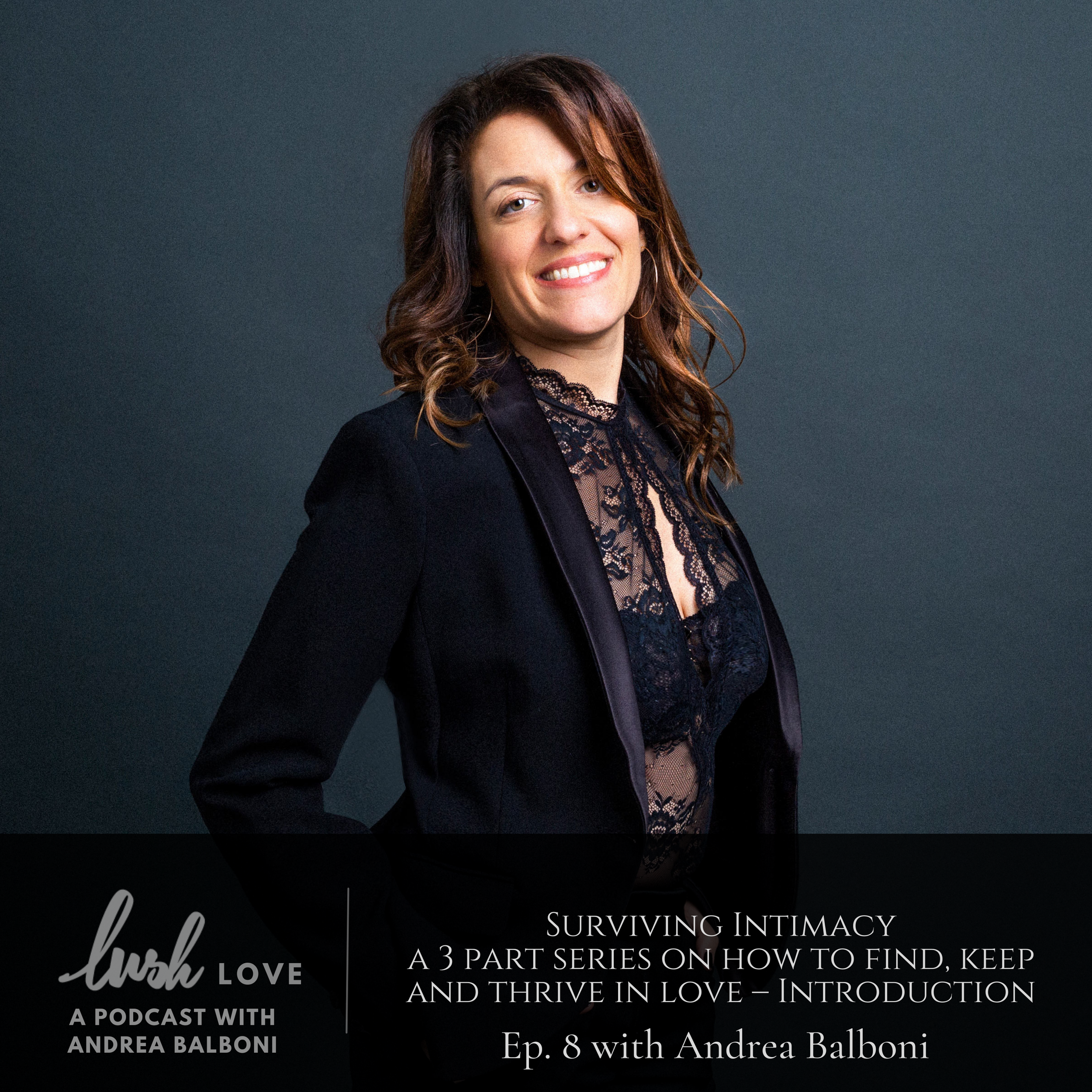
About Andrea:
Andrea Balboni is a certified Sex Love and Relationship Coach and founder of Lush Coaching. She helps smart successful heart-centered humans experience pleasure and fulfillment in their personal intimate lives and romantic relationships. From finding real love naturally and easily, to keeping it and deepening into healthy relationships, to thriving in passion and pleasure over the long-term, Andrea supports individuals and couples in all phases of love and relationships.
Find love with Andrea:
Roadmap to Relationships
A group coaching experience for women on finding love and keeping it
One-to-one Private Coaching
A limited number of spots are open. DM/email me to learn more and sign up.
andrea.lush.coach@gmail.com
Online Masterclass: Find, Keep and Thrive in Love
Learn to find real love and have a committed, long-term relationship. Tickets available on Eventbrite
Receive weekly Love Letters
Sign up for deep wisdom and practical skills and tools
https://www.lushcoaching.com/free
Work with me
Book in a 30 minute consultation call with Andrea
Let’s stay connected
Continue the conversation on Instagram at @andreabalboni_lush
Show us the love
And if you love the show, please leave us a rating and review on iTunes/Apple Podcasts.
Ep. 9 Surviving Intimacy : Part 1 – Finding Love
Welcome to lush. Love the podcast in this three part series on surviving intimacy. I'm your host, Andrea Balboni a sex love and relationships coach for anyone who wants to find, keep and thrive in love.
this is part one on finding love. In this episode, I'll share with you a very personal story. On what it took for me to finally find love after being single for nearly 15 years.
I'll leave you with some questions to ponder and I'll invite you to explore ways to move forward so that you too can find the love that you want. .
It was a soft, warm summer's. Outside lightning bugs lit up the cool dark air and a punctuated rhythm. I was standing in the Oak lined hallway of an elegant manner house. Deep in the English countryside lights were out nervous, giggles, sprinkled the space between us with their sweet sound. We were a small group of women, about 12 in total.
lace sometimes black, sometimes red and cheer, silks, and chiffon graced, otherwise naked bodies. As I looked around me, I thought how refreshing it was to see such a wide variety of shapes and forms. There was space for me in the difference I was dressed in a black lace Bodi. With a dramatic V cut down the front, small chains, sparkling rhinestones held it and me together, but just barely.
I'd never owned anything like this in my life, never mind what I was about to do in it. It had taken me months to get at the nerve to push through the heavy doors of the lingerie shop. It was the most expensive one on the high. I couldn't fathom anything less ensure I'd own a few pairs of matching lingerie sets in my life, but I'd never dared tried on anything else.
In my mind, only certain types of women wore what I had on now. And I definitely was not one of them. There was judgment and criticism and that thought, and also a kind of yearning. Mixed with envy and some curiosity. And so now standing there with a group of similarly dressed women shivering in my lace.
I wondered why, why had I signed up for this? Was this really going to help me to find love and was what I was about to do even. Okay. I'd managed to cultivate incredible friendships throughout my life. Pretty much effortlessly. So why was this finding love so difficult? The music came on and the lights dimmed and trembling like a leaf in the night.
I stepped onto the stage.
Intimate relationships are unique and that they contain an intensity, like no other in this kind of intimacy. We open all of ourselves to another. We open our hearts, our minds, and also our bodies and the mystery of the erotic that lies there. we allow more of ourselves to be seen. And often by only a select few, we hope that when seen fully that will be desired.
And when we aren't, it's devastating, our sexuality is one of the deepest, most sacred. Beautiful and natural parts of us. And yet, rather than learn how to protect this part of ourselves through safe boundaries around sex, we're taught to fear it completely, rather than talk openly about it. We learn that the subject is tab boo, and rather than celebrate the nourishment of healthy pleasure, we judge criticize and shame those who embody it easily and natural.
and then we carry the same shame, guilt and fear within us. That same shame, guilt and fear had created a high wall around me and yes, behind it, I was safe yet. It also kept me far away from the love and intimacy that I deeply desired. I didn't realize any of this though, as I shivered in my lace that warm summers night poised to perform my first ever stripped tease at the toter of retreat, I was on looking back on it.
Now that evening marked the beginning of a journey deep into me, a journey of trust in myself, a journey of knowing my body, a journey of letting go of the past and of stepping into the beauty of the essential and the erotic within. so that I could be seen in all ways by the people I was attracted to and to let love in
do shame, guilt, and fear around your sexuality. Hold you back from love. Here are some questions for you to journal on or simply to consider as you listen. What old learned beliefs around intimacy and sex, no longer serve you. What new beliefs might you replace those with? And if you could write your new truth around relationships, sex, and intimacy to reflect those new beliefs, what might that truth sound?
in roadmap to relationships, a group coaching program for single women on how to find, keep and thrive in love. We'll be answering these and other questions around relationships and intimacy enrollment is now open and I invite you in. If you are a woman who's looking for love. You can find information on roadmap on my website at lush coaching.com/relationship-roadmap.
There's a link in the show notes.
If you'd prefer to work with me privately, then there are a limited number of one to one coaching spaces, open for single people. And for couple. you can message me at Andrea lush, coaching.com. And we'll talk about how I can support you to create the love and the pleasure that you want in your life.
I invite you to listen to part two of this three part series on how to keep love coming up next.

Ep. 8 Surviving Intimacy : a 3 part series on finding, keeping and thriving in love – Introduction
Why are intimate relationships so intense?
Why is love so hard to find? And once found so hard to keep? And once kept so hard to survive, never mind thrive in?
From the disappointment of endless dating and constant swiping, to the destabilizing precariousness of early stage relationships, to the imminent frustration and tedious boredom of long term love. We might begin to ask ourselves if intimate relationships are even worth it.
And then we remember what they promise.
Note: This series was originally created as a Masterclass for The Times and Sunday Times Life Lessons Festival in London, UK 2022.
Why are intimate relationships so intense?
Why is love so hard to find?
And once found so hard to keep?
And once kept so hard to survive, never mind thrive in?
From the disappointment of endless dating and constant swiping, to the destabilizing precariousness of early stage relationships, to the imminent frustration and tedious boredom of long term love.
We might begin to ask ourselves if intimate relationships are even worth it.
And then we remember what they promise.
If we could meet real love in a way that feels natural and easy, love that gives a sense of trust, safety and security in a challenging and ever changing world.
If we could feel the nourishment of deep, meaningful connection, and the richness and excitement of learning and growing together.
If we could experience the deliciousness of passion and the sparkle of erotic desire that adds so much aliveness and dimension to life
Then yes, we would answer that relationships are absolutely worth it.
But all of that is no small ask.
Powered by RedCircle
In each of the 3 parts of this series we’ll consider…
PT 1: FINDING LOVE
- What it takes to find love on or offline.
- How to meet your person in a way that feels natural and easy
- Dissolving the things from the past that keep us from meeting our person.
PT 2: KEEPING LOVE
- The delicate dance of closeness and distance in intimate relationships
- Preparing your body, heart, mind and soul for long-term love
- What ‘healthy’ looks like in intimate relationships
PT 3: THRIVING IN LOVE LONG-TERM
- The skills and tools needed to make love and passion last over time
- How self-awareness and self-knowing allow for healthy adult relating
- And how to attain the awareness, skills and tools that long-term love asks for
Show us the love
And if you love the show, please leave us a rating and review on iTunes/Apple Podcasts.
Book in a 30 minute consultation call with Andrea and find love that lasts.
About Andrea:
Andrea Balboni is a certified Sex Love and Relationship Coach and founder of Lush Coaching. She helps smart successful heart-centered humans experience pleasure and fulfillment in their personal intimate lives and romantic relationships. From finding real love naturally and easily, to keeping it and deepening into healthy relationships, to thriving in passion and pleasure over the long-term, Andrea supports individuals and couples in all phases of love and relationships.
Find love with Andrea:
Roadmap to Relationships
A group coaching experience for women on finding love and keeping it
One-to-one Private Coaching
A limited number of spots are open. DM/email me to learn more and sign up.
andrea.lush.coach@gmail.com
Online Masterclass: Find, Keep and Thrive in Love
Learn to find real love and have a committed, long-term relationship. Tickets available on Eventbrite
Receive weekly Love Letters
Sign up for deep wisdom and practical skills and tools
https://www.lushcoaching.com/free
Work with me
Book in a 30 minute consultation call with Andrea
Let’s stay connected
Continue the conversation on Instagram at @andreabalboni_lush
Show us the love
And if you love the show, please leave us a rating and review on iTunes/Apple Podcasts.
Ep. 8 Surviving Intimacy : a 3 part series on finding, keeping and thriving in love – Introduction
Why are intimate relationships so intense?
Why is love so hard to find?
And once found so hard to keep?
And once kept so hard to survive, never mind thrive in?
From the disappointment of endless dating and constant swiping, to the destabilising precariousness of early stage relationships, to the imminent frustration and tedious boredom of long term love.
We might begin to ask ourselves if intimate relationships even worth it.
And then we remember what they promise.
If we could meet real love in a way that feels natural and easy, love that gives a sense of trust, safety and security in a challenging and ever changing world.
If we could feel the nourishment of deep, meaningful connection, and the richness and excitement of learning and growing together.
If we could experience the deliciousness of passion and the sparkle of erotic desire that adds so much aliveness and dimension to life
Then yes, we would answer that relationships are absolutely worth it.
But all of that is no small ask.
I'm your host, Andrea Balboni, and welcome to the lush love podcast series on surviving intimacy.
Intimacy is indeed intense and complex. And yet no one has taught us to navigate it all. Not our friends, not our families, not at school nor, and our professional lives. Instead we're told that with the right person, it will all just happen from romantic, beginning to sunset ending.
And when it doesn't, we feel like we've failed. so what can we do? Our healthy long-term relationships, even realistic. Is it really possible to find love easily, to stay steady through its ups and downs and to sustain passion and desire over time? If the answer could be yes. What would it take to actually make it happen?
These are some of the questions that I asked myself over the past 20. for the 15 years that I was single and looking for love in the past seven years. And my professional work as a sex love and relationships coach and in conversations with hundreds of people looking for finding and being in love. It is my belief that intimate relationships do indeed offer us the unique opportunity to know ourselves each other.
And the world in ways that no other type of relationship can. So what can we do to create them this three part series on finding, keeping and thriving in love begins to speak to this. I invite you to listen in ponder and explore for yourself what it means to thrive in intimacy.